What is NAD+ and why does it mater?
Nicotinamide Adenine Dinucleotide (NAD) is an extremely important molecule for cell function and energy production. It is pretty well known that NAD plays a vital role in how the mitochondria in your cells generate energy. Inside the body, NAD exists primarily as the oxidised (NAD+) and reduced (NADH) forms. By switching between NAD+ and NADH, in what is known as REDOX reactions, NAD facilitates the production of energy in the form of another molecule called ATP (1). In more recent years researchers have discovered the critical role that NAD has on the activation of certain longevity pathways, including Sirtuins (2). Sirtuins are a family of proteins that regulate cellular health, acting as protective enzymes against stressors linked to aging. These stressors manifest inside your cells as DNA damage, inflammation and metabolic decline. The Sirtuins act against the affects of ageing by boosting DNA repair, improving mitochondrial function, managing energy and promoting cell survival. Without a sufficient amount of NAD in our bodies, the Sirtuins become less efficient at fulfilling their role to protect us from the inside and delaying the effects of ageing (3).
Why NAD+ levels decline with age?
NAD levels decline with age due to a combination of increased consumption by enzymes, like CD38 (linked to inflammation) and PARPs (links to DNA repair), coupled with decreased synthesis and recycling, especially by the rate-limiting enzyme NAMPT. This leads to an imbalance where breakdown outpaces replenishment, impacting cellular function and contributing to the ageing process (4).
What is Nicotinamide Riboside (NR)?
Nicotinamide Riboside (NR) is a molecule that was discovered in the 1940s. It belongs to the vitamin B3 family and is found naturally occurring in milk. Its biological importance was not fully recognised until 2004. This is when researchers demonstrated that NR could be used to elevate intracellular (inside the cell) levels of NAD+. NR does this by supporting NAD+ production through the nicotinamide riboside kinase (NRK) pathway (5).
Nicotinamide Riboside is available in a number of forms, called salts. Salts are formed when the positively charged Nicotinamide Riboside is paired with a negatively charged counter-ion (much like sodium is paired with chlorine to make table salt, or NaCl). The change in counter-ion can have effects such as changing the molecules solubility or performance. Some details of different NR salts are shown in Table 1.
Table 1: Informational comparison of different Nicotinamide Riboside (NR) salts
| Salt Form | NR Content per 300mg Dose | Regulatory Status in UK | Published Toxicology Studies | Published Human Clinical Evidence |
| Nicotinamide Riboside Chloride (NRCL) | 263 mg | Authorised under Great Britain’s novel food regulations for use in food supplements (6) | (7) | More than 40 published clinical studies |
| Nicotinamide Riboside Hydrogen Malate (NRHM) | 197 mg | Not authorised | (8) | Only one preprint clinical study in combination with other compounds. No standalone NRHM studies |
| Nicotinamide Riboside Tartrate (NRHT) | 189 mg | Not authorised | None | No published clinical studies |
NR vs NMN vs NAD
It is possible to supplement NR and NMN, which are both precursors to NAD+, as well as to supplement NAD+ itself. So which supplement is the best to take? The answer to this comes in terms of their biology and the data that is already available in various clinical studies.
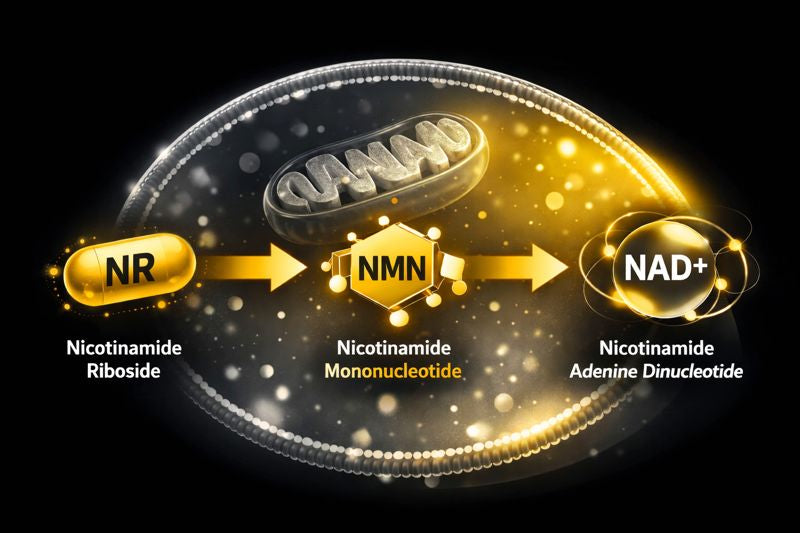
NR is the simplest molecule of these three options and is readily absorbed through your gut. NR is cell-permeable via nucleoside transporters, meaning it can enter your cells through the cell wall. Once NR has entered the cell, your body uses this to make NMN, which in turn is used to make NAD+ (9).
NMN can also be absorbed through your gut without degradation, however, the additional phosphate group attached (compared to NR) effectively blocks NMN’s entry to the cell through the cell wall. This means that NMN has to first be converted to NR so that it can pass through the cell wall to be converted back to NMN and then to NAD+, in a place where your body can utilise the beneficial effects. There are many independent studies showing that NMN cannot efficiently be transported across the cell membrane and must first be converted to NR (10) (11) (12). This difference underpins much of the current NR vs NMN discussion in the scientific literature.
There is actual physical data that can be taken from clinical studies which effectively shows these phenomena, and is shown in Figure 1 (13) (14). This shows that after a 14-day period of supplementing the same doses of NR and NMN, that the whole blood levels of NAD+ are approximately 20-30% higher, based on reported means, for those supplemented with NR. This data also shows that NR acts to increase whole blood levels of NAD+ much faster than NMN. Unfortunately, similar data is not available for supplementing NAD+ directly because there are no credible peer-reviewed human clinical studies showing that oral supplementation with NAD+ increases NAD+ levels over time.

Figure 1: Difference between supplementing the same dose of NR and NMN on whole blood NAD+ Levels; References * (13), ** (14)
Supplementing oral NAD+ directly faces a different issue in how the body processes the supplement. NAD+ is a large highly polar dinucleotide and is not orally bioavailable as intact NAD+. After ingestion NAD+ is hydrolysed in the gut and broken down into various precursors and is absorbed only after degradation (15). This is why modern research focuses on precursors, not NAD+ itself. There is the option of intravenous NAD+, however research has shown that this is not a good method to sustain increased whole blood NAD+ levels. Just 2 hours after the infusion has stopped, NAD+ levels decline back towards the baseline (16).
In summary, the available human data suggests that supplementing with NR offers a more efficient and well-characterised approach to supporting NAD+ levels than either NMN or NAD+ itself.
From Research to Real-World Supplementation
Most of the research discussed above focuses on mechanism, metabolism and measured changes in blood NAD+ levels, under controlled conditions. Translating these findings into real-world supplementation requires additional considerations beyond the choice of precursor alone.
In practice, an effective NAD+ support supplement must balance biological efficiency, regulatory compliance and evidence-based dosing. Not all forms of NR are equivalent, and not all products on the market reflect the conditions under which NR has been studied in human trials. This distinction is particularly relevant for anyone evaluating an NAD+ supplement in the UK, where regulatory authorisation and ingredient form matter.
For this reason, when formulating Timeless NAD+ Support, the focus was placed on using a form of Nicotinamide Riboside that is both authorised for use in food supplements in Great Britain and supported by a substantial body of published human clinical research, at doses consistent with those shown to meaningfully increase NAD+ levels within weeks of supplementation.
References
1. Intracellular coenzymes as natual biomarkers for metabolis activities and mitochondrial anomilies. A.A., Heikal. 2010, Biomarkers in medicine, pp. 241-263.
2. NAD(H) and NADP(H) Redox Couples and Cellular Energy Metabolism. Xiao, Wusheng, et al. s.l. : Antioxidants & Redox Signaling, 2018, Vol. 28, pp. 251-272.
3. The sirtuins family's role in ageing and age-associated pathologies. Hall, Jessica A, et al. 3, 2013, The American Society for Clinical Investigation, Vol. 123, pp. 973-979.
4. The Role of NAD+ in Regenerative Medicine. Conlon, Nichola J. 2021, Plast Reconstr Surg.
5. Discoveries of Nicotinamide Riboside as a Nutrient and Conserved NRK Genes Establish a Preiss-Handler Independant Route to NAD+ in Fungi and Humans. 4, s.l. : Cell, 2004, Vol. 117, pp. 495-502.
6. Nicotinamide Riboside Chloride. Food Standards Agency. [Online] https://data.food.gov.uk/regulated-product-applications/products-list/RP-1348.
7. Safety assessment of nicotinamide riboside, a form on vitamin B3. Conze, D B, Crespo-Barreto, J and Kruger, C L. 11, s.l. : Human & Experimental Toxicology, 2016, Vol. 35, pp. 1149-1160.
8. Preclinical safety assessments of nicotinamide riboside hydrogen malate. Dziwenka, Margitta and Mozingo, Amy. s.l. : Toxicology Research and Application, 2022, Vol. 6.
9. The NAD+ precursor nicotinamide riboside enhances oxidative metabolism and protects against high-fat diet induced obesity. Canto, Carles, et al. 6, s.l. : Cell Metab, 2012, Vol. 15, pp. 838-847.
10. Nicotinamide riboside kinases display redundancy in mediating nictonamide mononucleotide and nicotinamide riboside metabolism in skeletal muscle cells. Fletcher, R S, et al. 8, s.l. : Molecular Metabolism, 2017, Vol. 6, pp. 819-832.
11. Pathways and Subcellular Compartmentation of NAD biosynthesis in HUman Cells FROM ENTRY OF EXTRACELLULAR PRECURSORS TO MITOCHONDRIAL NAD GENERATION. Nikiforov, A, et al. 24, s.l. : Journal of Biological Chemistry, 2011, Vol. 286, pp. 21767-21778.
12. Reversal of endothelial dysfunction by nicotinamide mononucleotide via extracellular conversion to nicotinamide riboside. Mateuszuk, L, et al. 4, s.l. : Biochemical Pharmacology, 2020, Vol. 178, p. 114019.
13. Safety and Metabolism of Long-term Adminisration of NIAGEN (Nicotinamide Riboside Chloride) in a Randomised, Double-Blind, Placebo-controlled Clinical Trial of HEalthy Overweight Adults. Conze, D, Brenner, C and Kruger, C L. 1, s.l. : Scientific Reports, 2019, Vol. 9, p. 9772.
14. MIB-626, an Oral Formulation of Microcrystalline Unique Polymorph of β-Nicotinamide Mononucleotide, Increases Circulating Nicotinamide Adenin Dinucleotide and its Metabolme in Middle-Aged and Older Adults. Pencina, K M, et al. 1, s.l. : The Journals of Gerontology: Series A, 2022, Vol. 78, pp. 90-96.
15. NAD+ Precursors: A Questionable Redundancy. Canto, Carles. 7, s.l. : Metabolites, 2022, Vol. 12, p. 630.
16. A Pilot Study Investigating Changes in Human Plasma and Urine NAD+ Metabolome During a 6 Hour Intravenous Infusion of NAD+. Grant, Ross, et al. 11, s.l. : Front Aging Neurosci, 2019, Vol. 12, p. 257.
Author
This article was written by Adam Donley, Director at Everbright Labs. He holds a First-Class Master's Degree in Chemical Engineering with Chemistry from the University of Manchester and focuses on interpreting published research to translate nutritional science into practical guidance.
Share:
Acetyl-L-Carnitine: What It Is and Its Role in Fat Metabolism