Search for "best NAD+ supplement" and you will find dozens of products making similar claims; restore your energy, support healthy ageing, boost cellular repair. Almost none of them explain what actually separates one formulation from another. The honest answer has very little to do with marketing language and almost everything to do with a small number of specific, checkable variables: which precursor is used, which salt form of that precursor, whether the dose matches what has actually been studied in humans, whether a higher dose is genuinely better or just louder, and whether the formulation addresses NAD+ availability alone or the pathways that depend on it. Each of these can be verified from a product label and a small amount of published research, without needing to take a company's word for it.
Which Precursor Is Actually in the Formula?
NAD+ cannot usefully be supplemented directly. It is a large, polar molecule that is broken down in the gut before absorption, so oral NAD+ is not taken up intact (1). Intravenous NAD+ avoids the digestion problem but does not solve the underlying issue. In one pilot study, whole blood NAD+ levels had returned close to baseline within two hours of the infusion ending (2). This is why almost every credible NAD+ product on the market instead supplements a precursor, a smaller molecule the body converts into NAD+ inside the cell.
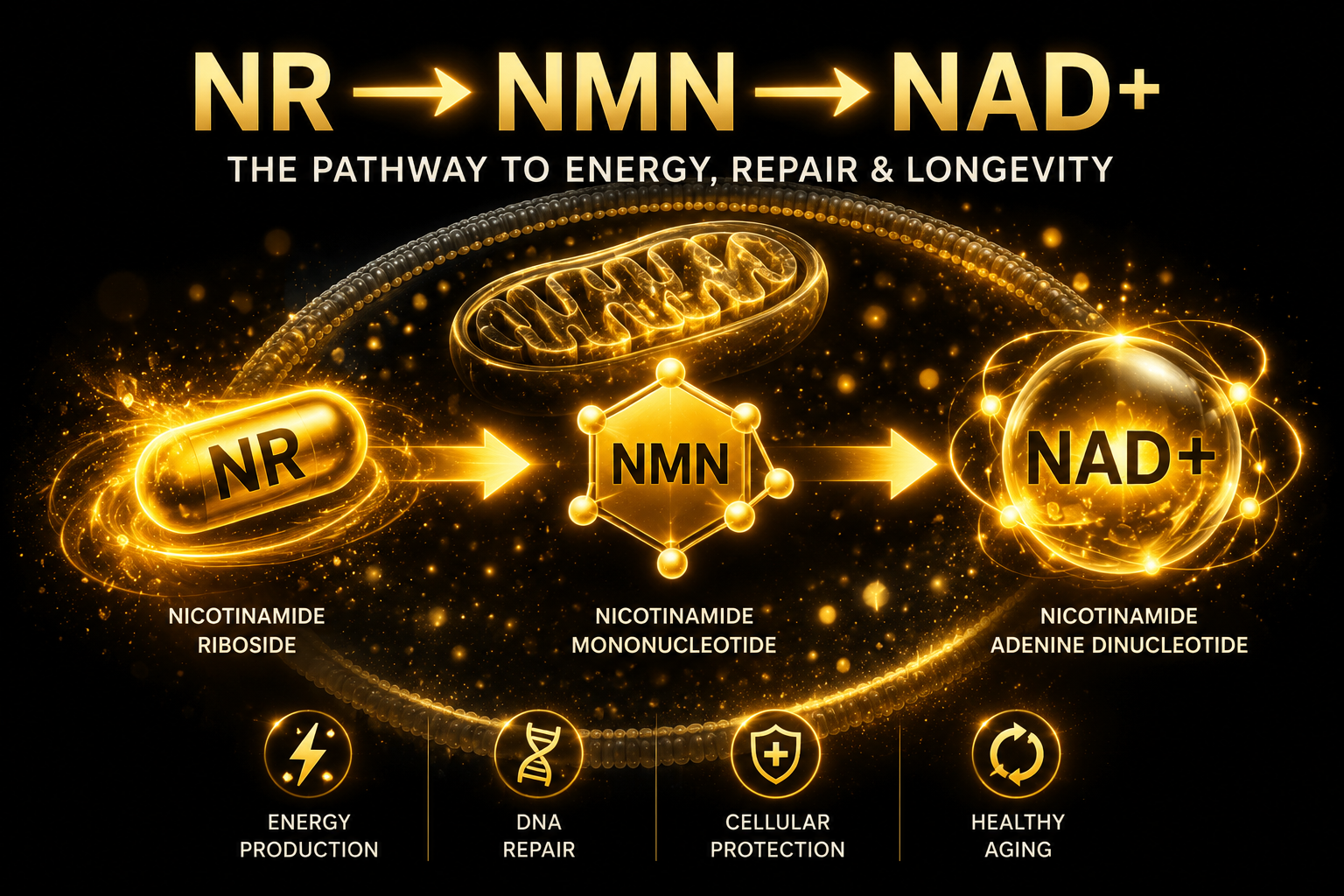
The two precursors in common use are Nicotinamide Riboside (NR) and Nicotinamide Mononucleotide (NMN). The distinction between them matters more than it first appears. NR is cell permeable and enters cells directly through nucleoside transporters, where it is converted first to NMN and then to NAD+ (3). NMN, because of the additional phosphate group attached to the molecule, cannot cross the cell membrane in the same way. Multiple independent studies have shown that NMN must first be converted extracellularly back into NR before it can enter the cell (4) (5) (6). In practice, this means NMN supplementation still relies on the same NR conversion pathway, but with an additional step in between.
This has been tested directly. In a comparison of equal doses of NR and NMN, whole blood NAD+ rose approximately 20 to 30% higher in the group supplementing NR, and rose faster (7) (8).
We've written a full breakdown of this mechanism, including the extracellular conversion pathway and the complete clinical dataset, in our article on Nicotinamide Riboside vs NMN.
Which Salt Form, and Is It Authorised for the UK?
Nicotinamide Riboside is not sold as a single, standardised ingredient. It exists in several salt forms, meaning NR bound to different counter ions. These forms differ in NR content per dose, in how thoroughly they have been studied, and in their UK regulatory status.
Nicotinamide Riboside Chloride is authorised under Great Britain's novel food regulations for use in food supplements (9), and its safety has been assessed in published toxicology studies (10). Other salt forms, including Nicotinamide Riboside Hydrogen Malate and Nicotinamide Riboside Tartrate, are not currently authorised for the UK market. Some preclinical safety data exists for the hydrogen malate form (11), while the tartrate form has no published human safety or efficacy studies at all.
This is worth checking directly on any product label. Two products can both list "Nicotinamide Riboside" as an ingredient while referring to meaningfully different compounds, with meaningfully different amounts of evidence behind them.
Does the Dose Match What Was Actually Studied?
Listing an ingredient on a label does not confirm that the amount included is the amount shown to do anything in human trials. Nicotinamide Riboside Chloride has been tested at 100mg, 300mg and 1,000mg daily doses in randomised, placebo-controlled research, with whole blood NAD+ rising significantly at every level tested (7). A product containing an amount outside that tested range is not necessarily wrong to include NR, but it is not standing on the same evidence base, regardless of how the label is worded.
That still leaves an obvious question. If 100mg, 300mg and 1,000mg have all been shown to work, is the highest of those automatically the best choice.
Is a Higher Dose Automatically Better?
The instinct, once you know a range of doses has been tested and found safe, is to assume more is simply better, more NAD+, more benefit. Before we make that choice, lets examine things in more detail.
Every time NAD+ is consumed by the enzymes that depend on it (sirtuins, PARPs and CD38) it leaves behind a by-product called nicotinamide, NAM. Supplementing an NAD+ precursor increases NAD+ turnover (production and consumption), and therefore increases how much NAM is being produced. NAM is a known inhibitor of the sirtuins, meaning its presence actually hinders the effects of increasing your NAD+ levels through supplementation. Your body has a natural way of dealing with NAM, it gets recycled back into NAD+ or it is cleared from the body through methylation. Whether that keeps pace depends on how much NAM is being produced. During methylation an enzyme called NNMT tags NAM with a methyl group from a methyl donor. It is then excreted as MeNAM and its oxidised by-products (12).
The methyl group used in that clearance step comes from SAM, S-adenosylmethionine, the body's universal methyl donor. SAM is a vastly important molecule and it is not reserved for this one job. It is the same molecule the body draws on for DNA and histone methylation, for several steps of neurotransmitter synthesis, and for phosphatidylcholine production in the liver, among other essential reactions, all drawing from the same pool (13). Every additional milligram of NR increases NAD+ turnover, which increases NAM production, which increases demand on that shared pool. In the trial that established NR's safety profile, every dose tested, including the lowest, produced a significant, dose dependent rise in MeNAM and Me2PY, the methylated clearance by-products of that step. This shows the NAM clearance pathway working at any dose (7).
MeNAM and Me2PY are the cleared by-products and provide evidence the NAM clearance pathway is doing its job. NAM itself, the molecule waiting to be cleared, is a different and more telling marker. The European Food Safety Authority's own review of the same trial data found that plasma concentrations of unmethylated NAM began rising at higher doses of 1,000mg of NR per day, and were not observed at 300mg of NR per day. The panel described this as saturation of the NAM pool, meaning clearance was starting to fall behind production once dose reached that higher level (14). This is why it makes more sense to dose at the 300mg NR level where NAM has been shown not to build up or accumulate over the period it was actually studied, rather than the level where the same review found early signs of it doing so at 1,000mg of NR.
Put together, this is why dose selection deserves more scrutiny than simply checking whether a number on a label matches any dose that was ever tested. NAD+ continues to rise at higher doses, though each additional milligram appears to contribute less than the one before it, while the same regulatory review found the clearance system beginning to be outpaced specifically once dose reached the 1,000mg of NR tier. A dose that sits below that point, while still producing a clear and statistically significant rise in NAD+, is a considered choice rather than simply the lowest number that happened to work.
Does the Formula Support NAD+ Levels, or the Pathways That Depend on Them Too?
The best NAD+ supplement isn’t necessarily the one with the single most impressive ingredient, it’s the one that addresses the whole system NAD operates within. Raising NAD+ availability is only part of the picture. NAD+ acts primarily as a cofactor, meaning it enables other processes rather than doing the work itself. The sirtuin family of proteins, involved in DNA maintenance, metabolic regulation and cellular repair, depend on NAD+ to function, and their activity is constrained when NAD+ is limited (15). Resveratrol is commonly discussed alongside NAD+ precursors because it appears to enhance SIRT1 activity specifically, but only when sufficient NAD+ is available to begin with (16). The two compounds address the same system from different directions, one restores the supply, the other supports how effectively that supply is used. Standard resveratrol also has notably poor oral bioavailability (17), which is why formulations using a liposomal delivery format, designed to improve absorption and stability, address a real limitation (18).
A separate but related system is autophagy, the process by which cells clear damaged proteins and organelles. Autophagy also declines with age. Spermidine has been shown in human trials to activate this process and is associated with reduced mortality risk in observational population data (19) (20). Autophagy and NAD+ dependent sirtuin activity are regulated by overlapping mechanisms, meaning a formulation addressing NAD+ levels without any consideration of these adjacent systems is supporting only one part of a more interconnected picture (21).
We've covered the specific mechanisms behind resveratrol and spermidine, including the acetylation pathway spermidine acts through, in our articles on Resveratrol and NAD+ and What Is Spermidine?
Applying This to Timeless NAD+ Support
These five considerations were the starting point when Timeless NAD+ Support was formulated, not a checklist applied afterwards to justify an existing product. It uses Nicotinamide Riboside Chloride, the UK authorised salt form, at a 300mg daily dose, a level shown to significantly raise whole blood NAD+ while sitting below the point where the same regulatory review found NAM beginning to accumulate in plasma. Alongside NR, it includes liposomal trans resveratrol to support the NAD+ dependent pathways that resveratrol influences, and spermidine to support the complementary process of autophagy. The formulation is built to restore NAD+ availability with NR, support the pathways that rely on it with resveratrol, and support cellular renewal with spermidine, rather than relying on a single ingredient to do all of the work. That’s the actual answer to what makes the best NAD+ supplement, not a single standout ingredient or the highest number on the chart, but a formulation built around how these systems interact.
References
1. NAD+ Precursors: A Questionable Redundancy. Canto, Carles. 7, s.l.: Metabolites, 2022, Vol. 12, p. 630.
2. A Pilot Study Investigating Changes in Human Plasma and Urine NAD+ Metabolome During a 6 Hour Intravenous Infusion of NAD+. Grant, Ross, et al. 11, s.l.: Front Aging Neurosci, 2019, Vol. 12, p. 257.
3. The NAD+ precursor nicotinamide riboside enhances oxidative metabolism and protects against high-fat diet induced obesity. Canto, Carles, et al. 6, s.l.: Cell Metab, 2012, Vol. 15, pp. 838-847.
4. Nicotinamide riboside kinases display redundancy in mediating nicotinamide mononucleotide and nicotinamide riboside metabolism in skeletal muscle cells. Fletcher, R S, et al. 8, s.l.: Molecular Metabolism, 2017, Vol. 6, pp. 819-832.
5. Pathways and Subcellular Compartmentation of NAD biosynthesis in Human Cells from Entry of Extracellular Precursors to Mitochondrial NAD Generation. Nikiforov, A, et al. 24, s.l.: Journal of Biological Chemistry, 2011, Vol. 286, pp. 21767-21778.
6. Reversal of endothelial dysfunction by nicotinamide mononucleotide via extracellular conversion to nicotinamide riboside. Mateuszuk, L, et al. 4, s.l.: Biochemical Pharmacology, 2020, Vol. 178, p. 114019.
7. Safety and Metabolism of Long-term Administration of NIAGEN (Nicotinamide Riboside Chloride) in a Randomised, Double-Blind, Placebo-controlled Clinical Trial of Healthy Overweight Adults. Conze, D, Brenner, C and Kruger, C L. 1, s.l.: Scientific Reports, 2019, Vol. 9, p. 9772.
8. MIB-626, an Oral Formulation of Microcrystalline Unique Polymorph of β-Nicotinamide Mononucleotide, Increases Circulating Nicotinamide Adenine Dinucleotide and its Metabolome in Middle-Aged and Older Adults. Pencina, K M, et al. 1, s.l.: The Journals of Gerontology: Series A, 2022, Vol. 78, pp. 90-96.
9. Nicotinamide Riboside Chloride. Food Standards Agency. [Online] https://data.food.gov.uk/regulated-product-applications/products-list/RP-1348.
10. Safety assessment of nicotinamide riboside, a form of vitamin B3. Conze, D B, Crespo-Barreto, J and Kruger, C L. 11, s.l.: Human & Experimental Toxicology, 2016, Vol. 35, pp. 1149-1160.
11. Preclinical safety assessments of nicotinamide riboside hydrogen malate. Dziwenka, Margitta and Mozingo, Amy. s.l.: Toxicology Research and Application, 2022, Vol. 6.
12. Nicotinamide riboside is uniquely and orally bioavailable in mice and humans. Trammell, Samuel A J, et al. s.l.: Nature Communications, 2016, Vol. 7, p. 12948.
13. The Metabolic Burden of Methyl Donor Deficiency with Focus on the Betaine Homocysteine Methyltransferase Pathway. Obeid, Rima. 9, s.l.: Nutrients, 2013, Vol. 5, pp. 3481-3495.
14. Safety of nicotinamide riboside chloride as a novel food pursuant to Regulation (EU) 2015/2283 and bioavailability of nicotinamide from this source, in the context of Directive 2002/46/EC. EFSA Panel on Nutrition, Novel Foods and Food Allergens (NDA). 8, s.l.: EFSA Journal, 2019, Vol. 17.
15. NAD+ and sirtuins in aging and disease. Imai, Shin-ichiro and Guarente, Leonard. 8, s.l.: Trends Cell Biol., 2014, Vol. 24, pp. 464-71.
16. Mechanism of human SIRT1 activation by resveratrol. Borra, Margie T, Smith, Brian C and Denu, John M. 17, s.l.: J Biol Chem, 2005, Vol. 280, pp. 17187-95.
17. Resveratrol and health, a comprehensive review of human clinical trials. Smoliga, James M, Baur, Joseph A and Hausenblas, Heather A. 8, s.l.: Mol Nutr Food Res., 2011, Vol. 55, pp. 1129-41.
18. Bioavailability of encapsulated resveratrol into nanoemulsion-based delivery systems. Sessa, Mariarenata, Balestrieri, Maria Luisa and Ferrari, Giovanna. s.l.: Food Chemistry, 2014, Vol. 147, pp. 42-50.
19. Induction of autophagy by spermidine promotes longevity. Eisenberg, Tobias, Knauer, Heide and Schauer, Alexandra. 11, s.l.: Nature cell biology, 2009, Vol. 11, pp. 1305-1314.
20. Higher spermidine intake is linked to lower mortality: a prospective population-based study. Stefan, Kiechl, Raimund, Pechlaner and Peter, Willeit. 2, s.l.: The American Journal of Clinical Nutrition, 2018, Vol. 108, pp. 371-380.
21. Essential role for autophagy in life span extension. Madeo, Frank, Zimmermann, Andreas and Maiuri, Maria Chiara. 1, s.l.: J Clin Invest., 2015, Vol. 125, pp. 85-93.
Author
This article was written by Adam Donley, Director at Everbright Labs. He holds a First-Class Master's Degree in Chemical Engineering with Chemistry from the University of Manchester and focuses on interpreting published research to translate nutritional science into practical guidance.
Share:
What Is Spermidine? Autophagy, Longevity and Spermidine Supplements
The Science of Fat Metabolisers: A Guide to Stimulant-Free Metabolic Support