


If you're reaching for a third espresso to clear the afternoon fog, you aren't actually solving a lack of energy; you're merely masking a biological deficit. Most of us accept persistent fatigue and cognitive "fuzziness" as inevitable consequences of a busy life or the natural ageing process. However, these symptoms are often signals that your cellular power plants are struggling to keep pace with demand. Understanding how to improve mitochondrial function uk is the critical first step for anyone seeking to reclaim their vitality at a fundamental, biological level.
You likely recognise the frustration of doing everything "right" yet still feeling physically drained and mentally clouded. We promise to move beyond superficial trends to provide a practical, science-led protocol that addresses the root causes of cellular sluggishness. By focusing on the engineering of energy production, you can achieve sustained daily energy and improved metabolic flexibility whilst avoiding the crash of artificial stimulants. This guide explores the essential cofactors required for the electron transport chain and details how to optimise the transport of fuel into your cells to support long-term health and cognitive clarity.
Key Takeaways
- Move beyond the "powerhouse" metaphor to understand the biological engineering of ATP production and why mitochondrial decline triggers persistent fatigue.
- Discover how to improve mitochondrial function uk through evidence-based lifestyle adjustments and hormetic stressors that stimulate mitochondrial biogenesis.
- Learn the importance of specific cofactors, such as Nicotinamide Riboside, in maintaining the electron transport chain whilst avoiding the pitfalls of artificial stimulants.
- Understand how Acetyl L-Carnitine facilitates the transport of fatty acids into the mitochondria, supporting metabolic flexibility and cognitive clarity.
- Adopt a precise, science-led protocol for cellular health that prioritises long-term sustainability over temporary, superficial fixes.
Understanding Mitochondrial Health and the Causes of Cellular Fatigue
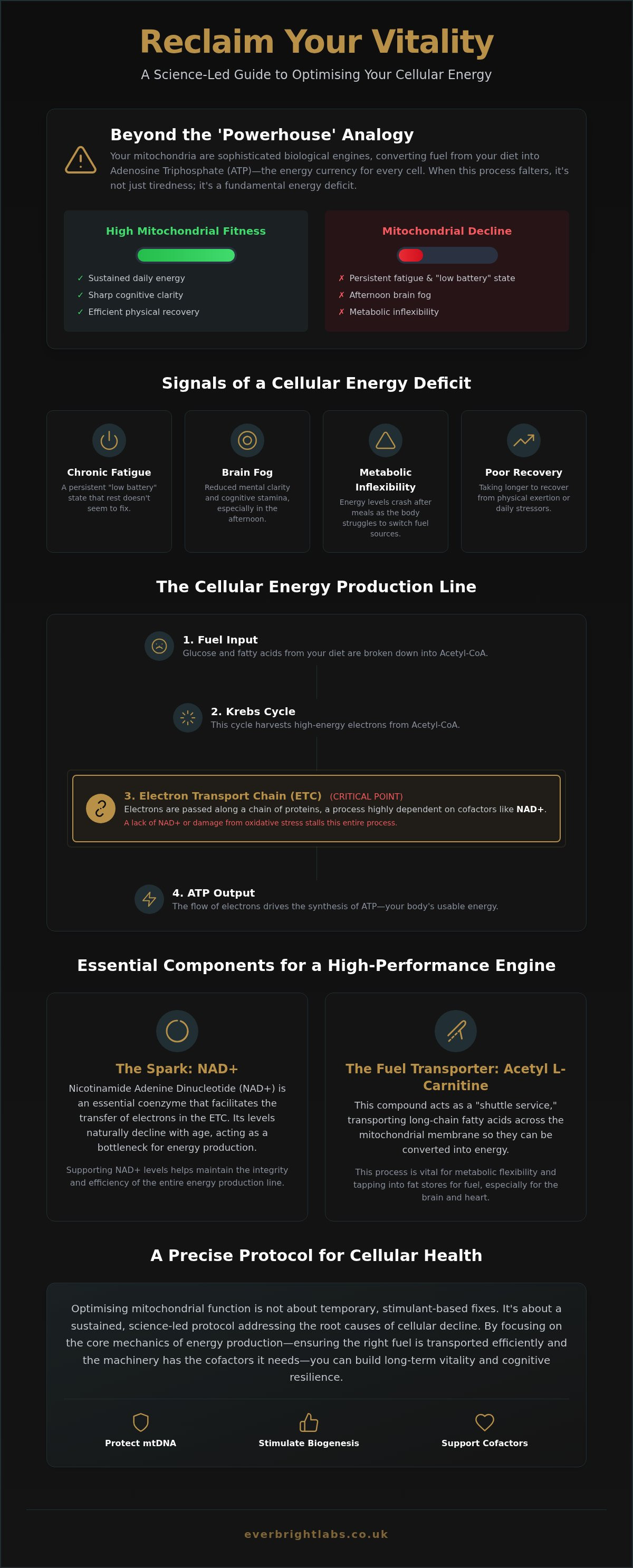
To understand What are mitochondria?, we must look beyond the standard "powerhouse" analogy. In biological engineering terms, these double-membraned organelles are sophisticated energy converters. They take the raw materials from our diet and transform them into Adenosine Triphosphate (ATP), the universal energy currency of the human body. When this conversion process is efficient, we experience high mitochondrial fitness. However, as we age or face chronic stressors, our cells can enter a state of senescence, where energy production falters and cellular repair slows down. Learning how to improve mitochondrial function uk is not just about boosting energy; it's about restoring the fundamental efficiency of your cellular architecture.
Mitochondrial dysfunction doesn't always manifest as a sudden illness. Instead, it often appears as a gradual decline in resilience. You might notice that it takes longer to recover from a workout, or that your mental clarity dips significantly by mid-afternoon. These aren't personal failures of discipline. They are physiological signals that your cellular energy production is failing to meet the demands of your lifestyle. Distinguishing between healthy mitochondrial fitness and age-related decline is essential for developing a precise protocol for long-term vitality.
The Role of Mitochondria in ATP Production
The process of creating ATP is a marvel of biological precision. It begins with the breakdown of nutrients, specifically glucose and fatty acids, into a molecule called Acetyl-CoA. This molecule enters the Krebs cycle, a series of chemical reactions that harvest high-energy electrons. These electrons are then passed along the electron transport chain, a sequence of protein complexes located in the inner mitochondrial membrane. This movement creates a gradient that ultimately drives the synthesis of ATP. This complex machinery relies heavily on specific coenzymes to facilitate the transfer of electrons. This is why cofactors like Nicotinamide Adenine Dinucleotide (NAD+) are so vital; without them, the entire energy production line grinds to a halt. Supporting these pathways with targeted nutrition, such as Timeless NAD+ Support, helps maintain the integrity of this electron flow.
Recognising the Symptoms of Mitochondrial Dysfunction
Chronic cellular fatigue differs significantly from the tiredness you feel after a late night. Whilst sleep-related fatigue usually resolves with rest, mitochondrial dysfunction feels like a persistent "low battery" state that sleep cannot fix. Because the brain and heart are the most energy-intensive organs, they are often the first to show signs of decline. This manifests as brain fog, reduced cognitive stamina, or a lack of physical "get-up-and-go." Another key indicator is metabolic inflexibility. This is the body's inability to switch efficiently between burning carbohydrates and fats for fuel. If you find your energy levels crashing shortly after a meal, it may be a sign that your mitochondria are struggling to process fuel effectively. Improving the transport of these fuels into the mitochondria is a critical component of any strategy on how to improve mitochondrial function uk, often involving compounds like Acetyl L-Carnitine found in the Fat Metaboliser.
The Biological Mechanisms Behind Mitochondrial Decline
Mitochondrial decline is a primary driver of biological ageing, yet the most significant damage often originates from within the cell itself. Whilst external environmental factors play a role, the internal mechanics of energy production are the true site of attrition. Mitochondria are uniquely vulnerable because they possess their own DNA (mtDNA), which lacks the protective histone proteins found in our nuclear DNA. Because these organelles are the primary site of energy conversion, they are constantly exposed to the volatile by-products of their own metabolic activity. Understanding how to improve mitochondrial function uk requires a focus on protecting this delicate genetic material from the cumulative effects of oxidative stress.
The "Mitochondrial Theory of Ageing" suggests that the gradual accumulation of damage to these organelles is why we experience a decline in physical and cognitive stamina. In the UK, this process is frequently accelerated by modern lifestyle choices. Diets high in ultra-processed foods, chronic psychological stress, and sedentary behaviour all place an undue burden on our cellular machinery. When we don't move our bodies, we fail to signal for the recycling of old, damaged mitochondria, leading to a cellular environment cluttered with inefficient energy producers.
Oxidative Stress and the "Leakage" of Energy
To understand oxidative stress, think of the mitochondrion as a high-performance engine. A well-tuned engine converts fuel into motion with minimal waste. However, an inefficient "leaky" engine produces excessive heat and exhaust fumes that eventually corrode the engine itself. In cellular terms, these fumes are Reactive Oxygen Species (ROS). When the electron transport chain falters, these ROS escape and attack the mitochondrial membrane and DNA. This creates a cycle of damage where the organelle becomes less efficient and produces even more harmful free radicals. Biological antioxidants, such as Resveratrol, are essential for neutralising these by-products before they can cause permanent structural harm.
Why Mitochondrial Efficiency Declines with Age
One of the most significant hurdles in maintaining cellular vitality is the natural depletion of Nicotinamide Adenine Dinucleotide (NAD+). This critical coenzyme is essential for both energy production and the activation of sirtuins, which are proteins responsible for DNA repair. Research suggests that NAD+ levels begin to drop significantly after the age of 30, often falling by as much as 50 percent by the time we reach 50. This deficiency creates a biological bottleneck; without sufficient NAD+, the cell cannot effectively repair the damage caused by ROS, and the "leaky engine" problem worsens. This internal slowing down is what we feel as the cognitive fog and physical lethargy of middle age. Supporting your internal repair systems with a targeted NAD+ support protocol can help restore the cofactors necessary for efficient energy conversion and cellular maintenance.
Lifestyle Strategies to Optimise Mitochondrial Fitness
Improving cellular energy isn't just about protecting existing structures; it's about building more. Mitochondrial biogenesis is the biological process of increasing mitochondrial mass within the cell, effectively expanding your internal power grid. This process is triggered by hormetic stressors, which are controlled, short-term challenges that force the cell to adapt and grow more resilient. For those investigating how to improve mitochondrial function uk, these strategies are highly accessible and require no specialist clinical equipment. They focus instead on the body's innate ability to recalibrate its energy production when provided with the correct physiological signals.
Consistency is the primary driver of success in cellular engineering. Whilst high-intensity interventions have their place, the long-term health of your mitochondria depends on regular, moderate signals for adaptation. By adopting a methodical approach to your daily habits, you can shift your biology away from cellular senescence and toward a state of sustained vitality. This doesn't require an overnight overhaul of your life, but rather a disciplined commitment to providing your cells with the fuel and the challenges they need to thrive.
Dietary Patterns: Fueling the Cellular Powerhouse
Nutrition acts as both the fuel and the structural material for your cellular machinery. Specific phytonutrients found in green tea (EGCG) and cruciferous vegetables like broccoli (sulforaphane) activate internal pathways that support mitochondrial repair and biogenesis. Crucially, the quality of your dietary fats determines the integrity of the mitochondrial membrane. Omega-3 fatty acids help maintain the fluidity of this double-membraned structure, which is essential for efficient electron transport and ATP production. You should also be mindful of blood sugar stability; frequent spikes in glucose can lead to mitochondrial "overload," causing the organelles to produce excessive reactive oxygen species and reducing their overall efficiency over time.
Physical Activity and Mitochondrial Biogenesis
Physical movement is perhaps the most potent driver of mitochondrial renewal. Zone 2 training, which is steady-state aerobic exercise at a pace where you can still hold a conversation, improves the efficiency of fat oxidation and increases mitochondrial density in the muscle fibres. In contrast, High-Intensity Interval Training (HIIT) provides a powerful stimulus for biogenesis by creating an acute, temporary energy deficit. This process also triggers mitophagy, the essential cellular "housekeeping" that identifies and recycles old, dysfunctional mitochondria. A balanced weekly framework might include 150 minutes of Zone 2 activity, such as brisk walking amongst the local countryside, paired with one or two brief HIIT sessions to ensure your cellular powerhouses are constantly being refined and renewed.
Evidence-Based Supplementation for Cellular Energy Support
Whilst lifestyle adjustments form the foundation of cellular health, targeted supplementation provides the technical precision required to address specific biological bottlenecks. When considering how to improve mitochondrial function uk, it's vital to distinguish between supports that nourish the cell and stimulants that merely mask fatigue. Caffeine, for instance, acts by blocking adenosine receptors. It borrows energy from your future self rather than increasing the underlying pool of ATP. This often leads to a cycle of dependence and eventual burnout. In contrast, evidence-based cofactors support the actual machinery of energy conversion at the cellular level. To ensure safety and efficacy, you should prioritise formulations manufactured in UK GMP-certified facilities. This ensures that every capsule meets rigorous standards for purity and traceability, avoiding the "proprietary blends" often found in less transparent markets.
NAD+ Precursors: The Role of Nicotinamide Riboside (NR)
Nicotinamide Riboside (NR) has emerged as a primary tool for restoring NAD+ levels, which decline significantly as we age. NR is a preferred precursor for NAD+ restoration in the UK because it is fully compliant with UK Novel Food standards. Beyond its role in the electron transport chain, NR facilitates the activation of sirtuins. These are a family of proteins responsible for overseeing DNA repair and mitochondrial maintenance. In alignment with current UK safety regulations, a daily dose of 300mg of NR is the established limit for food supplements. You can find this scientifically-backed dosage in Timeless NAD+ Support, which is formulated to bridge the gap between biological demand and natural supply.
L-Carnitine and Mitochondrial Fuel Transport
Even with optimal NAD+ levels, your mitochondria cannot produce energy if they lack a consistent supply of fuel. This is where the "carnitine shuttle" becomes essential. Acetyl L-Carnitine acts as a biological transport system, carrying long-chain fatty acids across the double mitochondrial membrane where they can be oxidised for energy. Without this shuttle, fatty acids may accumulate in the cytoplasm, leading to metabolic inefficiency and persistent lethargy. Supporting this transport mechanism is critical for maintaining metabolic flexibility and cognitive clarity, especially as the body's natural efficiency begins to wane. For those seeking to optimise this fuel delivery system, the Fat Metaboliser provides a stimulant-free method to support internal transport pathways. You can also find these synergistic supports bundled together in the Everbright Labs Bundle for a comprehensive approach to cellular health.
The Everbright Labs Approach: Science-Led, Stimulant-Free Vitality
At Everbright Labs, we view the human body through the lens of biological engineering. Our philosophy rejects the high-pressure marketing and hyperbolic "miracle" claims that saturate the supplement industry. Instead, we apply engineering-grade precision to identify and address the specific bottlenecks in cellular energy production. Understanding how to improve mitochondrial function uk requires a shift in perspective; we must stop attempting to override our biology with stimulants and start providing the technical support our cells need to function optimally. This is why our formulations are developed by a Chemical Engineer and an Applied Biologist, ensuring that every milligram serves a defined physiological purpose.
Integrity and transparency are the cornerstones of our formulation process. You won't find "proprietary blends" on our labels. We believe you have the right to know exactly what you're putting into your body, which is why we provide full ingredient disclosure and manufacture exclusively in GMP-certified UK facilities. By focusing on the root causes of fatigue rather than masking symptoms, we offer a sustainable path to vitality that respects your body's natural rhythms. Our approach is designed for those who value long-term cellular health over the fleeting, jittery "boost" provided by caffeine-based alternatives.
Timeless NAD+ Support for Cellular Longevity
The Timeless NAD+ Support is engineered to address the natural depletion of cofactors essential for the electron transport chain. Each serving provides 300mg of Nicotinamide Riboside (NR), the maximum daily limit compliant with UK Novel Food standards. We pair this with Liposomal Trans-Resveratrol to create a synergistic effect; whilst Resveratrol acts to activate sirtuin pathways, NR provides the essential fuel these "longevity genes" require to repair mitochondrial DNA. This "Scientist-Ally" approach ensures that you aren't just taking a supplement, but are actively supporting the structural integrity of your mitochondrial membranes and your cellular repair systems.
Fat Metaboliser: Supporting Energy Pathways Without Jitters
Efficient energy production relies on the seamless transport of fuel into the mitochondria. Our Fat Metaboliser facilitates this process using a robust 1000mg dose of Acetyl L-Carnitine. This compound acts as the primary "shuttle" for long-chain fatty acids, ensuring they can be converted into ATP rather than accumulating in the cell. To further support your metabolic rate, we include Chromium and Choline, which assist in lipid metabolism and blood sugar regulation. Because this formulation is entirely stimulant-free, it provides a stable foundation for energy without the metabolic crash associated with traditional diet pills. For a comprehensive protocol on how to improve mitochondrial function uk, many of our users choose the Everbright Labs Bundle, which combines both formulations to support both fuel transport and cellular cofactors simultaneously.
Take Control of Your Cellular Resilience
Reclaiming your energy is not a matter of masking symptoms with caffeine, but of addressing the biological bottlenecks within your cells. By understanding how to improve mitochondrial function uk, you move from reactive tiredness to proactive vitality. This journey requires a dual approach: stimulating mitochondrial biogenesis through consistent lifestyle challenges and providing the essential cofactors, such as NAD+, that naturally deplete with age. When you prioritise the structural integrity of your cellular powerhouses, you're investing in long-term cognitive clarity and metabolic flexibility.
Our formulations are developed by a Chemical Engineer and an Applied Biologist to ensure every ingredient serves a technical purpose. We manufacture in GMP and HACCP certified UK facilities, offering stimulant-free support with full ingredient transparency. You deserve a protocol that respects your internal chemistry and values long-term sustainability over temporary fixes. Optimise your cellular energy with the Everbright Labs Timeless NAD+ Support and begin the process of refining your biological efficiency. Your cells have the capacity for renewal; you simply need to provide the right signals and the correct fuel.
Frequently Asked Questions
What are the first signs that my mitochondria are not functioning well?
The first signs of mitochondrial dysfunction often manifest as persistent lethargy that isn't resolved by sleep. You might experience cognitive "fuzziness" or difficulty concentrating on complex tasks. Physically, you may notice a reduced capacity for exercise or a significantly slower recovery rate after exertion. These symptoms indicate that your cellular power plants are struggling to produce ATP efficiently to meet your body's energy demands.
How long does it take to improve mitochondrial function with supplements?
Improving mitochondrial function is a biological process rather than an overnight fix. Whilst some individuals report subtle improvements in mental clarity within the first few weeks, it typically takes between eight and twelve weeks of consistent supplementation to notice significant changes. This timeframe allows for the natural cycle of mitochondrial biogenesis and the restoration of essential cofactors like NAD+ to take effect at a systemic level.
Is it possible to increase the number of mitochondria I have?
It's entirely possible to increase your mitochondrial density through a process called biogenesis. This is triggered by hormetic stressors, such as Zone 2 aerobic exercise or High-Intensity Interval Training (HIIT), which signal the cell to create more power plants to handle increased demand. When researching how to improve mitochondrial function uk, it's essential to combine these lifestyle triggers with the correct nutritional cofactors to support the assembly of new, healthy organelles.
Why should I choose a stimulant-free energy supplement?
Stimulant-free supplements are critical because they support actual energy production rather than merely masking fatigue. Caffeine and other stimulants work by blocking adenosine receptors in the brain, which essentially "borrows" energy from your future self and often leads to a metabolic crash. A stimulant-free approach, like that used by Everbright Labs, focuses on providing the biological building blocks required for ATP synthesis, ensuring sustained vitality without the jitters or dependency.
What is the difference between NAD+ and NR in mitochondrial health?
NAD+ is the essential coenzyme your mitochondria use to produce energy, but the molecule itself is too large to enter cells efficiently when taken orally. Nicotinamide Riboside (NR) is a smaller precursor that your body can easily absorb and convert into NAD+ internally. In the UK, NR is the preferred and regulated precursor for supporting these energy pathways, facilitating the repair of mitochondrial DNA and the activation of longevity-linked sirtuin proteins.
Can diet alone fix mitochondrial dysfunction?
Whilst a nutrient-dense diet rich in phytonutrients and healthy fats is foundational, it's often insufficient to reverse chronic dysfunction on its own. Modern factors like environmental stressors and the natural biological decline of NAD+ after age 30 create a deficit that food alone may not bridge. Targeted supplementation provides the precise, high-dose cofactors, such as 300mg of Nicotinamide Riboside, required to restore cellular efficiency to youthful levels and maintain metabolic flexibility.
Are there any specific UK regulations I should look for in supplements?
When selecting supplements, you should look for products manufactured in UK facilities that are GMP and HACCP certified. These standards ensure rigorous quality control and ingredient traceability. Additionally, ensure that ingredients like Nicotinamide Riboside comply with UK Novel Food regulations, which currently establish a safe daily limit of 300mg. Choosing brands that adhere to these domestic standards protects you from the unregulated "proprietary blends" often imported from overseas markets.
How does stress impact my cellular energy levels?
Chronic stress triggers a prolonged release of cortisol, which can disrupt the delicate balance of mitochondrial activity. This state often leads to an overproduction of Reactive Oxygen Species (ROS), causing oxidative damage to mitochondrial DNA and membranes. Over time, this "leaks" energy and reduces the efficiency of the electron transport chain. Managing stress is therefore a physiological necessity to prevent your cellular machinery from being prematurely aged by internal chemical attrition.
Share:
Boost NAD Naturally: Science-Led Guide to Cellular Energy
Sirtuins and Longevity Supplements: The Science of Cellular Ageing in 2026