

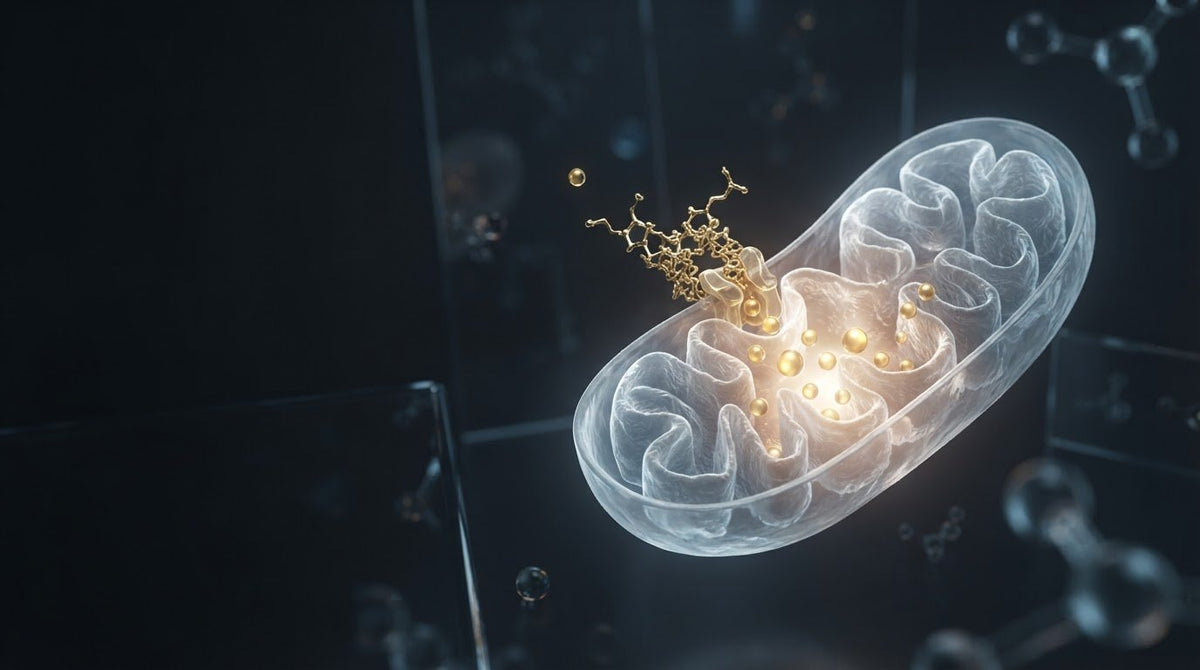
More L-carnitine does not automatically mean more fat is burned. L-carnitine for fat transport describes how the nutrient helps move long-chain fatty acids into mitochondria, where they can be used for energy. That is only one part of how the body uses fuel. For athletes, supplementation is best considered within a broader training and nutrition plan, not as a shortcut to fat loss.
It is reasonable to ask whether a nutrient involved in fat metabolism could support training or body-composition goals. The answer depends on understanding where carnitine comes from, how it moves through the body and why its entry into muscle matters. These details put potential benefits in perspective, without treating carnitine as a switch that directly burns fat.
This article explains how L-carnitine transports fatty acids, how the body obtains and distributes it, and what research suggests about exercise performance and fat loss. It also explains the limits of this transport mechanism and how to consider supplementation alongside the foundations of training and nutrition.
Key Takeaways
- L-carnitine helps carry long-chain fatty acids into mitochondria, where they can be used to produce energy.
- Your body makes carnitine and obtains it from food, with animal products such as red meat providing notable dietary sources.
- Its distribution matters: most of the body’s stores are held in muscle and heart tissue, rather than circulating in the blood.
- Evidence suggests possible modest effects on body weight and fat mass in some groups, but it does not establish a targeted effect on belly fat.
- Fat Metaboliser is Everbright Labs’ option for people looking to add a supplement designed to provide metabolic support.
How does L-carnitine support high performance?
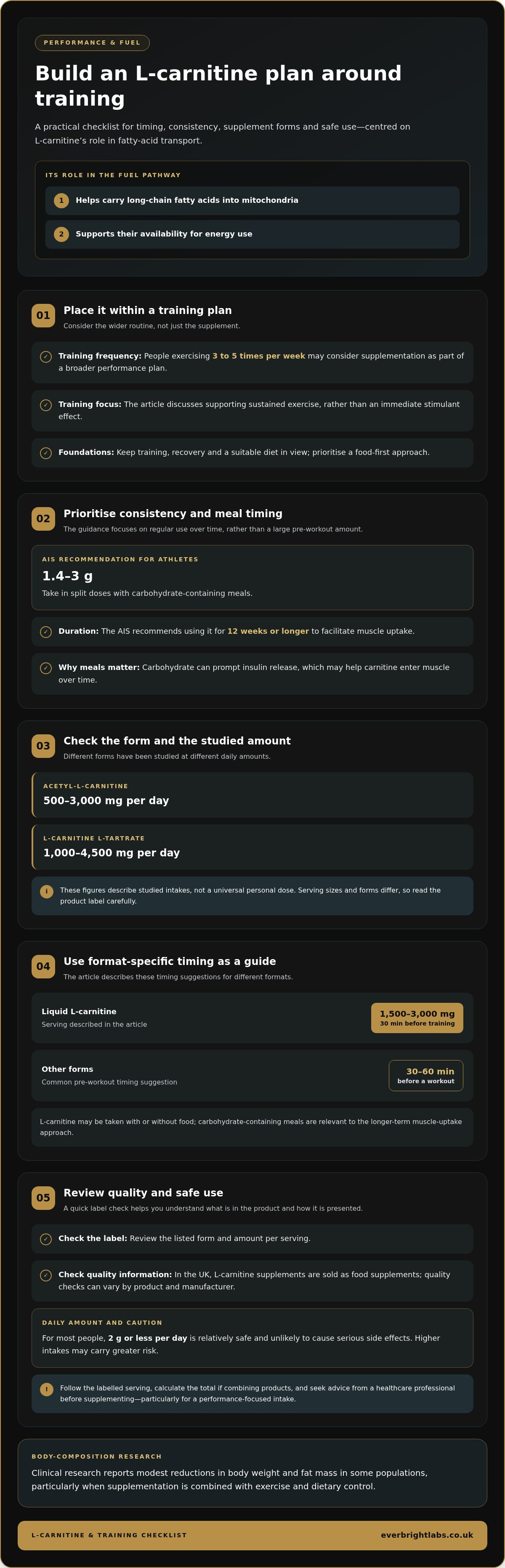
L-carnitine is involved in moving long-chain fatty acids into mitochondria, where cells use them to produce energy. That function helps explain interest from athletes, but supplements are not a substitute for training, recovery or a suitable diet. People exercising 3 to 5 times per week may consider supplementation as part of a broader performance plan, especially when aiming to support sustained exercise rather than an immediate stimulant effect.
Timing and consistency matter more than taking a large amount immediately before exercise. The Australian Institute of Sport recommends athletes take 1.4-3 g in split doses with carbohydrate-containing meals, and use it for 12 weeks or longer to facilitate muscle uptake. Carbohydrate can prompt insulin release, which may help carnitine enter muscle over time. Athletes should prioritise a food-first approach and seek professional advice before supplementing.
Supplement forms include acetyl-L-carnitine and L-carnitine L-tartrate, with different daily amounts used in research. The reported range for acetyl-L-carnitine is 500 to 3,000 mg per day, while studies of L-carnitine L-tartrate have used 1,000 to 4,500 mg per day. These figures describe studied intakes, not a universal personal dose. Read the product label carefully, since serving sizes and forms differ.
Liquid products are another format, with servings described as providing 1,500-3,000 mg. A common timing suggestion is to take liquid L-carnitine 30 minutes before training; other forms are often taken 30-60 minutes before a workout. L-carnitine may be taken with or without food, although carbohydrate-containing meals are relevant to the longer-term muscle-uptake approach.
For weight loss, researchers have studied carnitine supplements alongside diet and exercise. Clinical research reports modest reductions in body weight and fat mass in some populations, particularly when supplementation is combined with exercise and dietary control. This does not show that carnitine alone causes weight loss or targets a particular area. Fat loss still depends on consistently using more energy than the body takes in.
L-carnitine has a distinct role compared with many weight-loss supplements: it supports fatty-acid transport rather than acting as a general appetite suppressant or stimulant. The available evidence does not establish that it outperforms other supplements. A more useful comparison is its biological function and the evidence for the outcome you want to assess.
In the UK, L-carnitine supplements are sold as food supplements. Quality checks can vary by product and manufacturer, so the ingredient name alone does not tell you what testing has taken place. Before choosing a supplement, review its listed form, amount per serving and product-quality information.
For most people, taking 2 g or less per day is relatively safe and unlikely to cause serious side effects. Higher intakes may carry greater risk, so follow the labelled serving and don’t combine products without calculating the total. Athletes considering L-carnitine should seek advice from a healthcare professional before taking it, particularly when planning a performance-focused intake.
What is L-Carnitine and why is it used for fat loss?
L-carnitine helps move long-chain fatty acids into mitochondria, where they can be oxidised for energy. The phrase L-carnitine for fat transport refers to this role in the body’s use of fat as fuel.
Fatty-Acid Transport into Mitochondria
Long-chain fatty acids rely on carnitine to cross the inner mitochondrial membrane and reach the site of oxidation. First, an activated fatty acid joins coenzyme A. Carnitine carries the fatty-acid group across the membrane, where it transfers back to coenzyme A. This transport helps muscle cells access fatty acids as fuel during everyday movement and exercise.
How L-Carnitine Supports Fat Transport
The carnitine shuttle moves fatty-acid groups through a series of exchanges. At the outer mitochondrial membrane, carnitine palmitoyltransferase I transfers the group from coenzyme A to carnitine. A transport protein carries acyl-carnitine across the inner membrane, then carnitine palmitoyltransferase II transfers the group back to coenzyme A. This coordinated pathway is the biological basis of L-carnitine for fat transport, helping make fatty acids available for cellular energy production.
Mitochondrial Fatty-Acid Oxidation
Inside mitochondria, fatty-acid groups enter beta-oxidation, a sequence of reactions that produces acetyl-CoA. This molecule contributes to cellular energy pathways, allowing fatty acids to serve as fuel. By helping long-chain fatty acids reach the mitochondrial interior, carnitine supports this oxidation process. The transport pathway therefore links fat metabolism with the energy needs of active tissues, including muscle.
Fat Transport and Energy Metabolism
L-carnitine contributes to energy metabolism by helping move fatty acids into mitochondria. The body also uses fuels derived from carbohydrates, and exercise affects the balance muscles draw on. Insulin helps regulate nutrient handling, while nutrition and recovery support the wider processes involved in physical activity. Together, these systems coordinate fuel transport and use in response to different demands.
Understanding this pathway explains why carnitine is associated with fat metabolism. Its transport function supports the body’s use of fatty acids for energy, alongside the other fuels and processes that sustain daily activity.
Does L-carnitine help lose belly fat?
Research links L-carnitine supplementation with changes in some measures of weight and body composition. To assess what this could mean for abdominal fat, distinguish overall changes from changes in where body fat is stored.
L-Carnitine and Weight Loss
A 2020 review of 37 studies found significant reductions in body weight, BMI and fat mass among people taking L-carnitine. These findings make the ingredient relevant to discussions of weight management, while the outcomes measured help define what the evidence can tell us.
A review involving 1,239 people with type 2 diabetes reported weight-loss benefits from taking 2 grams daily for at least 2 weeks. This is evidence from a particular population and research context, so it’s most useful when considered alongside who was studied and how supplementation was used.
When asking about belly fat, separate changes in overall body weight or fat mass from changes in fat distribution. These are different measures. A general finding about weight management may inform a broader plan, but it does not specifically measure abdominal change.
Body Composition and Weight Loss
Body weight, BMI, fat mass and body-fat distribution each describe a different aspect of body composition. Tracking more than one measure can give a fuller picture. For example, you could monitor body weight alongside waist measurements, while recognising that each reflects a different outcome.
Clinical research reports modest reductions in body weight and fat mass in certain populations, particularly when supplementation is combined with exercise and dietary control. This places L-carnitine within a broader approach to body composition, where food choices and physical activity matter alongside supplementation.
Endurance performance is another reason athletes explore carnitine. More than 300 subjects took part in placebo-controlled studies discussed in a review of carnitine supplementation for skeletal muscle during exercise. This research offers context for performance questions, although participant numbers alone don’t describe the size or relevance of an outcome for an individual athlete.
Research on general fat-loss support has used 1,000 to 2,000 mg per day. A practical starting amount described for most individuals is 1,500 to 2,000 mg daily, while performance-focused studies have used up to 4,500 mg per day. These amounts relate to different study purposes, so compare the form and serving instructions rather than treating every figure as equivalent.
Assess progress using measures that match your goal, and interpret body-composition outcomes separately. This gives you a clearer basis for understanding how supplementation fits into a considered weight-management routine.
Dietary sources and endogenous carnitine synthesis
The body gets carnitine from food and internal production. It occurs mainly in animal products, particularly red meat, while the body can make it from the amino acids lysine and methionine. These sources contribute to the carnitine available for metabolism and fatty-acid transport, linking everyday nutrition with the body’s own supply.
Beef provides a concentrated dietary source: reported levels are 139 to 143 mg per 100 g. Pork contains 25 to 61 mg per 100 g, and chicken contains 13 to 34 mg per 100 g. Milk and cheese can contribute carnitine to the diet. These examples help compare carnitine contributions across familiar animal foods.
Plant foods contain much less carnitine. Vegetables, fruits and grains provide negligible amounts directly, so a meal based on lentils, vegetables and grains contributes little carnitine from food. The body also produces carnitine using lysine and methionine as building blocks. This internal production complements dietary sources and supports the body’s carnitine supply.
Approximately 75% of the body’s carnitine pool comes from dietary sources, while endogenous synthesis contributes approximately 25%. These proportions describe the overall pool, rather than the amount absorbed from a particular meal. For a practical comparison, beef contributes more carnitine per 100 g than chicken or hard cheese, while internal production also contributes to supply.
Absorption differs between food and supplements. Dietary carnitine has a reported bioavailability of about 63% to 75%, whereas absorption of supplemental L-carnitine is about 14% to 18%. These ranges describe different forms of intake, so the amount consumed and the amount absorbed are distinct. Food composition and the form of carnitine affect how much enters circulation.
After absorption, dietary carnitine joins the body’s existing supply and can contribute to transport functions in tissues. A carnitine-rich meal adds to intake, while absorption and distribution influence how the body handles it. Plant-based meals can also form part of a varied diet, alongside the body’s own synthesis from amino acids.
For practical meal planning, compare sources within your usual eating pattern. Beef, pork, chicken and dairy provide different amounts of carnitine, while plant foods contribute little directly. A balanced approach to nutrition and physical activity supports overall metabolism, with dietary carnitine and internal production contributing to the body’s supply.
Carnitine transport and tissue distribution
Carnitine’s role depends on more than how much enters the body; it must also reach the tissues that use it. In healthy people, skeletal muscle contains carnitine concentrations 50 to 200 times higher than blood plasma. This marked difference reflects how the body distributes and retains carnitine, rather than keeping it evenly spread through circulation.
More than 95% of the body’s L-carnitine stores are in the muscles. Muscle tissue needs carnitine for its normal fatty-acid transport function, linking tissue levels with energy metabolism. The heart also stores a substantial share: more than 90% of the body’s L-carnitine is stored in the heart and skeletal muscle. These figures show why blood levels alone don’t describe the total supply.
Blood plasma measurements provide a snapshot of circulating carnitine. Average concentrations are 41 μM/L in females and 50 μM/L in males. Those values differ from the much higher concentration inside skeletal muscle. A plasma reading and a muscle-store estimate therefore describe different compartments, so they shouldn’t be treated as interchangeable measures of the body’s carnitine status.
Carnitine moves from circulation into cells and is then retained in tissues. Muscle uptake is especially relevant because carnitine supports the entry of long-chain fatty acids into mitochondria. This is why increasing intake does not necessarily raise muscle stores immediately. The amount in muscle reflects transport and tissue handling, as well as dietary intake and the body’s own production.
The body produces carnitine using lysine and methionine as building blocks. Food contributes carnitine too, particularly animal products such as red meat. Together, dietary intake and internal production support the body’s supply, while tissue distribution determines where carnitine is held. Nutrition matters, but the amount in the bloodstream does not directly reveal how much is in muscle.
If you are considering supplementation, distinguish intake, circulation and tissue storage. A supplement enters the body through digestion, but muscle uptake is a separate physiological step. Research into athlete supplementation has therefore considered sustained use alongside carbohydrate-containing meals, rather than assuming one serving immediately changes muscle levels.
The practical point is that carnitine transport happens at the tissue level. Muscle holds most of the body’s stores and concentrates carnitine far above plasma levels. Blood values, dietary intake and muscle stores each describe a different part of the system, so none alone tells the full story of carnitine function.
Everbright Labs: Fat Metaboliser
Fat Metaboliser is designed to provide metabolic support, making it a relevant option for readers considering carnitine as part of their nutrition routine. Each serving contains 1000mg of acetyl-L-carnitine alongside decaffeinated green tea extract, inulin from chicory root, olive leaf extract, choline, chromium and black pepper extract.
Fat Metaboliser combines several ingredients rather than focusing on carnitine alone. Consider it alongside the evidence discussed above, your diet and regular physical activity, not as a replacement for them.
If you’d like to explore the formula and its ingredients, visit Everbright Labs’ Fat Metaboliser page.
Make your next step evidence-led
Understanding L-carnitine for fat transport can help you assess supplement claims in context and choose what fits your health priorities. Focus on a routine you can sustain, with nutrition and physical activity suited to your goals. For metabolic support, Everbright Labs’ Fat Metaboliser is a stimulant-free supplement with no caffeine. The company also offers Timeless NAD+ Support for healthy ageing and the Everbright Labs Bundle, which combines both formulations.
Supplements are one part of a broader approach, not a substitute for habits that support health over time. Consider which goal matters most to you, then explore the formulation relevant to that goal. For a personal next step, contact Everbright Labs to discuss your needs. A clear understanding of your priorities can help you move forward with confidence.
Frequently Asked Questions
Supplementation of L-carnitine in athletes: does it make sense?
L-carnitine may fit an athlete’s plan when the aim is sustained support for muscle carnitine, rather than an immediate pre-workout effect. The Australian Institute of Sport recommends a food-first approach and professional advice before supplementation. Training frequency, diet, the form used and the athlete’s wider nutrition plan all matter. For someone training regularly, these factors help determine whether supplementation has a clear purpose.
Does L-Carnitine burn fat?
No. L-carnitine does not burn body fat directly. It helps transport fatty acids for energy use, which is different from causing fat loss. A pathway can be essential to metabolism without acting as a direct fat-burning agent. Taking a supplement does not, by itself, show that someone has used more energy than they consumed or reduced body fat.
Should you take it?
Consider supplementation only if it fits a defined goal, such as supporting a consistent training routine, and you understand the product’s form and serving instructions. Your diet, exercise habits and health circumstances also matter. Athletes should seek advice from a healthcare professional before supplementing. A food-first approach helps place any supplement within a broader nutrition plan.
What foods are high in L-carnitine?
Red meat is a particularly rich source of carnitine, with pork and beef among the useful examples. Dairy, poultry and fish also provide carnitine, though amounts vary by food and serving. Someone planning meals around this nutrient could include beef or pork, while a vegetarian eating pattern relies more on the body’s own production. Food choices contribute to intake but do not determine tissue levels alone.
Does taking L-carnitine increase fat burning or cause weight loss?
Supplementation supports a process involved in fatty-acid use, but that mechanism alone does not show that taking carnitine causes weight loss. Weight change depends on the overall pattern of energy intake and use. Assess weight and body composition separately, alongside eating habits and physical activity. This helps avoid treating a change on the scales as proof of targeted fat loss.
What does clinical research say about L-carnitine supplements for weight loss?
Clinical research reports modest reductions in body weight and fat mass in certain populations, particularly when supplementation is combined with exercise and dietary control. Results vary by group and outcome measured. Overall weight and abdominal fat, for example, are not interchangeable measures. Keeping that distinction in mind helps you interpret study findings without assuming the same result applies to everyone.
What is the typical L-carnitine supplement dose used in studies?
Study amounts vary by form and purpose. Research on acetyl-L-carnitine has used 500 to 3,000 mg per day, while L-carnitine L-tartrate studies have used 1,000 to 4,500 mg per day. General fat-loss research has examined 1,000 to 2,000 mg per day. These are study ranges, not interchangeable instructions; check the supplement’s labelled serving.
How long does L-carnitine take to work, and how large are its effects?
Muscle uptake is a gradual process, so a single serving before exercise doesn’t represent the longer-term supplementation approach used in athlete guidance. The Australian Institute of Sport recommends use for 12 weeks or longer to facilitate uptake into muscle. Weight-related effects reported in research are modest and differ between populations. The outcome measured, such as body weight or fat mass, also shapes what “working” means.
Share:
Spermidine research: Where it comes from and what studies show