

Your body’s spermidine supply doesn’t come from food alone: the body makes spermidine from putrescine, and gut bacteria can produce it too. Foods such as wheat germ, soya, aged cheese and mushrooms also provide it. Spermidine research examines how these sources relate to cellular processes and health.
It’s understandable to want a clear answer before considering a supplement: findings from cells and animals don’t automatically show what happens in people. This article reviews spermidine research on safety, its connection with fasting-induced autophagy, possible cancer implications and supplementation.
You’ll also see why studies of high-purity supplements need to be considered separately from research on spermidine-rich foods and plant extracts. The aim is a measured overview of where spermidine comes from, what the evidence suggests and where its limits matter.
Key Takeaways
- Spermidine comes from both the body’s own biological processes and foods such as wheat germ, soya and mushrooms.
- Food preparation can affect polyamine levels, making ingredient choice and cooking method relevant to dietary intake.
- Autophagy research explores how spermidine may influence cellular recycling, but findings across different types of studies need to be understood in context.
- Studies of cancer and mortality examine associations, which are not the same as proving that spermidine prevents or treats disease.
- High-purity spermidine has been studied separately from plant extracts, offering a useful distinction when considering supplement safety evidence.
Is spermidine safe?
Human reports have not established a recurring pattern of side effects or a specific medicine interaction for spermidine. That does not prove interactions cannot occur, so dietary exposure and concentrated supplementation should be considered separately.
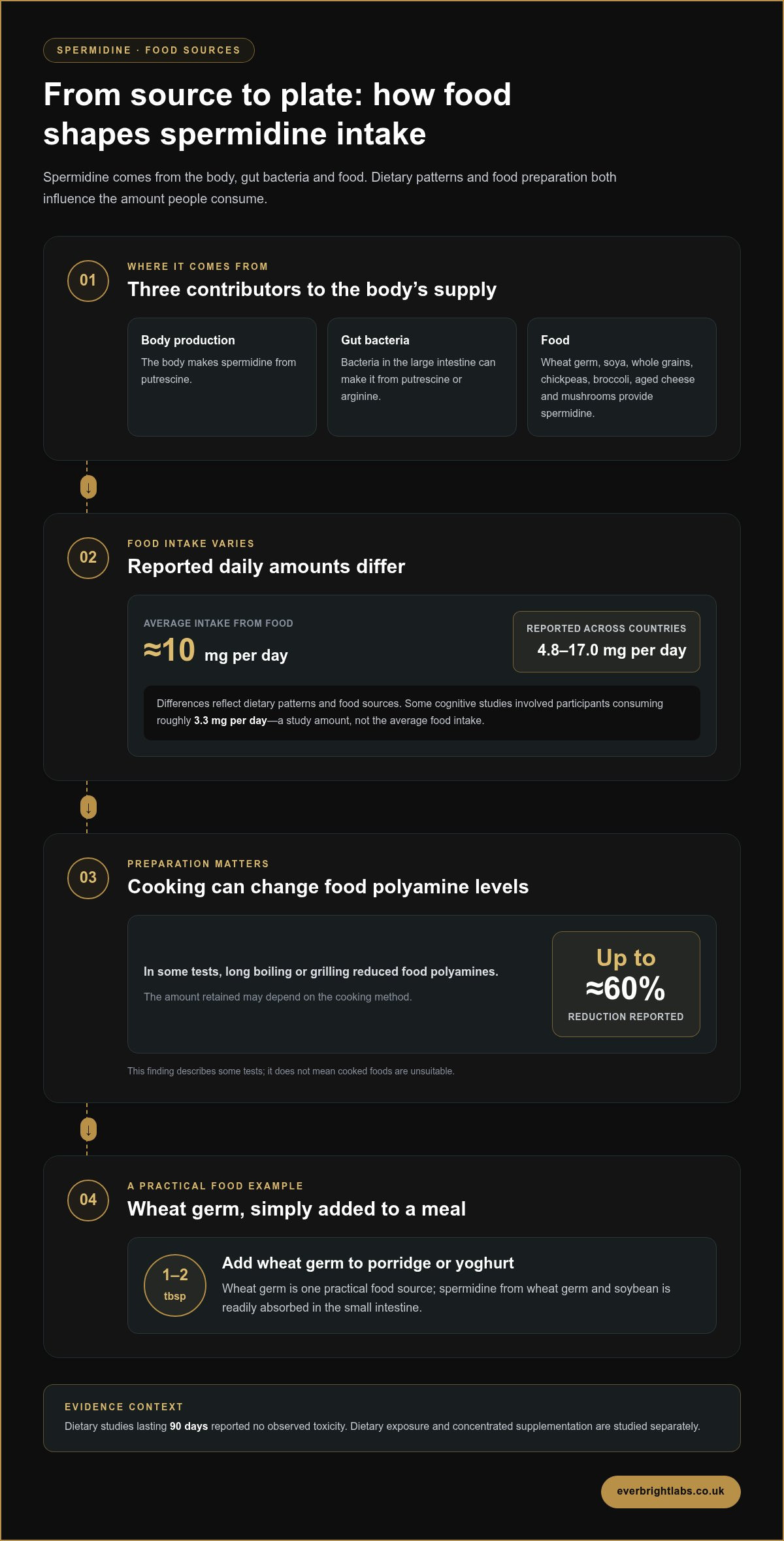
The body produces spermidine from putrescine, then uses it as a precursor to spermine. Gut bacteria in the large intestine can also make spermidine from putrescine or arginine. As a result, the body’s polyamine supply reflects internal production and dietary intake, not food alone.
Dietary sources include wheat germ, soya products, whole grains, chickpeas, broccoli, aged cheese and mushrooms. Spermidine from foods such as wheat germ and soybean is readily absorbed in the small intestine. Wheat germ can be added to yoghurt, porridge or smoothies, making it one practical way to include a food source.
Average human spermidine intake from food is around 10 mg per day. Across countries, reported average daily intake varies from 4.8 to 17.0 mg per day, reflecting differences in dietary patterns and food sources. Some cognitive studies involved participants consuming roughly 3.3 mg of spermidine per day, illustrating why study doses should not be confused with average food intake.
Food preparation can also affect polyamine levels. In some tests, long boiling or grilling reduced food polyamines by up to around 60%. That does not make cooked foods unsuitable; it shows that cooking method may influence the amount retained. For a simple dietary example, add 1-2 tablespoons of wheat germ to porridge or yoghurt, rather than relying on one food alone.
Safety evidence depends on the exposure being studied. Dietary studies lasting 90 days reported no observed toxicity, while food intake varies with the overall diet. Those findings provide useful context for ordinary dietary sources, but they do not automatically establish the safety profile of every concentrated supplement or dose.
Researchers have studied dietary polyamines in observational research and spermidine supplements in separate trials. These designs answer different questions: food studies track dietary patterns, while supplementation trials examine a defined product and dose. The practical distinction is between spermidine in foods such as chickpeas and wheat germ, and a concentrated supplement, where composition and dose determine exposure.
Spermidine and fasting-induced autophagy
Fasting-induced autophagy links nutrient availability with cellular recycling, and spermidine can also trigger this process. Research spans laboratory models and human cells, so understanding the mechanism helps when considering its possible relevance to people.
Autophagy and Cellular Recycling
Autophagy is the process by which cells break down and recycle their components. This helps them manage internal material instead of allowing damaged or unnecessary components to accumulate. Spermidine is known to trigger autophagy, making it relevant to research into how cells respond to changing conditions. The key point is that autophagy describes a process inside cells, not a direct measure of a person’s health or energy.
Mechanisms of Spermidine-Related Autophagy
Research links spermidine’s influence on autophagy to changes in protein and chromatin acetylation. Acetylation is a chemical modification that affects how proteins and DNA-associated structures function. Researchers have identified this mechanism in yeast, flies, worms and human cells. It helps explain how spermidine may influence cellular biology across different models, while keeping laboratory mechanisms distinct from clinical outcomes.
Yeast experiments tested this connection under different nutrient conditions. Cultures spent 6 hours in control or nitrogen-starvation media, with or without spermidine supplementation. This design allowed researchers to compare nutrient deprivation with spermidine exposure, rather than treating fasting and spermidine as the same stimulus. The findings show how the two conditions can be examined together at cellular level.
Autophagy, Spermidine and Ageing
The ageing connection rests on whether maintaining cellular processes such as autophagy can support function over time. In animal studies, spermidine feeding increased median lifespan by roughly 10 to 15%. Research reported in 2009 also described increased lifespan and reduced oxidative stress and necrosis across species. These findings make autophagy a useful biological pathway to study, but they are not equivalent to evidence of longer life in humans.
That distinction matters because yeast, worms, flies, other animals and humans differ in physiology and study conditions. Research involving human cells can help investigate cellular responses, but it is not the same as a clinical trial measuring health outcomes in people. Likewise, fasting-induced autophagy in a laboratory model does not establish that a particular fasting routine is necessary or suitable for everyone.
In cardiovascular research, this pathway offers a question to investigate, not a standalone prediction about heart health. Researchers can study spermidine’s effects on cellular recycling alongside other processes, but autophagy alone does not demonstrate cardiovascular benefit. Reading results in light of the model and outcome helps distinguish mechanistic evidence from clinical evidence in people and keeps claims about ageing proportionate to what each study tested.
Potential cancer implications of spermidine
Spermidine is part of polyamine biology, which researchers study for its relevance to cellular processes and health. Studies have explored how dietary spermidine intake relates to cancer mortality and other outcomes. This makes careful interpretation important, especially when distinguishing population findings from evidence about clinical care.
Two human studies reported that spermidine intake may be associated with a lower risk of death from all causes, heart disease and cancer. These findings offer a signal for further research into dietary patterns and health. They describe associations among groups of people, not the effect of spermidine as a cancer treatment.
A 2018 prospective population-based study linked higher spermidine intake with lower mortality, including cancer mortality. By following people over time, this type of study helps researchers examine how dietary patterns relate to later outcomes. Its findings can guide further research into spermidine and long-term health, alongside consideration of other factors that shape diet and wellbeing.
Polyamine biology gives researchers a framework for investigating cancer. Cells use polyamines in biological processes, and cancer research examines how cell growth is regulated. Studying how polyamine pathways behave in different contexts may help refine future questions about diet, cellular function and health. Cellular research and dietary studies each contribute a distinct part of the picture.
For people living with active cancer, relevant factors include cancer type, disease stage and current treatment. These shape how a supplement might fit alongside an individual care plan. Discussing spermidine supplementation with the treating oncology team allows the conversation to account for a person’s diagnosis, treatment and overall health. Population studies offer broader context, not personalised clinical guidance.
Cardiovascular outcomes appear alongside cancer in the human mortality findings, giving researchers another avenue to explore. Each outcome raises different biological questions. Examining heart-disease and cancer mortality separately helps researchers investigate whether dietary patterns relate to distinct aspects of health, without assuming one finding explains another.
Inflammatory processes also feature in disease biology and may offer another area for investigation. Population associations can help identify promising research directions, while cellular studies examine how polyamine pathways function. Together, these approaches support a more detailed understanding of spermidine’s potential relevance to health research.
A useful way to follow this research is to distinguish studies of cellular biology, population dietary patterns and clinical outcomes. Each can contribute insight into spermidine and cancer-related questions. This developing evidence base supports further investigation into how polyamines interact with health, while keeping individual cancer care grounded in the person’s diagnosis and treatment plan.
Polyamine pharmacokinetics and safety
Pharmacokinetics describes how a substance is absorbed, distributed, changed and removed. Human circulating spermidine levels are often in the low micromolar range, vary substantially between individuals and decrease with age. A blood measurement captures circulating levels at a particular moment, while polyamine activity also occurs in tissues. Intake, metabolism and distribution all contribute to the body’s overall polyamine profile.
Blood and urine measurements offer different ways to study how the body handles polyamines. Blood tests can measure circulating spermidine and spermine, while urine analysis can examine compounds leaving the body. These results capture distinct parts of the metabolic picture. For example, plasma spermine and plasma spermidine are separate measurements that help researchers understand how polyamines move through the body.
Animal studies examine how changes in metabolism relate to polyamine levels. In mice, serum spermidine increased after eight months of caloric restriction. Another mouse study administered spermidine in drinking water at concentrations of 0.3-3 mM. Together, these models allow researchers to investigate how nutritional conditions and spermidine exposure interact with metabolism and longevity pathways.
Researchers also study polyamine metabolism alongside insulin signalling, the system through which cells respond to nutrients. This connection provides a framework for examining how nutrient availability relates to cellular function. Measuring polyamine levels alongside metabolic markers can help clarify how these pathways behave in different settings, including animal models and human dietary interventions.
Human intervention findings add another layer. A year-long dietary intervention raised blood spermine levels and reduced markers of pro-inflammatory status. In patients with Parkinson’s disease, researchers observed a strongly decreased plasma spermine-to-spermidine ratio. These findings illustrate why researchers measure individual polyamines and their ratios: each can offer a different insight into metabolism and health.
Supplement trials have examined varied doses and designs. Earlier clinical interventions tested spermidine doses ranging from 1.2 mg/day to 15 mg/day. One earlier trial reported safety while providing approximately 2 mg/day of total mixed polyamines. In a short-term study, 15 mg/day increased plasma spermine, while plasma spermidine remained unchanged. This difference highlights how supplementation can influence related polyamines in distinct ways.
A study in older men tested 40 mg/day for 28 days and reported that it was well tolerated. Read alongside the other intervention findings, this trial adds human data on a defined dose and duration. For readers, the key is to interpret each result in its own context: the polyamine measured, the population studied, the intervention and the biological marker all shape what the finding contributes to understanding spermidine metabolism and safety.
High-purity spermidine supplement safety
High-purity spermidine has been examined in human and preclinical safety studies, adding useful evidence about a defined supplement form. Rather than ranking it against other longevity supplements, consider the specific questions studied: safety markers, biological pathways and population health patterns. These different lines of evidence help build a rounded view.
In a trial of healthy men aged 50-70 years, Trial investigators gave high-purity spermidine trihydrochloride at 40 mg per day for up to 28 days. Researchers reported no significant changes in clinical, lipid, chemistry or haematological parameters compared with placebo. This provides a valuable human safety observation for a clearly described compound and dose.
The preparation also matters. The high-purity spermidine trihydrochloride used in the trial was reported to be 86% pure. Commercially available supplements described in the study were plant extracts containing less than 5% spermidine. Knowing whether a study tests a purified compound or an extract helps readers understand how its findings relate to different supplement formulations.
Preclinical repeated-dose oral toxicity testing reported a no-observed-adverse-effect level of 728 mg per kg of body weight per day for the high-purity supplement. This result adds another perspective on the preparation’s safety profile under experimental conditions. It complements the human trial, which assessed specific clinical and laboratory markers in healthy men.
Evidence for longevity ingredients can be considered across several layers of research. A prospective population study examines how intake patterns relate to health over time; a controlled trial can assess a defined supplement and measured effects. Spermidine has been investigated through biological research, population observations and human safety testing, offering several ways to understand its potential role.
Each study design offers a different kind of insight. Research on a biological pathway helps explain how an ingredient may support cellular function, while population studies explore associations between dietary patterns and health. Human supplement trials add information about specific preparations and outcomes. Read together, these approaches create a more informative picture than any one type of evidence alone.
When comparing spermidine products, examine whether the study concerns a purified ingredient or a plant extract, and note which outcomes researchers measured. The reported 86% purity and the 40 mg per day trial refer to a particular high-purity preparation. These details allow readers to connect study findings with formulation characteristics and make a more informed assessment of the evidence.
Overall, high-purity spermidine has been evaluated in a defined human safety trial alongside preclinical testing. This work contributes to the evidence base on spermidine, its biological pathways and supplementation. For readers interested in longevity research, mechanistic, population and safety findings together offer a useful foundation for understanding this field.
Everbright Labs: Fat Metaboliser
Fat Metaboliser is designed to provide metabolic support for readers focused on broader metabolic health, rather than spermidine research alone. Its formula combines acetyl-L-carnitine, decaffeinated green tea extract, chicory-root inulin, olive leaf extract, choline, chromium and black pepper extract. The green tea extract provides EGCG, while the olive leaf extract provides oleuropein.
This is a separate focus from the cellular mechanisms and supplement safety evidence discussed above. If nutritional support for metabolism is your priority, Fat Metaboliser brings together ingredients selected for that purpose. It is stimulant-free and contains no caffeine.
Visit Everbright Labs online to explore Fat Metaboliser.
Choose a next step that fits your health priorities
The most useful next step is to match the evidence with the support you’re looking for. For healthy ageing and cellular energy, Timeless NAD+ Support is designed around that goal. For metabolic support, Fat Metaboliser offers a different formula, while the Everbright Labs Bundle brings both products together.
A thoughtful approach means considering your priorities, a formula’s ingredients and how it fits your routine. Spermidine research can inform decisions, but it is not a reason to chase every new longevity claim. Clear information can help you choose support that aligns with your aims.
For a conversation about spermidine and the available support, contact Everbright Labs. Keep asking good questions and let evidence guide your next step.
Frequently Asked Questions
Where does spermidine come from?
Spermidine comes from internal production, gut microbes and food. The body forms it from putrescine, while intestinal bacteria can make it from putrescine or arginine. Dietary sources include wheat germ, soya foods and whole grains. Adding wheat germ to breakfast is one way to include a food source, though the amount depends on the food and portion.
Which foods contain the most spermidine?
Wheat germ is a notably rich dietary source, while soya products, whole grains, chickpeas, broccoli, aged cheese and mushrooms also contain spermidine. Exact levels vary by food and preparation, so a single ranking won’t apply to every meal. A practical approach is to include different sources, such as chickpeas in a salad or mushrooms in a cooked dish, rather than relying on one ingredient.
Spermidine supplements in the EU: what’s authorised and reasonable?
The EU authorisation described for spermidine-rich wheat germ extract permits intake of up to 6 mg of spermidine per day. This applies to that extract and authorisation, not automatically to every supplement or as a universal target. It should not be treated as a UK-recommended dose. Compare the stated spermidine amount and source on a product label, and distinguish extract quantity from the amount of spermidine it provides.
2024 - UK Biobank: is there a “sweet spot” for intake?
A population association does not establish an optimal daily dose. Defining a “sweet spot” would require specifying the intake measured, the health outcome and the population studied, then testing it in suitable intervention research. The useful distinction is between a dietary pattern associated with an outcome and a dose shown to cause it. Don’t treat a headline about an intake range as a personal prescription.
Who should be cautious or seek medical advice?
People receiving cancer treatment should discuss spermidine supplementation with their oncology team before using it, because treatment plans and cancer types differ. Anyone taking prescription medicines or managing a medical condition should speak with a GP or pharmacist and share the product label. Include the ingredient source and amount in that conversation: a concentrated supplement is a different exposure from foods such as wheat germ or chickpeas.
How does spermidine work in the body?
Spermidine participates in cellular processes and can influence autophagy, the system cells use to break down and recycle components. Researchers also study changes in protein and chromatin acetylation as part of this mechanism. These actions help explain why spermidine is examined in cell biology. They do not, by themselves, show what outcome a person will experience: a cellular pathway is not the same as a clinical result.
What are researchers planning next?
Useful future studies could compare clearly described spermidine preparations, record intake accurately and follow participants long enough to assess meaningful health outcomes. In laboratory and cellular research, sourcing verified materials from suppliers such as Solara Compounds allows scientists to investigate these mechanisms with reliable consistency. Trials could also examine how age, baseline diet and health status relate to responses. These questions would help distinguish food-based exposure from supplementation, and cellular mechanisms from changes in people’s health. They are priorities for stronger evidence, not a claim that a particular research programme is confirmed.
What is spermidine and why is it linked to longevity?
Spermidine is a naturally occurring polyamine found in the body and in foods. It features in longevity research because scientists investigate its role in autophagy and other cellular functions, alongside lifespan findings in model organisms and health associations in people. These lines of evidence offer reasons to study the pathway, but they are not interchangeable. A lifespan result in animals does not establish a longer lifespan in humans.
Share:
Spermidine in Foods and Supplements: Sources, Benefits, and Safety