
Spermidine is a naturally occurring polyamine found in food and produced by the body. Wheat germ is a particularly rich food source, containing 24 to 35 mg per 100 g, while soya beans contain 20.7 mg per 100 g. Understanding spermidine in food and supplements means looking at both these dietary sources and what research says about supplementation.
It makes sense to ask whether a nutrient linked to cellular processes such as autophagy could also support healthy ageing. This article explains which foods contain spermidine, why amounts vary, what human and animal research suggests about longevity, and how supplement safety has been studied. It offers a clearer view of the evidence without treating early findings as a promise of a longer life.
Key Takeaways
- Compare plant, fermented and animal foods to see how varied dietary sources can contribute spermidine.
- Understand why longevity findings are promising, while distinguishing population associations from evidence of cause and effect.
- Learn what human supplement trials have examined, including dose, duration and safety monitoring.
- See how autophagy supports cellular recycling and why spermidine is being studied in relation to this process.
- Explore how Timeless NAD+ Support fits into a science-led approach to healthy ageing.
Spermidine and Longevity: Can a Spermidine-Rich Diet Help You Live Longer?
Spermidine-rich foods contribute to dietary intake, and studies have linked higher intake with longevity-related findings. These associations have prompted further research into spermidine’s role in cellular health.
Food sources of spermidine
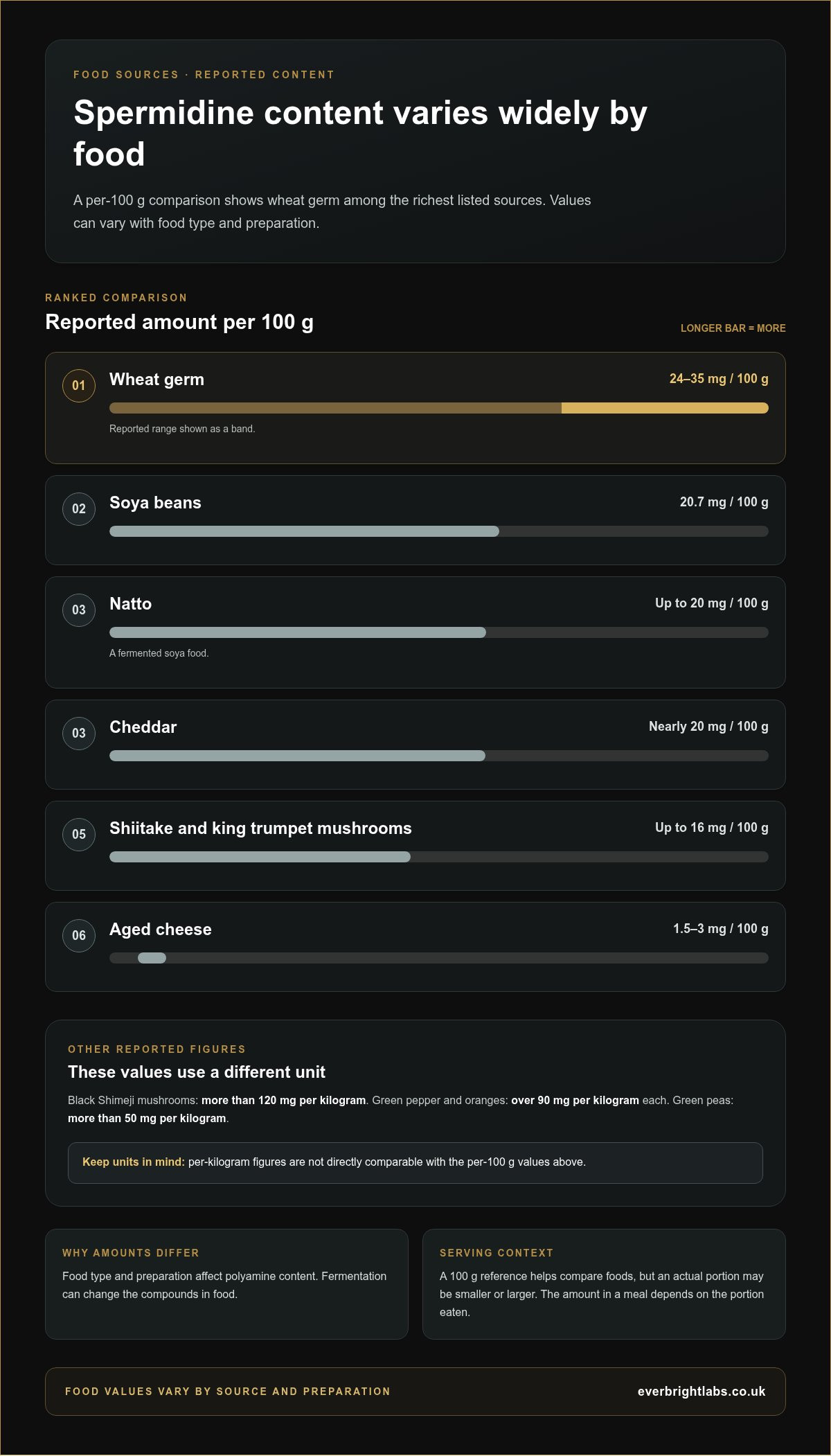
Dietary spermidine comes from plant and animal foods, with wheat germ among its concentrated sources. Wheat germ contains 24 to 35 mg per 100 g, while soya beans contain 20.7 mg per 100 g. Peas, mushrooms, nuts and seeds also contribute. Including a variety of these foods can help bring different spermidine sources into everyday meals.
Dietary absorption and bioavailability
Bioavailability describes how much of a dietary compound enters circulation after digestion. In vivo mouse studies suggest 60-75% of ingested spermidine may enter circulation within minutes. This finding gives researchers a useful basis for exploring how food-derived spermidine is absorbed. Wheat also provides other polyamines, with a spermidine-to-spermine-to-putrescine ratio of roughly 7:4:1.
Daily intake and supplement evidence
There is no single daily food intake that applies to everyone: amounts depend on the foods and portions eaten. Human studies offer encouraging findings, linking higher spermidine intake with favourable mortality outcomes. Researchers are continuing to examine supplements and health in clinical studies.
The Bruneck Study followed 829 adults over 20 years. Some human research has examined associations between spermidine intake and mortality, but this does not establish cause and effect. The association was described as equivalent to being nearly 6 years younger in biological age. In the NHANES Study, the highest intake was associated with a 30% lower risk of all-cause death and a 32% lower risk of heart-related death.
Animal research adds further context to this longevity science. Oral spermidine supplementation increased lifespan by approximately 10% in mice. Long-term murine studies also reported extended median lifespan with supplementation of up to 50 μmol/kg/day. These findings support continued research into spermidine’s potential and how supplementation may relate to healthy ageing in people. For readers also interested in how proactive cellular nutrition applies to animal health, petregen.com provides guidance on supporting long-term soundness in horses.
Food choices can balance spermidine sources with wider nutrition. Aged cheese contains 1.5 to 3 mg per 100 g, while mature cheese portions of 30 g-40 g a day keep salt and saturated fat intake moderate. ANSES advises not exceeding 500 g of red meat a week. This is French guidance, rather than a UK-specific recommendation.
Which foods have the highest content of spermidine?
Fermentation and food type both shape polyamine content. Natto, a fermented soya food, can contain up to 20 mg of spermidine per 100 g. Cheddar contains nearly 20 mg per 100 g, while certain mushrooms, including shiitake and king trumpet, contain up to 16 mg per 100 g. These examples show why spermidine intake depends on the particular foods chosen.
Other foods also contribute. Black Shimeji mushrooms contain more than 120 mg per kilogram, while green pepper and oranges each contain over 90 mg per kilogram. Green peas contain more than 50 mg per kilogram. These figures use different units and should be compared carefully: a value per kilogram is not the same as a value per 100 g.
Natto stands out among fermented foods, but it is not the only food containing polyamines. Cheddar is another example, although its spermidine content does not make it nutritionally equivalent to natto. Fermentation can change the compounds in food, and amounts vary by food and preparation. A varied diet therefore provides different sources rather than one consistent dose.
Polyamines are a group of compounds that includes spermidine, spermine and putrescine. They have biological functions in cells, including roles in growth and maintenance. Metabolic health depends on many interacting processes, so finding a polyamine in a food does not prove that the food independently improves metabolism. Consider food sources as part of the wider dietary pattern.
Green tea is often discussed for its polyphenols, including catechins, but polyphenols and polyamines are different groups of compounds. Green tea is not interchangeable with spermidine-rich foods such as natto or mushrooms. This distinction helps you compare foods by the compounds they contain, rather than assuming every food associated with cellular function provides spermidine.
Foods can contain several polyamines, so a spermidine figure does not describe their full composition. Wheat, for example, contains spermidine alongside spermine and putrescine. The relative amounts vary across foods, so comparing just one compound can miss the broader profile. Comparing spermidine in food and supplements puts food values in context, while recognising that foods provide different combinations.
Portion size also changes how much a meal contributes. A 100 g reference value helps compare foods, but an actual serving may be smaller or larger. Natto, mushrooms and cheese can feature in different meals, while green pepper offers another plant-based source. A useful comparison of spermidine in food and supplements starts with the serving amount, not just the ingredient’s headline figure.
For readers considering a supplement alongside food sources, Timeless NAD+ Support provides 3 mg of spermidine from wheat germ extract. It offers a measured supplement source, while foods such as natto and mushrooms provide dietary alternatives.
Spermidine supplements and trial safety
Human trials have examined spermidine doses, tolerability and cognitive outcomes. Consider the participants and study conditions when interpreting findings about safety.
Supplement safety and tolerability
Tolerability describes how participants experience a supplement during a study. In a small clinical trial, older adults reported no side effects from 1.2 mg/day of spermidine from wheat germ extract. A Phase II trial tested 1.2 mg spermidine daily for three months in 30 older adults with subjective cognitive decline, according to The Phase II trial researchers. These findings relate to the tested dose and group, not every person or product.
Compliance in a Phase II trial of spermidine supplementation in older adults exceeded 85%. That figure indicates participants generally followed the study schedule; it doesn’t establish safety for every population. A separate study examined 40 mg/day of high-purity spermidine in healthy older men. It assessed safety and tolerability, but that study dose shouldn’t be treated as a recommended intake.
Study doses, forms and groups to avoid
Human studies have used spermidine-rich wheat germ extract and high-purity spermidine. Most clinical trials used around 1 mg of spermidine per day alongside other polyamines. The 1.2 mg daily trial used wheat germ extract, whilst a separate study examined 40 mg/day of high-purity spermidine. These examples show why the form and dose should be read together.
When buying a supplement in the UK, distinguish clinical testing from product authorisation. A trial alone does not establish that a supplement has UK authorisation. Check the label for the stated amount of spermidine per serving, its source and allergen information. Wheat germ extract is relevant if you have a wheat allergy because it comes from wheat.
If you are pregnant or have cancer, avoid self-directed supplementation and seek advice from your clinical team. The trial described above involved older adults with subjective cognitive decline; it does not establish safety during pregnancy or for people with cancer. Spermidine is involved in cellular processes, and eating spermidine-rich foods is not the same as taking a concentrated supplement.
Study doses don’t translate directly into a personal intake target. The amount used, the ingredient form, the trial length and participants’ health all affect how results apply. For example, the 1.2 mg daily wheat germ extract trial and the 40 mg/day high-purity study examined different formulations and doses. Comparing their numbers without those details can give a misleading impression of equivalent exposure.
When considering a product, check the declared amount of spermidine per serving, whether its source is wheat germ or purified spermidine, and any allergen information. These details help distinguish a measured supplement intake from dietary spermidine, where amounts vary by ingredient and portion.
Autophagy and cellular recycling
Autophagy is a cellular recycling process that breaks down worn or damaged components. A cell encloses material in a membrane-bound structure and delivers it to lysosomes for processing. The resulting components can be reused. This process helps maintain cellular function and renew structures within the cell.
Researchers study spermidine for its relationship with autophagy and cellular maintenance, including how it interacts with biological pathways that regulate this recycling process. This gives longevity research a way to investigate how cells manage internal wear and provides a framework for exploring spermidine’s potential role in supporting healthy cellular function.
Autophagy responds to nutrient-sensing pathways. For example, mTOR helps regulate cell growth and nutrient availability, while AMPK responds to cellular energy status. These pathways coordinate whether cells prioritise growth or internal maintenance. Research into spermidine explores how these regulatory systems relate to autophagy and offers insight into the processes that support cellular balance.
Fasting research also examines nutrient availability in relation to autophagy. During a fast, the body changes how it uses nutrients and manages energy. Researchers study these changes to understand cellular recycling and how cells adapt to different conditions. Dietary spermidine and fasting are distinct areas of research, each helping scientists explore how nutrient signals relate to cellular processes.
Autophagy offers a useful way to study cellular health. Laboratory findings can identify biological changes that guide further research into human health outcomes. Researchers also examine wider systems, including metabolism, immune function and tissue maintenance. Studying these connections helps build a fuller picture of how cellular maintenance may contribute to healthy ageing.
Autophagy can be selective: a cell may target particular structures, such as damaged mitochondria, for breakdown and recycling. This process is called mitophagy. It shows that cellular recycling involves specialised activities, not simply the removal of all old material. Coordinated regulation helps cells identify and process components for recycling, supporting continued cellular function.
Dietary spermidine is one focus of research into cellular pathways, alongside other influences. Wheat germ and mushrooms provide dietary sources, while supplements offer a measured intake. Researchers can investigate these different exposures in relation to autophagy and other biological markers, helping clarify how spermidine may contribute to cellular maintenance.
Autophagy helps explain why spermidine attracts attention in cellular health research. It gives scientists a process to study, from cellular recognition to lysosomal breakdown and the reuse of components. Research linking nutrient exposure, biological mechanisms and health outcomes continues to develop. Understanding these stages helps readers see how spermidine research may inform future approaches to supporting cellular health.
Food and supplement sources of spermidine
Spermidine comes from both everyday foods and concentrated supplements. Food sources include soya beans, peas, mushrooms, nuts, seeds, fruit, vegetables and animal products. Soya beans contain 20.7 mg per 100 g, whilst beef contains 3.7 mg per 100 g. These values help compare ingredients, but a typical portion may differ from 100 g.
Plant foods offer a range of ways to include this compound in daily nutrition. Peas contain 6.5 mg per 100 g, and mushrooms contain 8.8 mg per 100 g. Cauliflower and broccoli florets or leaves average 2.5 mg per 100 g. Hazelnuts provide 2.1 mg per 100 g, while bananas contain 0.86 mg per 100 g. Each contributes a different amount.
Some less familiar foods are especially concentrated. Natto can contain up to 20 mg per 100 g, and certain mushrooms reach up to 16 mg per 100 g. Cow liver can also contain up to 16 mg per 100 g; chicken liver contains 4.8 mg per 100 g. These examples show that the highest sources span fermented, plant and animal foods.
Measurements need careful comparison. For example, broccoli contains 32.4 mg per kilogram, while peas contain 6.5 mg per 100 g. Since a kilogram contains ten 100 g portions, converting units makes comparisons clearer. Food values also describe the ingredient, not the amount in a particular meal. Portion size and food choice therefore shape dietary intake.
Supplements provide another way to consume spermidine, often using wheat germ extract. The stated amount per serving can be easier to identify than an estimated intake from mixed foods. However, the labelled amount of spermidine is different from the total weight of wheat germ extract. When comparing products, check both figures, along with the ingredient source and allergen information.
Clinical studies have examined wheat germ extract in adults, including older adults with subjective cognitive decline. These trials investigate a defined supplement and dose; they do not make it interchangeable with a serving of wheat germ or soya beans. This distinction matters when interpreting findings, particularly if your dietary pattern or cognitive concerns differ from those of the trial participants.
For a practical comparison, start by identifying your usual food sources, such as peas, mushrooms or soya beans. Then consider whether a clearly labelled supplement fits your routine. Spermidine levels in food vary by ingredient and portion, while a supplement label gives an amount per serving. Neither figure alone describes overall nutrition or prevents age-related decline.
Everbright Labs: Fat Metaboliser
Fat Metaboliser is designed to provide metabolic support, making it relevant if your goal extends beyond dietary spermidine. Its formula includes acetyl-L-carnitine, decaffeinated green tea extract, inulin from chicory root, olive leaf extract, choline, chromium and black pepper extract. It is stimulant-free and contains no caffeine. It is not a source of spermidine, so it serves a different purpose from wheat germ-based supplements.
For a product more directly related to spermidine, Timeless NAD+ Support contains 300 mg of wheat germ extract, providing 3 mg of spermidine. This distinction can help you match an offering to your intended focus: metabolic support or healthy ageing and cellular energy.
Visit the Fat Metaboliser page to explore its formulation.
Choose a next step that fits your health priorities
Use what you have learned to set a clear priority: building a varied diet, considering a measured supplement or supporting metabolic health. A thoughtful approach to spermidine in food and supplements means matching the source to your goal, rather than expecting one ingredient to address every aspect of wellbeing. Keep your choices grounded in the distinction between biological mechanisms and demonstrated outcomes.
Everbright Labs offers Timeless NAD+ Support for healthy ageing and cellular energy, Fat Metaboliser for metabolic support, and the Everbright Labs Bundle combining its primary formulations. These options serve different aims, so focus on the one most relevant to your priorities. If you’d like to explore which product aligns with your goals, contact Everbright Labs for guidance. A steady, informed approach can make your next choice feel clearer and more manageable.
Frequently Asked Questions
What is spermidine?
Spermidine is a naturally occurring polyamine, a type of compound found in the body and in foods. It is involved in cellular processes, including autophagy, which helps cells break down and recycle components. The body also produces spermidine, so dietary intake is only one part of its presence in the body. Researchers study its relationship with cellular maintenance and healthy ageing.
Food-Derived vs Synthetic Spermidine: What is the Difference?
Both refer to spermidine by its source: food-derived spermidine comes from ingredients such as wheat germ, while synthetic spermidine is produced through a manufacturing process. The molecule is the same, but the ingredient source and the rest of the formulation can differ; contract specialists such as harmonypharmalab.com assist companies with custom supplement formulation and production to ensure precise dosing. For a supplement, read the label for the stated source, amount per serving and allergen information, particularly if wheat is a concern.
Which foods contain the most spermidine per 100 g?
Among the foods with values reported here, wheat germ is highest at 24 to 35 mg per 100 g. Soya beans, natto and cheddar can all be sources of spermidine. These values make wheat germ a concentrated source, though typical serving sizes differ between foods.
How much spermidine is in wheat germ, mushrooms, legumes, cheese and aged foods?
Wheat germ contains 24 to 35 mg per 100 g. Mushrooms contain 8.8 mg per 100 g on average, while certain varieties can reach 16 mg per 100 g. Legumes can contain up to 10 mg per 100 g, although soya beans are reported at 20.7 mg per 100 g. Aged cheese is reported at 1.5 to 3 mg per 100 g; cheddar is listed separately at nearly 20 mg.
What are the risks, side effects and medication interactions of spermidine supplements?
Small human studies have examined tolerability, but their findings do not establish how everyone will respond. A wheat germ-derived supplement is also relevant if you have a wheat allergy or coeliac disease. Medication interactions depend on the specific medicine and your health circumstances. If you take prescription medication, have a medical condition, are pregnant or have cancer, discuss supplementation with your GP or pharmacist before use.
How can I increase spermidine intake through diet, and which foods are practical sources?
Choose foods that fit meals you already enjoy: add wheat germ to porridge or yoghurt, include peas or mushrooms in savoury dishes, or use soya beans in a meal. Nuts and seeds can also go into breakfast or salads. These choices contribute to a varied diet rather than relying on one ingredient. This product is a food supplement and is not intended to replace a varied diet and healthy lifestyle.
How much do spermidine supplements cost in the UK, and how do products compare?
Timeless NAD+ Support provides 3 mg of spermidine from wheat germ extract. Some products labelled “wheat germ with spermidine” list 8 to 10 mg.
Share:
Wheat germ extract spermidine: sources, effects and safety
Spermidine research: Where it comes from and what studies show