

In preclinical research, spermidine supplementation extended lifespan by approximately 10% in mice; this is a finding in animals, not a human outcome. Spermidine is a naturally occurring polyamine, and wheat germ extract offers a food-derived source. In Great Britain, food supplements may contain no more than an equivalent of 6 mg/day of spermidine from spermidine-rich wheat germ extract.
If you’ve seen spermidine linked with healthy ageing, it helps to understand the biology behind that interest. Researchers study spermidine for its role in autophagy, the cellular process that helps clear and recycle damaged components. Findings need context, however, and should not be treated as promises of a particular result.
This article explains what spermidine is, how wheat germ extract provides it, and how food-derived forms compare with synthetic spermidine. It also covers research on autophagy and calorie restriction, Great Britain’s supplement requirements, and safety considerations to weigh before choosing a supplement.
Key Takeaways
- Understand how spermidine relates to autophagy, the cell’s process for clearing and recycling damaged components.
- Compare wheat germ with other food sources and see why spermidine content can vary.
- Separate findings from preclinical research on lifespan and calorie restriction from what human studies have examined.
- Learn the Great Britain limit for spermidine-rich wheat germ extract supplements and the key safety considerations.
- See how Everbright Labs’ Timeless NAD+ Support fits into a science-led approach to cellular energy and healthy ageing.
Spermidine and autophagy
Spermidine is a polyamine studied for its relationship with autophagy, the cell’s recycling process. This pathway helps cells break down and reuse components as part of routine cellular maintenance. Research in yeast, nematodes, fruit flies and mice has explored how spermidine and autophagy relate to healthy ageing.
Autophagy and cellular damage
Autophagy is the process through which cells break down and recycle damaged components. Misfolded proteins and dysfunctional mitochondria can affect normal cell function, which is why researchers study this process. Spermidine’s potential role in supporting autophagy has been investigated in laboratory and animal studies, including research on brain damage.
Autophagy and healthy ageing
Autophagy supports cellular housekeeping by helping cells manage damaged material, making it relevant to research on healthy ageing. Polyamine levels, including spermidine, decrease with age, so researchers are examining how spermidine relates to this maintenance pathway. Findings from preclinical models make autophagy an important focus for understanding spermidine’s biological role.
In preclinical research, oral spermidine supplementation increased lifespan by approximately 10% in mice. Lifespan extension has also been observed in studies involving yeast, nematodes and fruit flies. Together, these findings allow researchers to investigate spermidine’s effects across different biological models and to explore the cellular processes associated with longer lifespan.
The proposed mechanism centres on cellular maintenance. Misfolded proteins may accumulate, and dysfunctional mitochondria can disrupt a cell’s energy-producing systems. Autophagy helps break down and recycle these components. Studying spermidine’s relationship with this process gives researchers a way to investigate how cells respond to damage and maintain normal function.
Brain-related research offers another example. Laboratory and animal studies have explored whether spermidine’s relationship with autophagy may help limit brain damage by supporting the breakdown of misfolded proteins and dysfunctional mitochondria. These models let scientists examine a specific biological pathway and its possible relevance to brain health, but they do not establish outcomes in people.
Age-related changes in polyamine levels add context to this research. As levels decrease with age, studies can examine how spermidine interacts with autophagy and cellular maintenance. Findings from mice, yeast, nematodes and fruit flies offer complementary perspectives on lifespan and cell function. This preclinical research helps explain why spermidine is being studied in healthy-ageing research.
Food-Derived vs Synthetic Spermidine: What is the Difference?
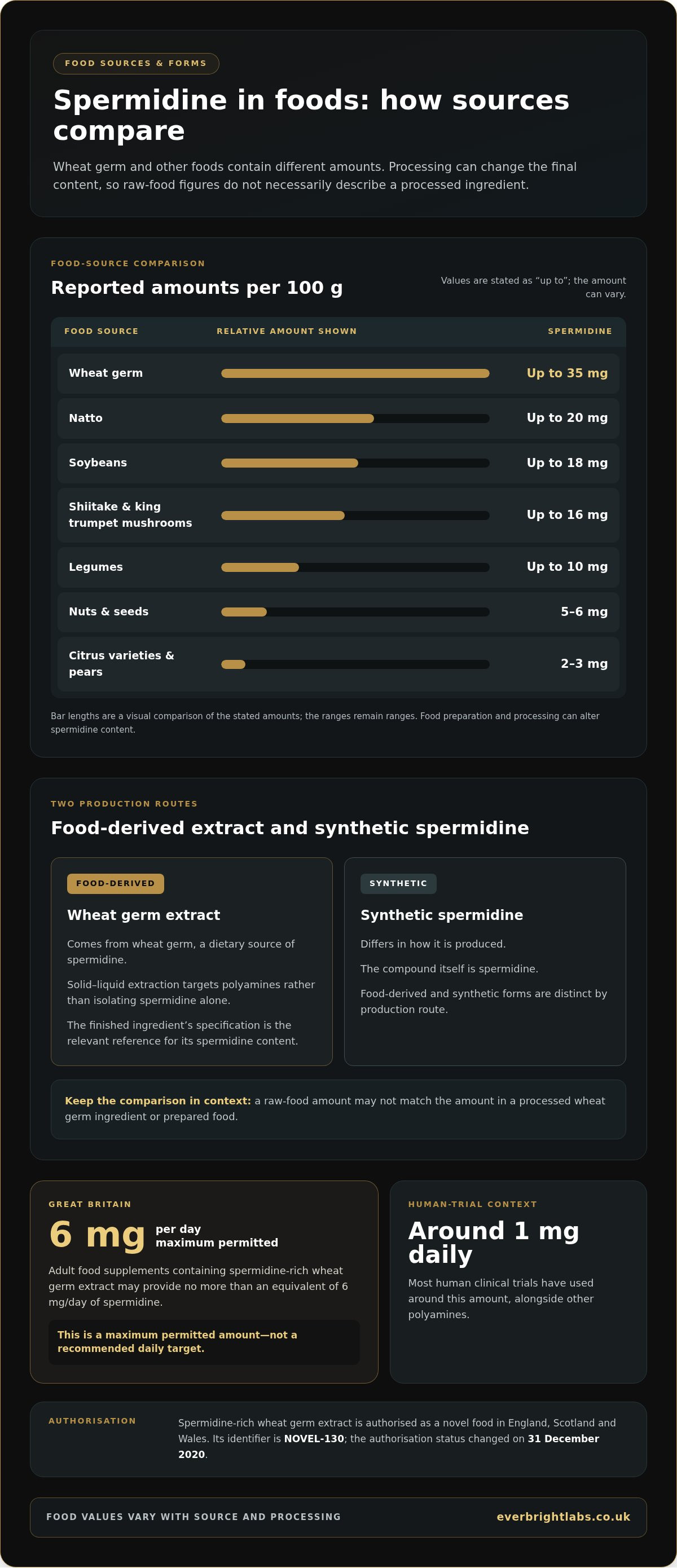
Wheat germ is a dietary source of spermidine, while extracts provide a processed form with a defined composition. Compared with other foods, wheat germ contains up to 35 mg per 100 g; amounts vary across foods and can fall during processing.
Food processing and spermidine variability
Processing can alter a food’s spermidine content, so an ingredient’s amount may differ from that of its unprocessed source. Preparation and processing methods affect the final composition. When comparing foods, remember that a value for raw wheat germ may not describe a processed wheat germ ingredient or prepared food. The spermidine content of wheat germ extract is best understood from the finished ingredient’s specification.
Wheat germ extract and other dietary sources
Wheat germ extract comes from wheat germ, whereas other foods contain spermidine within their broader nutritional composition. Wheat germ contains up to 35 mg per 100 g; natto can contain up to 20 mg, and soybeans up to 18 mg per 100 g. These foods offer different dietary sources, rather than interchangeable forms of a supplement ingredient.
Shiitake and king trumpet mushrooms contain up to 16 mg per 100 g. Legumes contain up to 10 mg, while nuts and seeds offer 5-6 mg per 100 g. Citrus varieties and pears contain 2-3 mg per 100 g. These comparisons help show how food choices differ, although processing can change the amount present.
Food-derived spermidine has been part of the human diet for thousands of years. Synthetic spermidine differs in how it is produced, though the compound itself is spermidine. In wheat germ extract, solid-liquid extraction targets polyamines rather than isolating spermidine alone. So, interpret the stated spermidine amount in relation to the extract’s composition.
In Great Britain, spermidine-rich wheat germ extract is authorised as a novel food in England, Scotland and Wales. Its identifier is NOVEL-130, and it is not classified as a traditional food. The authorisation status changed on 31 December 2020.
The specification refers to Assimilated EU Regulations 2017/2470. The linked legislation for the Great Britain authorisation includes Assimilated EU Regulations 2018/1023, according to the UK legislation register. These identifiers describe the authorised novel-food ingredient and its specification, rather than wheat germ as an ordinary food. They help distinguish a regulated extract from spermidine-containing foods eaten as part of a varied diet.
Safety and tolerability of spermidine supplements
Great Britain permits adult food supplements containing spermidine-rich wheat germ extract to provide no more than an equivalent of 6 mg/day of spermidine. This is a maximum permitted amount, not a recommended daily target. Most human clinical trials have used around 1 mg daily, alongside other polyamines.
The distinction matters because the amount of extract and the amount of spermidine are different measurements. A label should clearly state the spermidine content, so you can assess the active amount rather than relying on the weight of wheat germ extract alone. In Great Britain, food supplement labels must designate the ingredient as “spermidine-rich wheat germ extract”.
Wheat germ extract contains polyamines, including spermidine, spermine and putrescine. The wheat polyamine ratio is roughly 7:4:1 for spermidine, spermine and putrescine. This helps explain why the extract is not simply a single isolated compound. For consumers, the key practical detail is the stated spermidine quantity per serving.
Some products labelled “wheat germ with spermidine” may list 8 to 10 mg of spermidine. That figure exceeds Great Britain’s 6 mg/day maximum equivalent for adult supplements containing spermidine-rich wheat germ extract. Read the ingredient designation and daily serving information together, rather than relying on a prominent front-label claim.
Authorised food supplement use in Great Britain excludes pregnant and lactating women. Wheat-derived ingredients also require care for people with non-gluten wheat sensitivities. They should avoid the ingredient or consult a healthcare practitioner before use. These considerations are distinct from gluten sensitivity, and the source remains wheat germ.
Human tolerability evidence and preclinical testing provide different kinds of information. A mouse tolerance study of spermidine-enriched wheat germ extract lasted 28 days. Human clinical trials have generally used around 1 mg daily with other polyamines. Neither figure changes the Great Britain supplement limit, and neither should be confused with an individual product’s serving instructions.
For a practical label check, look for three details: the exact ingredient name, the amount of spermidine per daily serving, and the serving directions. Compare the declared spermidine amount with the 6 mg/day Great Britain limit. If the label gives only the extract weight, it doesn’t tell you the equivalent spermidine amount by itself.
The European Food Safety Authority set a safe upper intake of 6 mg per day for food-derived spermidine. In Great Britain, the relevant supplement limit is also expressed as an equivalent of 6 mg/day from spermidine-rich wheat germ extract. These figures describe intake limits, not a dose that every adult should aim to reach.
Calorie-restriction mimetic effects
Calorie restriction means reducing energy intake. A calorie-restriction mimetic is studied for its relationship with biological effects associated with that approach. Spermidine is investigated for its potential to engage related cellular processes. “Mimetic” describes the research question: it does not mean that spermidine changes food intake or replaces a calorie-restricted diet.
Long-term murine studies reported median lifespan extension with spermidine supplementation at doses up to 50 μmol/kg/day. This daily dose is expressed in micromoles per kilogram of body weight, making the study protocol clear. The reported result gives researchers a measurable outcome for investigating spermidine in the context of calorie restriction and lifespan.
The phrase “up to” matters. It describes the highest dose in the stated range of the murine studies, not a universal dose for every study or an instruction for supplement users. The unit matters too: μmol/kg/day expresses the quantity of spermidine relative to body weight over a daily period. It should not be interpreted as a capsule amount.
Researchers use comparisons with calorie restriction to examine biological effects, not simply food intake. They can investigate whether spermidine relates to cellular processes also considered in calorie-restriction research. This frames a specific scientific question: how might spermidine supplementation engage pathways associated with changes in energy availability? The comparison gives studies a shared biological context.
Autophagy is one cellular process examined in spermidine research. It involves breaking down and recycling cellular components, providing a mechanism researchers can study alongside the effects of calorie restriction. This connects the mimetic concept to measurable cellular activity, rather than suggesting a supplement recreates every aspect of dietary restriction.
The lifespan measure adds another layer. Median lifespan refers to the midpoint of lifespan observations within a study group. In the long-term murine research, this outcome was reported alongside supplementation at doses up to 50 μmol/kg/day. Researchers can use such measures to compare study groups and explore how spermidine relates to ageing biology.
Clinical studies and murine studies contribute different perspectives to this research area. Animal models let researchers investigate lifespan under defined study conditions, while clinical research examines spermidine in people and specific outcomes. Together, these approaches help build a fuller picture of the calorie-restriction mimetic question. For readers, the key is to understand 50 μmol/kg/day as a research dose in mice, not personal dosing guidance.
Spermidine from wheat germ extract
Spermidine is a naturally occurring polyamine, and wheat germ contains up to 35 mg per 100 g. Another reported measurement is 243 mg/kg, illustrating how composition figures can vary by source and measurement.
Spermidine-rich wheat germ extract is produced from non-fermented, non-sprouting wheat germs identified as Triticum aestivum. Solid-liquid extraction targets polyamines, including spermidine, rather than isolating spermidine alone. The result is an ingredient with a distinct production process and a measurable composition.
Standardisation helps describe that composition. Wheat germ extract powders are specified at 0.2%, 0.5% and 1% spermidine. At 1%, the extract provides 1 mg of spermidine per 100 mg of extract. The percentage expresses concentration, while the amount of extract in a serving determines its contribution.
Wheat germ also contains spermine and putrescine. Its reported spermidine-to-spermine-to-putrescine ratio is roughly 7:4:1. Since extraction targets polyamines, the resulting ingredient retains a broader plant-derived profile. The declared spermidine amount helps readers understand the contribution of the ingredient alongside its extract weight.
Research examines spermidine from both concentrated supplements and food-derived sources. These approaches let scientists study defined amounts alongside the wider context of wheat germ as a food. Human studies investigate specific outcomes, while food-composition research describes naturally occurring polyamines. Together, they build a broader understanding of how spermidine is studied and supplied.
Concentration and source are useful details to compare when reading a product description. A standardised percentage describes the extract’s spermidine concentration, while the serving amount shows how much extract is consumed. Considering both gives a clearer picture of how a wheat germ ingredient is characterised.
For a practical label comparison, first note the standardised spermidine percentage, such as 1%. Then consider the amount of extract per serving to understand the ingredient’s stated contribution. This separates the concentration of the raw extract from the quantity used in a finished supplement.
Everbright Labs: Fat Metaboliser
Fat Metaboliser is designed to support metabolism for people whose health goals include metabolic support. Its formula combines acetyl-L-carnitine, decaffeinated green tea extract, inulin from chicory root, olive leaf extract, choline, chromium and black pepper extract. It is a separate option from spermidine supplementation.
For a product more directly related to this article, Timeless NAD+ Support contains 300 mg of wheat germ extract, providing 3 mg of spermidine. It also contains nicotinamide riboside chloride and liposomal trans-resveratrol, and is designed to support healthy ageing and longevity.
Choose based on the support you’re looking for: metabolic support or a formulation that includes spermidine. Visit Everbright Labs to explore Timeless NAD+ Support.
Choose your next step with your health goals in mind
To turn interest in spermidine from wheat germ extract into a practical choice, start by identifying the support you’re looking for and how a supplement would fit your routine. Compare ingredient and serving information on product labels, then consider which formulation aligns with your broader health goals.
At Everbright Labs, Timeless NAD+ Support is designed to support healthy ageing, while Fat Metaboliser is designed for metabolic support. The Everbright Labs Bundle combines these formulations for those looking to support both areas.
If you’d like to explore which option aligns with your priorities, contact Everbright Labs to discuss your needs. A thoughtful, informed next step can help you build a routine around the support you value.
Frequently Asked Questions
What is spermidine?
Spermidine is a naturally occurring polyamine found in human cells and foods such as wheat germ. Polyamines contribute to cellular functions, including processes connected with cell maintenance. The body also produces spermidine, and food is another source. On supplement labels, look for the stated amount of spermidine rather than assuming the entire weight of wheat germ extract is spermidine.
What Are the Limitations of the Current Evidence?
Much of the evidence linking spermidine with ageing-related outcomes comes from preclinical research, including studies in animals and other organisms. These findings help researchers explore biological mechanisms, but they cannot establish the same outcomes in people. Human studies have examined specific groups and outcomes, such as subjective cognitive decline. Their results do not automatically apply to every adult, supplement formulation or longer-term use.
What Does the Research on Spermidine Actually Show?
Research examines spermidine’s relationship with autophagy, cellular maintenance and outcomes in animal models. Human studies have also tested supplementation in defined groups, including older adults reporting subjective cognitive decline. These lines of evidence answer different questions: laboratory and animal work investigates mechanisms, whilst clinical studies assess people. The research offers reasons for continued investigation, but study design and measured outcomes determine what each finding can tell us.
What are the evidence-based health benefits of spermidine supplements?
Research has explored spermidine in relation to autophagy, healthy ageing and cognitive outcomes, with findings varying by study type. These areas are scientifically relevant, but they do not prove that a supplement prevents or treats disease. If you’re considering a product, compare its declared ingredients and serving information with your needs. This product is a food supplement and is not intended to replace a varied diet and healthy lifestyle.
What clinical studies have tested wheat germ extract or spermidine in humans?
Human research includes a trial involving older adults with subjective cognitive decline who took spermidine alongside other polyamines. It examined cognitive performance in that specific group, not general disease prevention or treatment. Studies using concentrated spermidine also differ from eating wheat germ as a food. To interpret a result, consider the participants, formulation, duration and outcome measured, rather than relying on a headline alone.
What are the side effects and risks of taking wheat germ extract or spermidine?
Wheat-derived ingredients can be unsuitable for people with wheat allergy or sensitivity, and the label should be read for the precise ingredient. In Great Britain, adult supplements containing spermidine-rich wheat germ extract must stay within the permitted equivalent of 6 mg spermidine per day. Pregnancy and lactation are excluded from its authorised supplement use. Follow the product directions and seek clinical advice if a reaction occurs.
Who should avoid spermidine supplements, including people with wheat allergy or coeliac disease?
People with a wheat allergy should avoid wheat germ extract unless their healthcare professional advises otherwise. Those with coeliac disease should also treat wheat-derived supplements cautiously and discuss suitability with their clinician, since the ingredient comes from wheat. Authorised supplement use in Great Britain excludes pregnant and lactating women. Read the full ingredient declaration, not just the front label, as the source ingredient may appear in smaller print.
Do spermidine supplements interact with medicines or medical conditions?
Potential interactions depend on the medicine, a person’s health and the supplement’s full ingredient list. If you take prescription medication or have a medical condition, discuss the specific product with a GP or pharmacist before adding it. Share the label so they can review the wheat germ extract and other ingredients. Do not stop or change prescribed treatment to accommodate a supplement without guidance from your healthcare professional.
Share:
Spermidine supplement clinical studies on safety and evidence
Spermidine in Foods and Supplements: Sources, Benefits, and Safety