


The early clinical safety findings are reassuring, though limited in duration. In a placebo-controlled trial, 37 healthy men aged 50-70 received 40 mg/day of high-purity spermidine trihydrochloride for up to 28 days, with no significant adverse effects compared with placebo, according to the authors of the placebo-controlled spermidine trial. This supports short-term tolerability in that study group; longer-term safety requires separate evaluation.
It’s reasonable to want more than a promising mechanism before considering a supplement. Spermidine is studied for its role in autophagy, the cell’s recycling process, but evidence about biological pathways needs to be considered alongside findings in people.
This article explains what clinical research says about safety, autophagy, memory, dementia risk and cardiovascular outcomes. It also puts human trials in context, helping you distinguish early findings from questions that still need study.
Key Takeaways
- At 40 mg/day, high-purity spermidine did not significantly change clinical, lipid, chemistry or haematological parameters compared with placebo, according to the Authors of the placebo-controlled spermidine trial.
- Explore how spermidine’s role in autophagy connects cellular recycling with the questions researchers are investigating in human studies.
- Compare findings on memory and dementia risk, including what a randomised trial can tell us beyond observational research.
- Learn how oral study design, dose and duration shape what safety results can tell us.
- Understand why cardiovascular findings are promising, and how to interpret associations between dietary spermidine intake and health outcomes.
Autophagy and cellular recycling
Autophagy is the cellular process of breaking down and recycling damaged components. Researchers study spermidine for its possible influence on this process and its connection with ageing.
Spermidine and autophagy
Spermidine is a naturally occurring molecule studied in relation to autophagy, the cell’s internal recycling system. In this process, cellular components are broken down so their materials can be reused. This helps cells maintain their internal systems. Research asks whether spermidine can support this housekeeping activity, rather than simply mask a symptom.
Autophagy involves several steps: a cell encloses material for breakdown, delivers it to a compartment containing digestive enzymes, then recycles the resulting components. Think of a cell reusing parts instead of letting damaged material accumulate. This explains why researchers study the pathway in relation to cellular maintenance. It does not, by itself, show that taking a supplement changes a person’s health.
Spermidine appears in dietary sources, and average intake varies between countries. Reported estimates range from 4.8 to 17.0 mg/day, while average human intake from food is around 10 mg per day. These figures describe dietary intake, not a recommended supplement dose. Nutrition also includes the wider pattern of foods eaten, so one molecule cannot represent the whole diet.
Spermidine, autophagy and ageing
Ageing is associated with declining circulating spermidine levels, making the molecule relevant to research on cellular recycling. The proposed connection is that supporting autophagy may help cells manage damaged components as they age. This provides a biological explanation for interest in spermidine, but it is not proof that supplementation slows human ageing.
Animal findings provide one part of the evidence. In animal models, spermidine feeding increased median lifespan by roughly 10 to 15%. That result helps researchers investigate possible links between spermidine, autophagy and longevity. It cannot be transferred directly to people, whose biology, lifespan and dietary patterns differ from those of animal models.
Human evidence needs to be interpreted on its own terms. In a study of high-purity spermidine supplementation, researchers found no substantial changes in serum or urine polyamine concentrations. This result concerns measured polyamine levels, not every possible effect on cellular activity. It illustrates why a plausible pathway and a measurable change in the body are separate questions.
That distinction matters in cardiovascular research, too: dietary patterns and circulating molecules can be associated with outcomes without proving cause. The evidence has several layers: cellular mechanisms, animal findings, dietary observations and controlled human trials. Each answers a different question. Together, they help show how far the science has progressed, without treating autophagy as a guaranteed result of supplementation.
Clinical research on memory and dementia risk
Human evidence on memory ranges from long-term dietary observations to controlled supplementation trials. These designs answer different questions: cohort studies track associations over time, while randomised trials test changes after an intervention. Separating the findings helps explain interest in spermidine and cognitive ageing without treating an association as proof that a supplement prevents disease.
The Bruneck cohort followed 829 adults aged 45-84 years for 20 years. Researchers examined dietary spermidine intake alongside health outcomes, giving them a long view of how habitual intake relates to ageing. Some cognitive studies involved participants consuming roughly 3.3 mg of spermidine per day. That intake provides context for interpreting dietary research, but it should not be mistaken for a universal supplement dose.
Intervention findings offer a different perspective. A randomised controlled Phase IIa trial found a positive impact on memory performance in older adults at risk of dementia after three months. Another study examined spermidine in older adults with dementia over three months, while a separate report described a positive effect after one year. The duration and participant group matter: memory performance in people at risk and outcomes in people already living with dementia are distinct research questions.
Long-term population research also investigates polyamines, the family of molecules that includes spermidine. A Japanese study followed more than 29,000 adults aged 35 and older for 16 years, using food frequency questionnaires from 1992 to estimate polyamine intake. Such studies can identify patterns between dietary exposure and later outcomes. They cannot isolate spermidine from the other features of nutrition or establish that intake caused a change in dementia risk.
Ageing research also examines cellular stress. Oxidative stress describes damage associated with reactive molecules, while inflammatory markers reflect another part of the body’s response. In a year-long human dietary intervention, blood spermine levels rose and markers of pro-inflammatory status fell. Spermine is a related polyamine, so this finding informs the wider biological pathway; it does not prove a direct memory benefit from spermidine.
Animal lifespan research adds mechanistic context because laboratory models let researchers examine biological processes across an organism’s life. These findings can help guide questions about cellular maintenance and ageing in people, but they are not human dementia outcomes. Taken together, the evidence is best read in layers: dietary cohorts suggest long-term patterns, controlled trials assess memory changes, and animal studies explore possible mechanisms. Each layer offers insight but measures a different outcome.
Oral spermidine study design and registration
Study design determines how far findings from oral trials can be applied to other people and products.
Participants, eligibility and ethics
An exploratory oral trial screened 57 participants and randomised 38. Its reported cohort included 37 healthy men aged 50-70 years, with a BMI of 18.5-28 kg/m². The University of Luebeck Ethics Committee approved the protocol in Germany on 13 August 2020. For readers assessing spermidine supplement clinical studies, participant details help show who was represented and which groups the results may inform.
The researchers tested high-purity spermidine trihydrochloride at 40 mg per day across 7-day and 28-day dosing periods. During the 7-day crossover phase, 18 participants followed a placebo-then-spermidine sequence and 20 followed spermidine-then-placebo. As each participant received both conditions in sequence, the design allowed within-person comparisons. Its short dosing periods still define the scope of the observations.
Study registration records planned methods and outcomes, allowing readers to compare a protocol with reported findings. Registration and ethics review describe aspects of study oversight; neither, by itself, establishes that a supplement is authorised in the UK or determines which claims sellers may make. These are separate questions from whether a trial was conducted and what it measured.
Supplement doses and food comparisons
For UK supplements, compare the declared milligrams of spermidine per serving, not just the total weight of a plant extract. The oral trial used 40 mg/day of high-purity spermidine, whereas commercial plant extracts described in research had spermidine concentrations below 5%. Extract weight alone therefore cannot show the amount of spermidine supplied.
Food provides another comparison point. Average dietary spermidine intake is around 10 mg per day, with estimates varying between countries from 4.8 to 17.0 mg/day. Food intake and supplement doses are not directly interchangeable: foods contain spermidine within meals, while trials test defined preparations and protocols. Across spermidine supplement clinical studies, compare the compound, dose, participant group, duration and measured outcome before drawing parallels.
A separate human supplementation study ran for 90 days and reported promoted hair growth and resistance. That outcome differs from memory or cellular measures, just as the study’s duration and preparation differ from the oral safety trial. Keeping these distinctions visible helps readers judge what each study contributes to the evidence, without treating one trial as a template for every supplement or health goal.
Is spermidine safe?
Human safety findings depend on the preparation, dose, participant group and follow-up period. Read trial results alongside these details: they define what researchers measured and which people were represented.
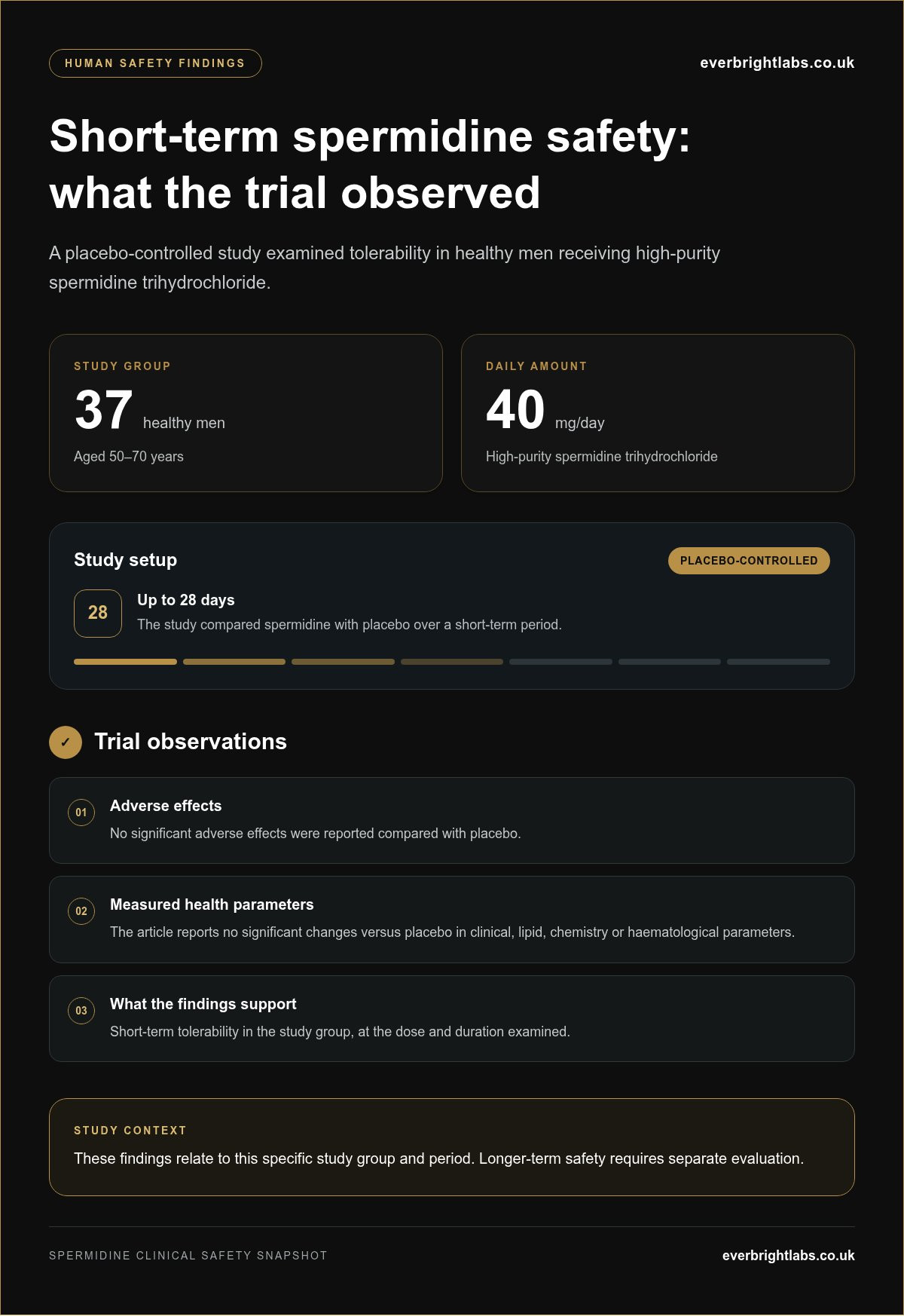
In a placebo-controlled trial, 37 healthy men aged 50-70 years received high-purity spermidine trihydrochloride at a daily dose of 40 mg/day for up to 28 days, with no significant adverse effects compared with placebo, according to the Authors of the placebo-controlled spermidine trial. This provides a direct comparison within the trial, but applies to its participants and study conditions.
At a daily dose of 40 mg/day, high-purity spermidine did not significantly change clinical, lipid, chemistry or haematological parameters compared with placebo, according to the Authors of the placebo-controlled spermidine trial. These measures include blood lipids, clinical chemistry and blood-cell parameters. Together with reported adverse events, they provide different views of tolerability rather than one all-purpose safety measure.
Evidence from spermidine supplement clinical studies should be read by preparation and dose, not pooled as if every intervention were identical. Earlier clinical intervention trials used doses ranging from 1.2 mg/day to 15 mg/day. A separate safety study provided approximately 2 mg/day of total mixed polyamines, a different preparation from high-purity spermidine trihydrochloride.
Safety and cancer-related cautions
Safety evidence also includes animal toxicology and dietary studies, which answer different questions from controlled human trials. Preclinical rat toxicology studies reported a no observed adverse effect level of 728 mg/kg body weight/day. Ninety-day dietary studies reported no observed toxicity from spermidine. These findings add context, but animal measures do not establish a human dose or replace human safety data.
A prospective population-based study associated higher spermidine intake with lower mortality, including cancer mortality. This observation concerns dietary intake and population outcomes; it is not evidence that spermidine prevents or treats cancer. Keeping these claims separate helps readers interpret the evidence without confusing association with a treatment effect.
Spermidine and cancer research
Cancer research considers spermidine’s biological roles alongside the complex processes involved in cell growth. The population study’s association with lower cancer mortality is relevant to research interest, but it cannot show that supplementation caused the outcome. It also does not establish how the findings apply to people with a cancer diagnosis or those receiving treatment.
Across spermidine supplement clinical studies, human safety observations come from specific preparations, participants and trial durations. The placebo-controlled trial reported no study-product-related adverse events, while broader conclusions require evidence across more settings and longer use. This distinction lets readers recognise reassuring findings without extending them beyond the groups studied.
Cardiovascular outcomes
Cardiovascular findings on spermidine mainly come from population studies of dietary intake. They examine associations with mortality and heart-related outcomes, rather than testing spermidine as a cardiovascular treatment.
The SAPHIR study reported a 26% reduction in mortality for every 1 standard deviation increase in spermidine intake, after adjustment for potential confounders. A standard deviation describes variation within the measured population, so this comparison reflects relative differences in intake. The finding concerns mortality across the study population, not a measured improvement in heart function after supplementation.
A separate analysis of 23,894 US adults aged 18 years or older reported a cardiovascular mortality hazard ratio of 0.68 for the highest versus lowest spermidine-intake quartile. The analysis covered 2003-2014. A hazard ratio compares the rate of an outcome between groups over time; here, the comparison is between intake categories, not supplement users and non-users in a randomised trial.
The Bruneck Study reported around 40% lower risk of fatal heart failure among participants with higher daily spermidine intakes. This result focuses on a specific cardiovascular outcome, unlike a measure of all-cause mortality. It suggests a research link between dietary patterns and heart-related outcomes, while the observational design leaves other population differences relevant to interpretation.
These studies assess higher spermidine intake through dietary patterns. Food-frequency data can group people by intake, then researchers compare later outcomes across those groups. This approach helps investigate long-term associations and longevity. It does not isolate spermidine from the rest of a person’s diet, lifestyle or biological characteristics.
The key distinction is between association and intervention. A population study may find lower mortality in a higher-intake group, while a controlled trial tests a defined product and administration protocol. Neither type of result should stand in for the other. In particular, cohort findings do not establish that taking a supplement improves cardiovascular function or prevents heart disease.
Across SAPHIR, the US adult analysis and Bruneck, the recurring signal is an association between higher spermidine intake and favourable mortality outcomes. The endpoints differ: overall mortality, cardiovascular mortality and fatal heart failure. Keeping these outcomes separate makes the evidence easier to assess and avoids treating every result as proof of the same benefit.
Everbright Labs: Fat Metaboliser
Fat Metaboliser is designed to provide metabolic support, offering a separate option for readers whose goals centre on metabolism rather than cardiovascular outcomes. Its formulation includes acetyl-L-carnitine, decaffeinated green tea extract, inulin from chicory root, olive leaf extract, choline, chromium and black pepper extract. It is stimulant-free and contains no caffeine.
It’s useful to keep that purpose distinct from the spermidine studies discussed above: population findings about dietary intake don’t establish that a metabolic supplement changes cardiovascular risk. For readers interested specifically in spermidine alongside support for healthy ageing, Timeless NAD+ Support contains wheat germ extract providing 3mg of spermidine.
Choose according to the support you’re seeking, and consider the formulation in that context. Visit everbrightlabs.co.uk to explore the available information.
Make your next choice with clarity
A careful reading of spermidine supplement clinical studies can help you frame useful questions: which outcome matters to you, what formulation is being considered, and whether the evidence relates to your goal. Use those questions to guide a thoughtful choice, rather than expecting one molecule to address every aspect of health.
Everbright Labs offers the Everbright Labs Bundle alongside its individual formulations, giving you options for your broader supplement routine. The right focus depends on the support you’re seeking, whether that is metabolic support or healthy ageing.
If you’d like to explore the available formulations and decide which best fits your priorities, visit Everbright Labs. A considered, evidence-aware approach is a constructive place to begin.
Frequently Asked Questions
What human clinical trials have studied spermidine supplements?
Human research includes oral supplementation trials, cognitive studies and dietary interventions. Examples include a placebo-controlled safety trial in healthy men, a randomised Phase IIa memory trial involving older adults at risk of dementia, and a study of adults already living with dementia. Researchers have also examined dietary polyamines over time and reported hair-related outcomes after supplementation. These studies differ in participants, preparations and measured outcomes, so they address distinct questions.
What were the results of spermidine trials for memory and cognitive function?
A randomised controlled Phase IIa trial found a positive impact on memory performance in older adults at risk of dementia after three months. Some cognitive studies involved spermidine intake of roughly 3.3 mg per day. Memory-test performance is a specific outcome, not the same as diagnosing dementia or demonstrating that disease progression has changed. When assessing a result, note the participants’ cognitive status and the measure used, not just the headline conclusion.
What dose of spermidine was used in clinical studies, and for how long?
Clinical interventions have used a range of doses and study periods. Earlier trials used 1.2 mg/day to 15 mg/day, while an exploratory safety trial tested 40 mg/day for up to 28 days. Some cognitive research examined intake around 3.3 mg per day, and a hair-related supplementation study ran for 90 days. These figures describe different studies and preparations, so they are not interchangeable dose recommendations.
What are the sample sizes and limitations of spermidine clinical trials?
Sample sizes vary by design. The placebo-controlled oral safety trial involved 37 healthy men aged 50-70 years; its screening and randomisation figures were 57 and 38, respectively. A separate Bruneck cohort followed 829 adults, but dietary observation differs from a supplement trial. Small or narrowly selected groups, limited follow-up and different outcomes all affect how broadly findings can be applied to other adults.
What side effects and safety risks have been reported in human studies?
The placebo-controlled oral trial reported no significant adverse effects compared with placebo and no study-product-related adverse events. It also assessed clinical and laboratory measures, offering information beyond participants’ reported symptoms. These results describe the preparation, participants and short study period examined. They cannot establish how every formulation will be tolerated, particularly with longer use or in people with health conditions not represented in the trial.
Does spermidine interact with medicines or affect people with specific health conditions?
Interaction findings depend on the medicine, dose and person’s health, and the oral safety trial was not designed to establish compatibility with every prescription treatment. Its results in healthy men cannot answer every question about use alongside medicines or with a specific condition. For a practical assessment, consider the exact supplement formulation, current medicines and diagnosed conditions; these determine which interaction or safety concerns are relevant.
Share:
Spermidine and Ageing: Levels, Food Sources and Health Links
Wheat germ extract spermidine: sources, effects and safety