

What if your persistent hunger isn't a sign of weak willpower, but a sophisticated biological signal that's simply been misaligned? Many people spend their days trapped in a cycle of sugar cravings and the inevitable energy crashes that trigger even more hunger, leading to a sense of lost control over their own eating habits. If you've felt anxious about using stimulant-based diet pills that cause heart palpitations, you're right to seek a more clinical, evidence-based approach to your health.
We understand that these struggles are biological hurdles rather than personal failures. This guide will show you how to manage appetite naturally by addressing the underlying physiological mechanisms that dictate when you feel full. You'll discover the science of hunger hormones like ghrelin and leptin, and learn why supporting your metabolic pathways is more effective than masking symptoms with caffeine. We'll examine how specific nutrients and lifestyle adjustments can recalibrate your internal feedback loops, providing a steady, stimulant-free path to regaining control over your daily nutrition.
Key Takeaways
- Identify the hormonal interplay between ghrelin and leptin to understand why your body may signal hunger despite having sufficient energy reserves.
- Discover how targeted doses of soluble fibre, such as 500mg of inulin, support satiety by triggering internal GLP-1 and PYY signalling pathways.
- Learn how to manage appetite naturally by breaking the cycle of artificial stimulants that often lead to heart palpitations and rebound sugar cravings.
- Uncover the physiological connection between sleep deprivation, elevated cortisol levels, and the biological drive for calorie-dense foods.
- Develop a sustainable metabolic protocol that prioritises long-term hormonal balance over the fleeting results of restrictive fads.
The Biology of Hunger: Understanding Your Internal Feedback Loops
Hunger is not a failure of character. It is a biological imperative driven by a complex network of chemical messengers. When you find yourself reaching for a snack shortly after a meal, your body is likely reacting to a disruption in its internal appetite regulation mechanisms. Learning how to manage appetite naturally requires us to move beyond the idea of willpower and instead focus on the hormonal signals that govern our desire for food.
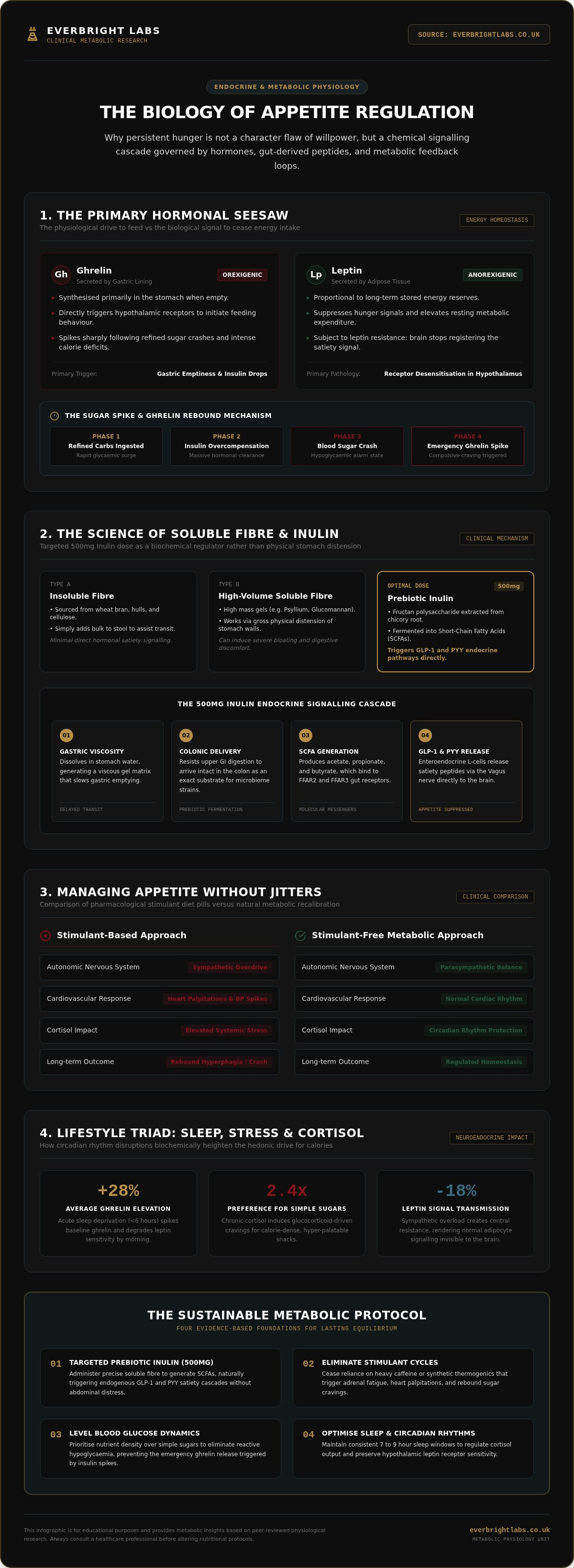
Two primary hormones dominate this system: ghrelin and leptin. Ghrelin, often called the hunger hormone, is produced in the stomach and signals the hypothalamus to initiate feeding behaviour. Conversely, leptin is secreted by adipose tissue to signal satiety and energy sufficiency. In a balanced system, these hormones oscillate to maintain energy homeostasis. However, many individuals experience leptin resistance; a state where the brain becomes deaf to satiety signals despite having ample energy stores. This results in persistent hunger and a lower metabolic rate, making it physically difficult to stop eating.
This hormonal dysregulation is frequently exacerbated by insulin spikes. When we consume refined carbohydrates, blood glucose levels surge, forcing a massive insulin release. The subsequent rapid drop in blood sugar triggers an emergency ghrelin response, leading to intense cravings for more sugar. These pathways often lose their precision as we pass our 30s because hormonal sensitivity naturally declines and metabolic flexibility reduces. Supporting these systems with a targeted Fat Metaboliser can help restore the efficiency of these internal pathways without the need for artificial stimulants.
The Gut-Brain Axis: How Your Digestion Speaks to Your Mind
Your digestive tract and brain are physically linked via the Vagus nerve, creating a constant dialogue known as the gut-brain axis. Satiety is not just about the physical volume of food in your stomach; it's about the nutrient density detected by specialised cells in the gut lining. When you consume high-quality nutrients, your gut bacteria ferment certain fibres into short-chain fatty acids (SCFAs). These SCFAs act as signalling molecules that tell your brain you have received what you need, effectively dampening the drive to eat and improving your mood simultaneously.
Why Willpower is a Finite Resource for Appetite Control
Relying on willpower to control hunger is a losing strategy because the biological drive for survival will always override conscious discipline. When you impose extreme calorie deficits, your body initiates a starvation response, spiking ghrelin and making high-calorie foods appear more rewarding. This is not a lack of discipline; it's a physiological safeguard. Metabolic adaptation is a survival mechanism developed over millennia to protect the body against prolonged energy scarcity by reducing its resting energy expenditure. Understanding this helps us realise that the key to how to manage appetite naturally is supporting our biology rather than fighting it.
Soluble Fibre and Satiety: The Science of 500mg Inulin
Whilst many general health guides suggest simply eating more vegetables, a precise understanding of how to manage appetite naturally requires a distinction between fibre types. Insoluble fibre, found in wheat bran and fruit skins, primarily adds bulk to the stool and aids regularity. However, soluble fibre is the true driver of satiety. When soluble fibre enters the digestive system, it dissolves in water to create a viscous, gel-like substance. This gel plays a critical role in dietary fiber and satiety by slowing the rate of gastric emptying; the speed at which food leaves the stomach and enters the small intestine.
By delaying this process, soluble fibre ensures that nutrients are absorbed more gradually. This provides a steady release of energy rather than a sharp spike and crash. Amongst the various types of soluble fibre, inulin stands out for its unique molecular structure. Often extracted from chicory root, inulin is a fructan-type polysaccharide that remains undigested until it reaches the colon. At a targeted dose of 500mg, inulin does not work through physical stomach distension like high-volume fibres. Instead, it functions as a biochemical signal, supporting the internal pathways that regulate how we perceive hunger throughout the day.
How Inulin Supports GLP-1 Production
The primary mechanism of 500mg inulin is its role as a prebiotic substrate for beneficial gut bacteria. When these microbes ferment inulin, they produce short-chain fatty acids (SCFAs) such as butyrate and propionate. These SCFAs bind to specific receptors on intestinal L-cells, triggering the release of Glucagon-like peptide-1 (GLP-1) and Peptide YY (PYY). These incretin hormones are recogniseable for their ability to signal the brain to reduce food intake and improve post-meal blood glucose stabilisation. By fostering a diverse microbiome, you effectively train your body to manage its own craving signals more efficiently.
Chicory Root: A Natural Source of Metabolic Support
Chicory root has been utilised in traditional wellness for centuries, but modern biology has refined our understanding of its concentrated extracts. Whilst whole chicory contains inulin, obtaining a consistent, therapeutic dose through diet alone can be challenging and may lead to gastrointestinal discomfort if consumed in excess. Utilising a precise extract allows for the benefits of metabolic signalling without the bloating associated with high-fibre loading. For those seeking a structured approach, the Everbright Labs Fat Metaboliser incorporates 500mg of inulin alongside other evidence-based ingredients. This formulation is designed to support your natural satiety pathways, providing a sophisticated alternative to the high-pressure stimulants often found in the supplement market.
Managing Cravings Without the Jitters: Why Stimulant-Free Matters
Many weight loss aids rely on high doses of caffeine to suppress hunger, but this often backfires. This "Caffeine Cycle" masks fatigue by blocking adenosine receptors, yet it does nothing to address underlying energy needs. When the stimulant wears off, the body experiences a crash, often leading to intense sugar cravings as the brain seeks a quick glucose fix. Understanding how soluble fiber regulates hunger and digestion is a more sustainable approach than relying on central nervous system (CNS) stimulants that can cause heart palpitations and adrenal stress.
True metabolic support focuses on physiological corrections rather than temporary masks. Instead of forcing the heart to beat faster, we can support the transport of energy at a cellular level. This is why choosing "Clean Label" supplements, manufactured in GMP-certified UK facilities, is essential for long-term health. These standards ensure that what is on the label matches what is in the capsule, providing the transparency required for a serious health journey. By prioritising safety and traceability, you avoid the unnecessary physiological strain of synthetic additives.
The Problem with Proprietary Blends in Weight Loss Pills
Many manufacturers use proprietary blends to hide the specific dosages of their ingredients. This lack of transparency makes it impossible to know if you're receiving a therapeutic amount or merely a "dusting" of an active component. We believe in full disclosure for every milligram, allowing you to see exactly how to manage appetite naturally using precise, evidence-based quantities. Full transparency is the only way to ensure you aren't consuming hidden stimulants that disrupt your internal balance.
L-Carnitine and Metabolic Efficiency
A key alternative to CNS stimulation is supporting the body's ability to use fat for fuel. Acetyl L-Carnitine plays a vital role in this process by transporting long-chain fatty acids into the mitochondria, the powerhouses of your cells. At a dosage of 1000mg, it facilitates the conversion of stored fat into usable cellular energy. Unlike the volatile highs and lows of caffeine, fat metabolism provides a steady, reliable energy source that naturally dampens the drive for frequent snacking. By improving metabolic efficiency, you address the biological root of your hunger rather than just masking the symptom with artificial energy.
Lifestyle Interventions: Sleep, Stress, and the Cortisol Connection
Learning how to manage appetite naturally requires an understanding of how chronic stress influences our chemical balance. When the hypothalamic-pituitary-adrenal (HPA) axis is constantly active, it sustains elevated levels of cortisol. High baseline cortisol increases insulin resistance and selectively enhances reward signalling in the brain, driving cravings for hyper-palatable, calorie-dense foods. This biochemical shift explains why willpower often fails during periods of high pressure; your biology is actively seeking energy to combat a perceived threat rather than acting out of a lack of discipline.
Sleep deprivation acts as a similar metabolic disruptor. Clinical trials have shown that restricted sleep can result in an 18% decrease in leptin, the satiety hormone, and a 28% increase in ghrelin, the hunger hormone. This hormonal imbalance often triggers a 24% increase in appetite, specifically for high-carbohydrate snacks. If you want to understand how to manage appetite naturally, you must prioritise 7 or more hours of regular sleep. Simple hygiene, such as maintaining a consistent wake-up time and reducing blue light exposure before bed, provides the stability your endocrine system needs to function correctly.
Mitochondrial Health and Appetite Control
Every physiological process requires Adenosine Triphosphate (ATP), the primary energy currency of your cells. When mitochondrial efficiency declines, cellular energy levels drop. The brain often misinterprets this lack of cellular fuel as a systemic energy deficit, triggering hunger signals even if you have sufficient adipose tissue stores. Supporting your cellular vitality with Timeless NAD+ Support can help ensure your cells have the resources they need, reducing the likelihood of false hunger signals. This biological support allows you to maintain healthy lifestyle habits without the constant interference of phantom hunger caused by low cellular energy.
Circadian Rhythms and Meal Timing
Your metabolic pathways are governed by a 24-hour internal clock. Eating in alignment with these circadian rhythms, specifically by consuming most calories during daylight hours, supports efficient nutrient processing and hormonal release. Late-night snacking disrupts the body's repair phase and promotes fat storage by interfering with insulin sensitivity and growth hormone production. A protein-rich breakfast can set the tone for satiety throughout the day by stabilising blood glucose from the outset. Regain control of your metabolic health by supporting your cellular energy with Timeless NAD+ Support.
Creating a Sustainable Protocol for Natural Appetite Management
Appetite management is a physiological puzzle that requires a cohesive strategy rather than isolated, frantic efforts. When you understand how to manage appetite naturally, you stop looking for "miracle" fixes and start focusing on biological consistency. This protocol integrates dietary fibre, mindful movement, and targeted supplementation into a single, sustainable plan designed to work with your body's internal rhythms. It's essential to shift your focus away from the weighing scales as the sole metric of success. Scales often fail to capture the nuanced hormonal shifts occurring within your endocrine system. Instead, you should track the stability of your energy levels and the diminishing frequency of mid-afternoon sugar cravings. These are the true indicators that your internal feedback loops are recalibrating and that your metabolic health is improving.
The Everbright Labs Science-Led Approach
Our approach is rooted in the rigorous precision of engineering and applied biology. We reject the high-pressure urgency typical of the supplement industry, opting instead for formulations that support your natural internal processes at a cellular level. Every product is manufactured in GMP and HACCP certified UK facilities, ensuring the highest standards of transparency and quality control. By choosing a stimulant-free regime, you avoid the adrenal fatigue and heart palpitations associated with traditional diet aids. This methodology is particularly relevant for those noticing a shift in their physiological responses as they age, as detailed in our guide on why metabolism slows down after 40. We believe in providing the technical tools you need to overcome biological hurdles with professional-grade precision.
Practical Steps for Your First 30 Days
Establishing a new metabolic baseline takes time and disciplined adherence. During your first month, you should focus on these three foundational pillars to see how to manage appetite naturally over the long term:
- Step 1: Optimise Hydration and Fibre. Increase your daily water intake and ensure you are meeting the 500mg inulin threshold to support GLP-1 signalling and gut health.
- Step 2: Prioritise Restorative Sleep. Commit to 7 or more hours of sleep per night. This is a non-negotiable requirement for regulating the ghrelin-leptin balance and keeping cortisol levels in check.
- Step 3: Support Biochemistry. Introduce the Fat Metaboliser daily to facilitate fatty acid transport and provide a stable energy source.
For those seeking comprehensive support, the Everbright Labs Bundle provides the complete toolkit to align your cellular energy with your metabolic goals. Consistency is the primary driver of success, and by addressing the root causes of hunger, you can regain control over your eating habits for good.
Take Control of Your Biological Feedback Loops
Understanding how to manage appetite naturally is the first step toward breaking the cycle of energy crashes and persistent cravings. We've explored how hunger is a complex biological signal driven by hormones like ghrelin and leptin, rather than a lack of discipline. By supporting your body with targeted nutrients like inulin and Acetyl L-Carnitine, you can recalibrate these internal pathways and foster long-term metabolic flexibility without the jitters of artificial stimulants.
Regaining control doesn't require restrictive fads; it requires technical precision. Our Fat Metaboliser was formulated by an Applied Biologist and a Chemical Engineer to provide evidence-based, stimulant-free support. Manufactured in the UK to rigorous GMP standards, it's designed to align with your body's natural processes. It's time to stop fighting your biology and start supporting it with a protocol that values transparency and cellular vitality.
Support your metabolism naturally with Everbright Labs Fat Metaboliser and begin your journey toward a more stable, energetic, and sustainable lifestyle today.
Frequently Asked Questions
Is it possible to manage appetite naturally without using caffeine?
Yes, it is entirely possible and often more sustainable to regulate hunger without stimulants. Caffeine only masks hunger signals by temporarily stimulating the central nervous system. A more biological approach involves supporting hormonal pathways like GLP-1 and PYY through prebiotic fibres and metabolic cofactors. This method avoids the heart palpitations and subsequent sugar crashes often associated with stimulants, allowing you to maintain a stable energy level throughout the day without jittery side effects.
How does Inulin help with feeling full for longer?
Inulin is a fermentable prebiotic fibre that works through biochemical signalling rather than just physical bulk. When consumed, it reaches the colon where gut bacteria ferment it into short-chain fatty acids (SCFAs). These SCFAs trigger the release of satiety hormones, specifically GLP-1 and Peptide YY, from the intestinal lining. This process signals the brain to reduce hunger and helps stabilise post-meal blood glucose levels, effectively extending the period of fullness between your meals.
Why am I always hungry even when I eat a high-protein diet?
Whilst protein is highly satiating, persistent hunger can stem from leptin resistance or poor metabolic flexibility. If your body struggles to access stored fat for fuel, you may experience energy dips that trigger hunger signals despite adequate protein intake. Additionally, a lack of soluble fibre can lead to faster gastric emptying. Supporting your cellular energy with NAD+ precursors or improving fat transport can help your brain accurately perceive your body's actual energy reserves more effectively.
Can poor sleep really make me crave sugar and carbohydrates?
Yes, sleep deprivation directly disrupts the balance of your hunger hormones. Research indicates that restricted sleep can lead to a significant increase in ghrelin, which stimulates appetite, and a decrease in leptin, which signals fullness. This hormonal shift often results in a 24% increase in overall hunger, particularly for high-calorie, sugary foods. Prioritising 7 or more hours of sleep is a fundamental pillar of how to manage appetite naturally and regain metabolic control.
How long does it take for natural appetite suppressants to start working?
Biological corrections are rarely instantaneous because they involve recalibrating hormonal and metabolic pathways. Whilst some effects on blood sugar stabilisation can be felt within a few days, most individuals notice a significant shift in craving intensity and satiety levels after 2 to 4 weeks of consistent use. This timeframe allows the gut microbiome to adapt to prebiotic fibres like inulin and enables metabolic cofactors to improve cellular energy efficiency across the body as you learn how to manage appetite naturally.
What is the difference between a fat burner and a fat metaboliser?
The distinction lies in the mechanism of action. Traditional fat burners often rely on high-dose stimulants to artificially increase heart rate and metabolic speed. In contrast, a fat metaboliser, like the Everbright Labs formulation, supports the natural transport and conversion of fatty acids into cellular energy. It uses ingredients like Acetyl L-Carnitine to facilitate fat oxidation within the mitochondria, providing a steady energy source without the physiological stress or anxiety associated with central nervous system stimulation.
Are there any side effects to taking stimulant-free metabolic supplements?
Stimulant-free supplements are generally well-tolerated because they avoid the heart palpitations, anxiety, and sleep disruption caused by caffeine. Some users may experience mild digestive adjustments when first introducing prebiotic fibres like inulin as the gut microbiome begins to shift. Our formulations are developed by an Applied Biologist and Chemical Engineer to ensure dosages are effective yet gentle. It is always advisable to consult a healthcare professional if you have specific underlying health conditions or concerns.
How can I tell if my hunger is emotional or physiological?
Physiological hunger typically develops gradually and is felt physically in the stomach; it can usually be satisfied by a variety of nutrient-dense foods. Emotional hunger often appears suddenly and manifests as an urgent craving for specific, hyper-palatable foods like sweets or refined carbohydrates. Recognising these signals is vital for long-term health. If your hunger persists shortly after a balanced meal, it may be a sign of hormonal dysregulation or a lack of cellular energy rather than a genuine need for calories.
Share:
The Dangers of Stimulant-Based Diet Pills: A Science-Led Myth-Busting Guide
Natural Energy Boosters Without Caffeine: A Science-Led Guide to Cellular Vitality