

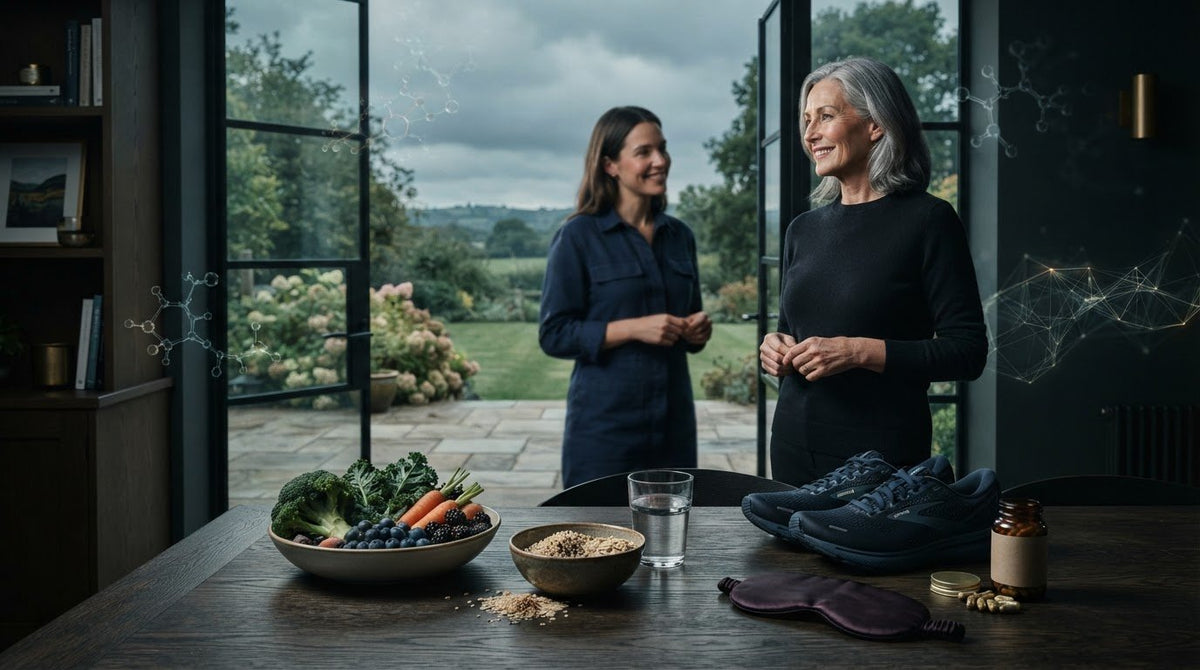
A holistic approach to healthy ageing is less about finding a single “longevity” solution and more about making supportive choices work together. If you’re unsure which habits matter, or whether supplements can genuinely help, that uncertainty is understandable. Energy, strength and independence can change with age, while bold claims often outpace evidence. Start with foundations you can build on, not a promise to stop time.
This guide covers how movement, nourishing food, restorative sleep, social connection and preventive healthcare can support wellbeing as you age. It also explains how to fit these habits into everyday routines and assess where carefully chosen supplements may have a place. Supplements are optional, not a replacement for foundational habits or medical care.
You’ll find practical ways to choose a manageable starting point, build a routine gradually and assess longevity claims with a clear head. Ageing brings real changes, but losing energy or independence isn’t an inevitable story with only one ending.
Key Takeaways
- A holistic approach to healthy ageing considers physical, mental and social wellbeing, while recognising that everyone’s experience is different.
- Ageing affects multiple body systems. Everyday habits can support general health, but they don’t stop the biological process.
- Prioritise sustainable foundations that suit your needs over restrictive routines or promises centred on a single ingredient.
- Build a routine gradually: notice your current habits, choose one manageable priority, then review and adapt it.
- Supplements are optional. Consider them thoughtfully and don’t treat them as a substitute for balanced habits or appropriate medical care.
What does a holistic approach to healthy ageing actually mean?
A holistic approach to healthy ageing supports physical, mental and social wellbeing over time, taking account of how these areas interact and of each person’s circumstances. It focuses on maintaining health and everyday function, rather than promising to stop, reverse or cure ageing. The broader idea of Healthy aging also recognises that wellbeing is shaped by more than one factor.
Ageing is not a single biological process that unfolds identically for everyone. Changes in strength, sleep, mood or energy can reflect a mix of influences, including health conditions, life experiences and the support available to you. If a habit is difficult to maintain, that isn’t a personal failure. It may be a sign that the approach needs adapting to your needs, rather than evidence that you lack motivation.
Which parts of health belong in a holistic approach?
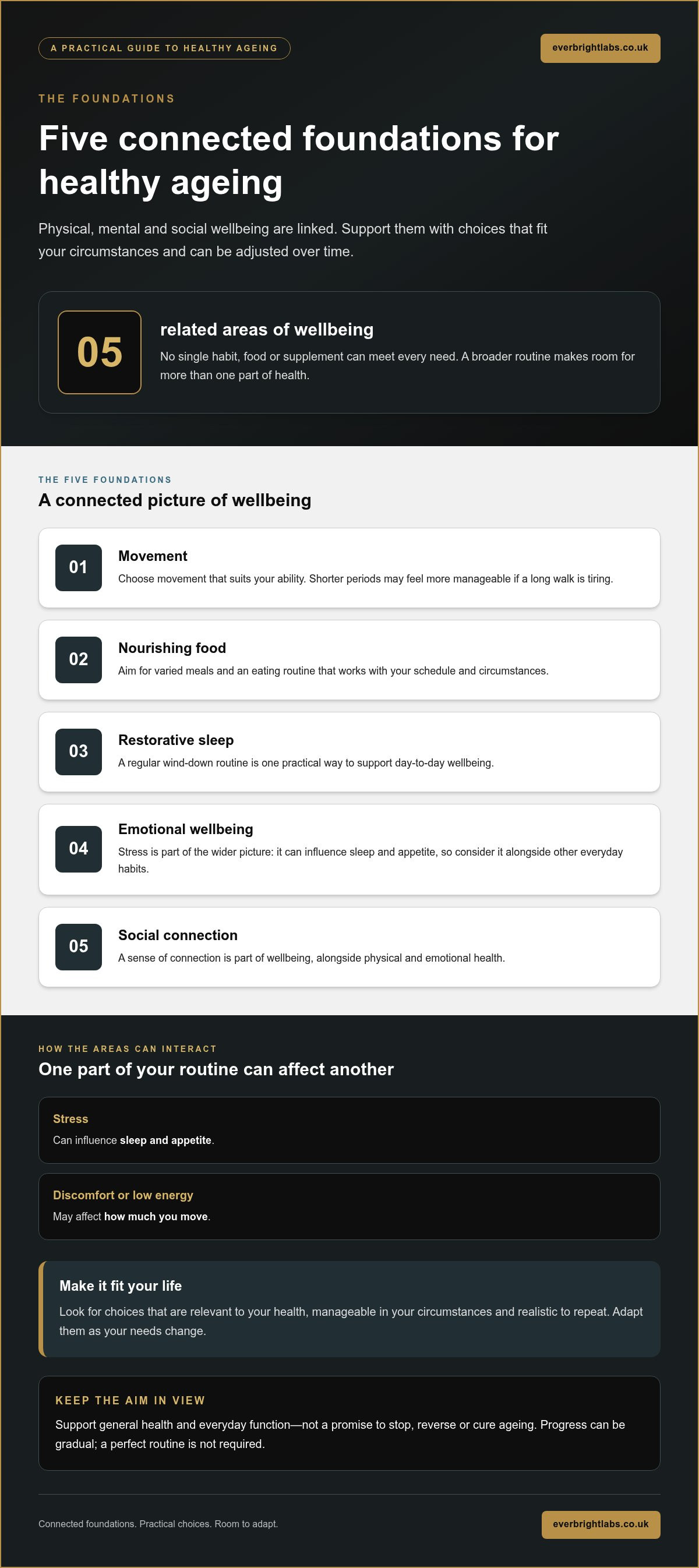
Movement, nutrition, sleep, emotional wellbeing and social connection are related parts of health. For example, discomfort or low energy may affect how much you move, whilst stress can influence sleep and appetite. Supporting one area may make it easier to care for another, but no single habit, food or supplement can meet every need.
What feels realistic depends on your circumstances, health conditions, ability, preferences and daily responsibilities. A routine that works for one person may not suit another. Look for choices that fit your life, can be repeated and can be adjusted as your needs change.
Healthy ageing is about function, not a perfect routine
Practical aims might include staying able to manage everyday tasks, doing activities that matter to you and maintaining a sense of connection and wellbeing. Progress can be gradual. You don’t need to overhaul your diet, exercise every day or follow a rigid programme to take a useful step.
For instance, if a long walk feels tiring, shorter periods of movement may be more manageable, depending on your energy and ability. If busy mornings make breakfast difficult, another eating routine that works with your schedule may be easier to sustain. Adapting your approach is part of making it realistic, not a compromise.
Healthy ageing is not a test of discipline or a promise of permanent vitality. It is an ongoing process of responding to changing needs, supporting the functions that matter to you and making practical choices without expecting perfection.
How ageing biology connects with everyday health habits
Ageing involves gradual changes across several body systems, including those involved in movement, metabolism, sleep and immune function. The pace and effects vary between people, shaped by factors such as biology, health conditions and life circumstances. This helps explain why two people of the same age may experience different levels of energy or physical capacity.
Daily routines can support general health and help maintain function, but they don’t switch off the biological processes of ageing. Think of the body as a network of connected systems: each has its own role, and the way they work together affects how well the whole network responds to everyday demands. Supporting basic needs such as movement, nourishment and rest can help maintain that broader foundation, without promising to change lifespan.
Cellular energy and the ageing process
Inside cells, mitochondria help convert nutrients into usable energy. NAD+ is a coenzyme, a molecule that helps other molecules carry out essential reactions, including processes involved in cellular energy metabolism. As a simple analogy, mitochondria are like local power stations, while NAD+ is part of the equipment involved in the energy system.
Scientists are studying how these processes change with age, but a plausible biological explanation is not proof that a supplement can reverse ageing or deliver a guaranteed outcome. Research into cellular mechanisms is different from evidence that a particular intervention improves health in people. For more information about the product, read about Timeless NAD+ Support.
Established health foundations are distinct from emerging longevity research: the former support general wellbeing, whilst the latter is still investigating mechanisms and possible interventions.
Why everyday patterns matter more than isolated interventions
Activity, food, sleep and ways of managing stress are complementary parts of a wider routine. Choosing movement that suits your ability, eating varied meals and keeping a regular wind-down routine are practical examples of habits that may support day-to-day wellbeing. They are not guaranteed to alter lifespan, and no single food or supplement can stand in for the wider pattern.
A holistic approach to healthy ageing puts these connected foundations into context. Your routine should be practical for your circumstances, not built around a single cellular pathway or trend. If you’re curious about supplements, consider them optional support within that bigger picture, rather than a shortcut around everyday health habits.
Which healthy-ageing habits deserve attention first?
Start with what is relevant to your health, manageable in your circumstances and realistic to repeat. The best first step isn’t necessarily the most ambitious one. A demanding routine may be hard to sustain, whilst a small adjustment that fits your day can become part of ordinary life. A holistic approach to healthy ageing favours steady foundations over restrictive protocols, trend-led plans or promises built around a single ingredient.
Use this comparison to choose a possible starting point. What is accessible and sustainable depends on your ability, preferences, health needs and daily routine.
Movement, balanced nutrition and sleep
Movement doesn’t have to mean a fixed exercise plan. Walking, chair-based activity or other forms of motion may suit different people; ability and existing conditions matter. Balanced eating is a pattern, not a checklist of supposedly age-defying foods. A sleep routine, such as allowing time to wind down, may support rest. Persistent sleep concerns deserve proper attention rather than being treated as a habit problem alone.
Mental wellbeing, connection and preventive care
Emotional wellbeing and social connection belong alongside physical health. A regular conversation, shared activity or another form of contact that matters to you can be a practical way to nurture connection. There’s no single right format.
Keep appropriate routine health appointments and raise new or ongoing concerns with a clinician. Medical needs, prescribed care or changes in ability may make clinical advice the priority before adjusting activity, food or supplements. Let your health needs guide your first step, rather than following a routine designed for everyone.
How to build a realistic healthy-ageing routine step by step
A routine is more useful when it fits your actual life than when it looks perfect on paper. Start with what you already do, then make one change small enough to repeat. This keeps a holistic approach to healthy ageing practical, while leaving room to adapt as your health, energy or responsibilities change.
Use this sequence to get started:
- Notice your current routines. Look at a typical day and identify existing patterns around movement, meals, sleep, social contact and appointments. Notice what feels supportive and what gets in the way, without judging yourself.
- Choose one relevant priority. Pick an area that matters to your wellbeing and feels realistic to work on. If a health condition or new symptom is affecting your options, seek clinical advice before making a change that could affect your care.
- Make the action manageable. Turn the priority into a specific action that fits your schedule and ability. For example, you might prepare a straightforward meal in advance or set aside time for a relaxing activity before bed.
- Plan for changes in capacity. Decide how you’ll scale the action down or pause it if your energy, symptoms or responsibilities change. Flexibility helps prevent an interrupted routine from feeling like failure.
- Review and adjust. Choose a realistic time to reflect on whether the action is manageable and how you feel day to day. Keep it, adapt it or choose another priority based on what you learn.
Start with one change you can repeat
Ask yourself: “What feels both useful and achievable this week?” A modest action that fits around work, caring responsibilities or fluctuating energy is often easier to maintain than a sudden overhaul of diet and activity. If a plan becomes uncomfortable or hard to manage, adjust it. The aim is a workable routine, not strict adherence to a target that doesn’t suit you.
Review progress without chasing perfection
Track behaviour and everyday experience rather than expecting a particular weight or biological-age result. A brief note can capture whether you followed your chosen action, how manageable it felt and any changes in mood, energy or sleep. These personal observations can help you decide what to do next, but they aren’t a clinical assessment.
Measurements and test results need appropriate professional interpretation. Speak with a clinician about persistent, new or concerning changes, and don’t use a routine or supplement in place of prescribed care. If you’re exploring optional supplement support alongside your habits, discover Everbright Labs’ approach.
Where supplements fit into a holistic approach to healthy ageing
Supplements are an optional part of a wider plan, not a substitute for balanced habits, prescribed care or appropriate medical advice. A biological rationale may explain why an ingredient is being studied, but it doesn’t establish that a supplement will deliver a particular outcome for you. Evidence varies, and claims about cellular processes shouldn’t be confused with proof of guaranteed health benefits.
How to assess a supplement claim responsibly
Look beyond the headline. Check whether the ingredients are clearly disclosed, what kind of evidence supports the claim and what that evidence can and can’t show. Research into a mechanism is not the same as evidence of a meaningful result in people. Be cautious of promises to reverse ageing or replace established care.
Suitability also depends on the person. Medicines, health conditions and other individual circumstances can affect whether a supplement is appropriate. If you take medicines, have a health condition or are unsure, discuss supplement use with your GP or pharmacist. Don’t stop or change prescribed treatment because of a supplement claim.
Considering cellular-health support within the bigger picture
Some people explore supplements aimed at cellular processes as one optional element of their wellbeing routine. Timeless NAD+ Support is Everbright Labs’ product for cellular energy support. Consider it in context: it doesn’t replace foundational habits or medical care, and its description isn’t a promise of a clinical outcome.
Everbright Labs’ formulations are stimulant-free and use fully disclosed ingredients. They’re manufactured in UK facilities certified to GMP and HACCP standards. The company was founded and its products formulated by a Chemical Engineer and an Applied Biologist. These details describe the brand’s science-led approach, but manufacturing standards and scientific rationale don’t guarantee an individual result.
For more background on broader strategies, read the healthy-ageing longevity protocol. To explore the products, including Timeless NAD+ Support and the Fat Metaboliser, visit Everbright Labs and consider whether they fit your wider wellbeing routine.
Take your next step towards ageing well
A holistic approach to healthy ageing isn’t a search for one perfect habit or a way to stop biological ageing. It means supporting physical, mental and social wellbeing with choices that fit your health, ability and everyday life. Consistent foundations matter more than restrictive routines, and a small action you can sustain is a useful place to begin.
Supplements remain optional. Consider the evidence and your circumstances, and don’t use them instead of appropriate medical care. Everbright Labs’ formulations are developed by a Chemical Engineer and an Applied Biologist, with fully disclosed ingredients and stimulant-free formulations. They’re manufactured in UK facilities certified to GMP and HACCP standards.
To explore optional supplement support, discover Everbright Labs’ science-led supplements, including the Fat Metaboliser and Timeless NAD+ Support. Choose a manageable next step, adapt as your needs change and give yourself credit for each practical step forward.
Frequently Asked Questions
What is a holistic approach to healthy ageing?
A holistic approach to healthy ageing supports physical, mental and social wellbeing together over time. It recognises that movement, nutrition, sleep, emotional health, relationships and preventive care can all contribute to wellbeing, while each person’s needs and circumstances differ. The aim is to support everyday function and quality of life, not to stop, reverse or cure ageing. A useful routine is one that can adapt as your health and priorities change.
Can lifestyle changes slow the ageing process?
Lifestyle changes can support general health and everyday function, but they can’t be promised to halt or reverse biological ageing. Ageing involves changes across multiple body systems, and these vary between individuals. Habits such as movement suited to your ability, balanced eating, adequate rest and social connection are supportive foundations. Treat claims that a specific routine or product can dramatically alter biological age with care, especially when evidence for the promised outcome is unclear.
Which habits matter most for healthy ageing?
The most useful habits are those that support your health and that you can realistically sustain. Consider movement that fits your ability, a varied and balanced eating pattern, a consistent sleep routine and meaningful contact with others. Keep appropriate routine health appointments, too. There isn’t one habit that works for everyone, and no single food or supplement can replace these broader foundations. Existing conditions and personal priorities may affect what makes sense to address first.
Is it too late to improve health as I get older?
No. It’s possible to make supportive changes at different stages of life, although the right approach depends on your health, ability and circumstances. You don’t need a complete lifestyle overhaul: choose one manageable action, such as adding a suitable form of movement or making time for a regular wind-down routine. Progress needn’t be perfect to be worthwhile. If a health condition affects what you can safely do, discuss suitable adjustments with a clinician.
Do supplements support healthy ageing?
Supplements may be an optional part of a wider wellbeing routine, but they shouldn’t replace balanced habits, prescribed treatment or appropriate medical care. A proposed biological mechanism doesn’t prove a supplement will deliver a specific outcome. Check that ingredients and claims are clearly disclosed, and consider the quality and limits of the evidence. Medicines, health conditions and individual circumstances can affect suitability, so speak with a GP or pharmacist if you’re unsure.
What is the role of NAD+ in healthy ageing?
NAD+ is a coenzyme, a molecule that helps other molecules carry out essential reactions, including processes involved in cellular energy metabolism. Researchers study how NAD+ and related cellular processes change with age. That scientific interest doesn’t show that a supplement can reverse ageing or guarantee a health benefit. If you’re considering NAD+ support, treat it as an optional choice and look at the evidence and your personal circumstances rather than relying on mechanism alone.
When should I speak to a healthcare professional about changes in my health?
Speak with a healthcare professional about changes that are new, persistent, worsening or concerning to you, particularly if they affect daily activities. A GP can help assess symptoms and advise on next steps; a pharmacist can discuss questions about medicines and supplement suitability. Don’t assume a change is simply part of ageing or try to manage it with supplements alone. For a sudden or severe problem, seek urgent medical help through the appropriate NHS service.
Share:
UK Long-Term Health Supplements: Science-Led Buying Guide
How to Improve Insulin Sensitivity with Supplements: An Evidence-Led Guide