


What if the best supplement for long-term health is the one with the clearest reason to take it, rather than the boldest promise? Conflicting claims can make it difficult to judge what is evidence-led, suitable for regular use or relevant to your needs. Choosing supplements for long term health uk readers can feel confident about starts with asking what a product contains, what it is intended to support and whether that purpose fits your circumstances.
This guide offers a practical way to compare evidence, ingredient transparency, product quality and suitability over time. It also explains when to seek advice from a GP or pharmacist, particularly if you have a health condition, take medication or are considering ongoing use.
We’ll look at how to approach metabolic and cellular-health goals without treating supplements as guaranteed solutions. Everbright Labs’ Fat Metaboliser and Timeless NAD+ Support are examples of products positioned around those interests. Both have fully disclosed ingredients and are manufactured in UK facilities certified to GMP and HACCP standards. The aim is to help you make a considered choice, not add another promise to the pile.
Key Takeaways
- Start with a specific health goal and consider whether your diet and circumstances suggest a supplement is relevant.
- Use a label checklist: identify the ingredients, quantities, intended use and serving directions before comparing products.
- Fully disclosed formulations make it easier to assess what you would be taking over time.
- Compare supplements for long term health uk options by personal goal, evidence and relevant cautions, rather than assuming one category suits everyone.
- Build a regular-use routine around your needs, review whether it still fits over time and seek clinical advice when your circumstances call for it.
What should UK long-term health supplements actually do?
A food supplement is intended to add to your diet, not replace a varied diet or the nutrients and other benefits it provides. It may contain nutrients or other substances, but taking one does not guarantee better health. If you’re considering supplements for long term health uk, ask whether a particular formulation supports a relevant personal goal, taking your diet and health circumstances into account. For a general overview, see what a dietary supplement is.
Long-term use describes a pattern of taking a supplement over time. It does not mean a product can prevent ageing, disease or an inevitable decline in health. A supplement may help address a defined nutritional or wellbeing need, but its suitability depends on the ingredients, amounts, intended use and the person taking it.
How to set a realistic goal before choosing a supplement
Begin with a specific question, not a sweeping promise. “Could this support a goal that matters to me?” is more useful than “Will this provide complete longevity support?” Consider your usual diet, lifestyle and health circumstances, and whether you have a defined need. Supplements should sit alongside the foundations of wellbeing, including nutritious food, sleep and regular physical activity, rather than replace them.
Without a clear goal, it is harder to judge whether a product is relevant or whether continuing to take it makes sense. A specific purpose gives you a basis for comparing formulations and reviewing your choice later.
What evidence can and cannot tell you
Evidence about an ingredient does not automatically apply to every finished product containing it. Research may involve a particular form, amount, population or context. A product’s formulation and labelled use may differ, so consider whether available evidence relates to the product as it is presented. An ingredient name or broad marketing claim alone is not enough.
Even relevant study findings cannot guarantee an individual result. People’s diets, health circumstances and responses differ. Treat claims of dramatic or certain outcomes cautiously, and remember that a supplement is not a treatment for illness. The wording of a specific health claim matters as well as the research behind its ingredients.
Long-term use is most sensible when there is a defined reason, the formulation is understandable and the choice remains appropriate for your circumstances. That is a more grounded starting point than expecting a supplement to secure a particular future.
How to assess supplement evidence, ingredients and quality in the UK
A careful label review turns a broad health claim into practical questions: what is in the product, how much does it contain and how is it intended to be used? For supplements for long term health uk, transparency helps you compare a formulation with its stated purpose and decide whether it fits your circumstances.
Which supplement label details deserve close attention?
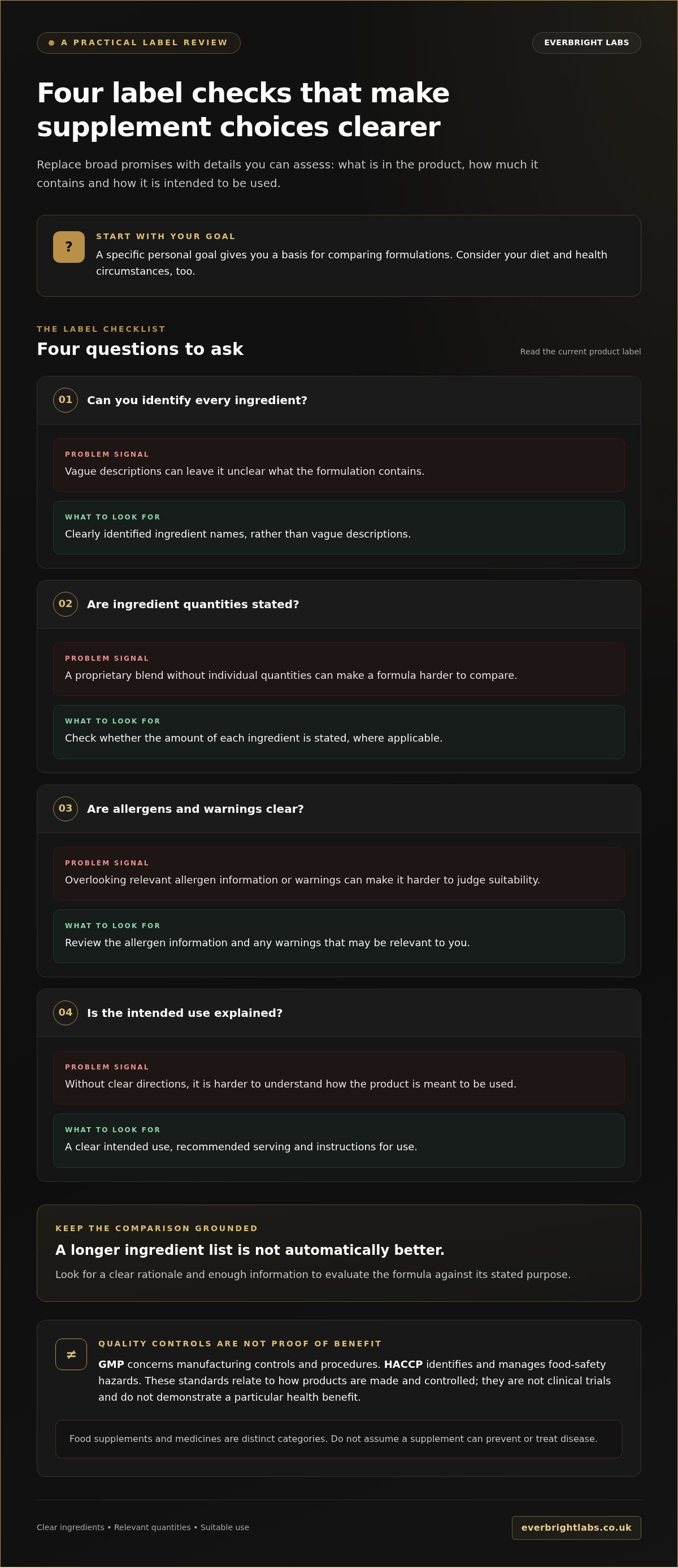
Read the current product label rather than relying on an advert or an ingredient list copied elsewhere. Check:
- Ingredient names: Look for clearly identified ingredients, not vague descriptions.
- Quantities: Check whether the amount of each ingredient is stated, where applicable.
- Allergens: Review allergen information and any relevant warnings.
- Intended use and directions: Look for a clear recommended serving and instructions for use.
A proprietary blend that lists ingredients without individual quantities can make it difficult to compare formulations or understand how much of each component a serving provides. A long ingredient list is not automatically better. Look for a clear rationale and enough information to evaluate the formula. For general context on nutrients and their roles, consult NHS guidance on vitamins and minerals.
What UK manufacturing and quality standards mean
Good Manufacturing Practice (GMP) concerns the controls and procedures used in manufacturing. Hazard Analysis and Critical Control Points (HACCP) is a system for identifying and managing food-safety hazards. These standards relate to how products are made and controlled. They are not clinical trials and do not demonstrate that a supplement delivers a particular health benefit.
Manufacturing standards can support confidence in production controls, but they are not proof of a health benefit. Quality and efficacy are separate considerations. Both matter, but one does not establish the other.
Food supplements and medicines are distinct categories. Do not interpret a supplement as a medicine or assume it can prevent or treat disease. Specific health claims should use appropriate wording for the product and its ingredients.
Everbright Labs products are manufactured in UK facilities certified to GMP and HACCP standards, with fully disclosed ingredients. To see how ingredient transparency applies to a specific formulation, explore the Fat Metaboliser formulation and compare its label details with your goal.
How do long-term health supplements compare by personal goal?
Compare products by the goal they are intended to support, the information available about their ingredients and quantities, and how well the evidence relates to their labelled use. This makes supplements for long term health uk easier to assess without assuming everyone needs one. The table is a starting point, not a recommendation to supplement.
| Personal goal | What to compare | Evidence and cautions |
|---|---|---|
| Metabolic support | Check the full ingredient list, stated quantities and the formulation’s intended purpose. | Look for evidence relevant to the actual ingredients and labelled use. Do not interpret a support claim as a promise of weight change or disease prevention. |
| Cellular energy or healthy ageing interests | Assess whether the product explains its formulation clearly and whether its stated purpose matches your personal goal. | Broad longevity language is not proof of a particular outcome. Consider the evidence for the finished product and use caution with claims of guaranteed effects. |
| General nutritional intake | Compare the nutrients and amounts with your diet and any identified need. | A supplement may be unnecessary if your needs are already met through food. Consider your personal circumstances and relevant clinical advice. |
Metabolic support and cellular-health interests are different goals
Metabolic support and interest in cellular energy or healthy ageing are distinct reasons to compare products. Do not assume one formulation addresses both. Fat Metaboliser is positioned for metabolic support, but that positioning does not guarantee a particular result. Assess the product’s ingredient information in relation to your goal and the evidence for its labelled use.
Cellular-health interests call for their own assessment. A product’s name or broad positioning cannot establish what it will do for an individual. Check its disclosed formulation and do not treat support for a goal as a promise to prevent ageing or illness.
When is a bundle worth comparing with individual products?
A bundle may be convenient to compare when its products match more than one relevant goal. Review each product’s ingredients and quantities, consider any overlap and decide whether taking multiple formulations suits your needs. A bundle is not automatically more effective or appropriate than one product. If only one product fits your goal, comparing individual products may be clearer.
What to check before taking a supplement regularly
Regular use calls for a deliberate review, not a guess about what might help. Use this sequence before starting:
- Define your goal. Be specific about what you want the supplement to support.
- Review the current label. Check the ingredients, quantities, allergens, serving directions and warnings.
- Consider your circumstances. Take account of your diet, health conditions, medicines and life stage.
- Monitor and review. Note relevant changes and revisit whether the product still fits your original goal.
There is no universal duration or cycling schedule that applies to every supplement. Follow the product’s directions and seek appropriate advice if you are unsure whether ongoing use is suitable.
How to consider medicines, health conditions and life stages
Ingredients can affect people differently, and suitability may depend on your health and other products you take. If you have a health condition or use medicines, speak with your GP or pharmacist before starting a supplement regularly. They can help consider potential interactions and whether the product is appropriate for your circumstances.
Take particular care during pregnancy or whilst breastfeeding. Do not assume a supplement is suitable during these life stages. Seek guidance from a GP, midwife or pharmacist before use.
How to review whether a supplement still fits
Return to your original goal and check the label again if the product or your circumstances change. You could keep a simple note of relevant, observable changes, such as shifts in your routine or how you feel. This can help structure a review, but a change after starting a supplement does not prove the supplement caused it.
Stop taking the supplement and seek suitable professional advice if you develop new symptoms or have concerns about its effects. Do not use it to delay care for a health problem. If your interest relates to NAD+ or cellular vitality, read more about NAD+ and cellular vitality, while remembering that symptoms alone cannot establish a specific cause.
For an example of a product positioned around cellular energy and healthy ageing, review Timeless NAD+ Support alongside its current label and your personal circumstances.
How Everbright Labs approaches supplements for long-term health
Everbright Labs’ approach draws on its founders’ backgrounds as a Chemical Engineer and an Applied Biologist. This science-led perspective focuses on formulation rationale and clear ingredient information, giving you a practical basis for deciding whether a supplement aligns with your goals. For supplements for long term health uk, clarity matters: a product should be something you can assess, not a promise of a guaranteed outcome.
A transparent approach to formulation and manufacturing
Everbright Labs uses fully disclosed ingredients and stimulant-free formulations. Seeing what a product contains helps you review its label and decide whether the formulation is relevant to your intended use. It also makes comparisons more meaningful than a blend that obscures ingredient quantities.
The products are manufactured in UK facilities certified to GMP and HACCP standards. These credentials relate to manufacturing and food-safety processes. They are not clinical evidence that a product will produce a particular health benefit. Quality controls and evidence for an intended benefit are separate considerations, and neither is a guarantee.
Explore products by the health goal you want to support
Timeless NAD+ Support is positioned around cellular energy and healthy ageing, while Fat Metaboliser is positioned for metabolic support. These are different areas of interest, not interchangeable goals. Neither positioning guarantees an individual result or means that a supplement can prevent or treat disease.
Review the current product label, consider how its stated purpose relates to your goal and take your personal circumstances into account. You do not need to choose a supplement simply because it addresses a popular health topic. A suitable choice starts with relevance to you.
Explore Everbright Labs supplements and compare the disclosed formulations with your goals. Use the information to decide whether a product fits, rather than treating a broad health claim as a promise.
Choose a supplement with a clear purpose
Choosing supplements for long term health uk starts with a personal goal, not a sweeping promise. Check the ingredients, quantities and directions, then consider how the evidence relates to the finished product and its intended use. A transparent label helps you make that assessment, while manufacturing standards provide information about production, not proof of a health outcome.
Before taking a supplement regularly, consider your health circumstances and medicines. If you have a condition, take medication, are pregnant or breastfeeding, seek appropriate clinical advice. Review your choice over time, and do not treat a supplement as a replacement for the foundations of wellbeing or care for a health concern.
Everbright Labs’ formulations are developed by a Chemical Engineer and an Applied Biologist, use fully disclosed ingredients and are stimulant-free. They are manufactured in UK facilities certified to GMP and HACCP standards. These details can help you assess the approach behind the products while keeping your decision centred on suitability.
Explore the Everbright Labs supplement range and compare the formulations with your goals. Start with the product that best matches a clear purpose.
Frequently Asked Questions
Is it safe to take supplements for long-term health?
It depends on the supplement, its ingredients, serving directions and your personal circumstances. Being sold as a food supplement does not automatically make a product suitable for indefinite use. Read the label, consider any health conditions or medicines, and ask a GP or pharmacist for advice if these may affect your choice. Review your reason for taking it periodically rather than assuming you need to continue indefinitely.
Which supplements are best for long-term health in the UK?
There is no single best supplement for everyone. The right choice depends on your goal, diet, health circumstances and the evidence for the specific ingredients and finished product. For supplements for long term health uk, compare clear labels and realistic claims rather than choosing a broad formula simply because it promises comprehensive wellbeing. Supplements should complement health-supporting habits, such as a varied diet, and appropriate clinical care, not replace them.
Can you take more than one supplement at the same time?
Some people take more than one supplement, but combining products can duplicate ingredients or raise suitability concerns. Compare their labels for overlapping ingredients and follow each product’s serving directions. If you take medicines, have a health condition, are pregnant or breastfeeding, ask a GP or pharmacist for individual advice before combining products. Taking a larger number of supplements does not automatically mean greater benefits, so base each choice on a clear purpose.
How do I know whether a supplement is evidence-based?
Look for clearly named ingredients, disclosed quantities and a formulation rationale that relates to your goal. Check whether research concerns an ingredient or the finished product used as labelled. Study findings do not guarantee your individual result. Transparent labelling and manufacturing standards can help you assess a product, but they do not prove effectiveness. Be cautious of dramatic promises, especially claims that a supplement can prevent or cure disease.
Are UK-made supplements automatically safer or more effective?
No. UK manufacture tells you where a product is made, and standards such as GMP and HACCP relate to manufacturing controls. Neither UK origin nor certification alone proves that a supplement will benefit you or is suitable for your circumstances. Assess the actual ingredients, quantities, intended use and supporting evidence. Then consider your diet, health conditions and medicines before deciding whether the product is appropriate for you.
Should I speak to a GP or pharmacist before taking a supplement?
It is sensible to seek advice if you take medicines, have a health condition, are pregnant or breastfeeding, or are unsure whether an ingredient is suitable for you. A GP or pharmacist can consider your circumstances and potential interactions. If you experience unexpected symptoms or have concerns after starting a supplement, seek appropriate professional advice rather than increasing the serving or adding another product.
Do supplements replace a healthy diet or medical treatment?
No. Food supplements are intended to supplement the diet, not replace a varied diet or prescribed treatment. If you have symptoms or a diagnosed condition, discuss appropriate care with a qualified health professional. A supplement may be one part of a wider approach to wellbeing when there is a clear, realistic reason to use it, but it should not be treated as a substitute for health-supporting habits or clinical care.
Share:
Cellular Rejuvenation Supplements: What Does the Science Actually Say?
A Holistic Approach to Healthy Ageing: A Practical, Science-Led Guide