


The most credible alternative to a prescription weight-loss drug may not be another medicine or a supplement. For some people, structured support with eating habits, activity and behaviour is a sensible starting point. For others, a GP can help assess whether clinical treatment is appropriate. If you’re searching for alternatives to prescription weight loss drugs uk, it’s understandable to want clear answers about suitability, access and possible effects, especially when supplement claims can sound like medical promises.
Non-prescription approaches may offer support, but they don’t work in the same way as prescription medicines, and results vary. Judge supplements by their evidence and transparent claims, not by suggestions that they’re a “natural” equivalent. There’s no single route that suits everyone, and needing more support isn’t a personal failure.
This guide compares lifestyle-based and clinically supervised options, explains where pharmacy medicines and supplements fit, and sets out their limitations. It also outlines what to discuss with a GP or another qualified healthcare professional, so you can choose a realistic next step rather than relying on a shortcut or unsupported promise.
Key Takeaways
- Understand what counts as alternatives to prescription weight loss drugs uk, from clinician-led support to non-prescription products.
- Compare options by evidence, supervision, potential risks and the ongoing commitment they may involve.
- Learn what health details and questions to prepare before discussing weight-management support with a healthcare professional.
- Assess supplement claims carefully and consider products only as optional support, not as substitutes for prescribed treatment or clinical care.
- Use current NHS or national health-service guidance to check which pathways may be appropriate for your circumstances.
Alternatives to prescription weight loss drugs in the UK: what counts?
Questions about whether a medicine is suitable, how to access it, or what side effects it may cause are reasonable. You may also prefer to explore support that doesn’t involve medication. The phrase alternatives to prescription weight loss drugs uk can refer to several different approaches, but they aren’t interchangeable or equally effective.
What does “alternative” mean in weight-management care?
An alternative might be a different prescribed medicine or a route that doesn’t use medication. The broader picture includes clinician-led care, behavioural and lifestyle programmes, specialist procedures, and non-prescription products such as supplements. These options differ in clinical oversight, evidence, monitoring and purpose. A neutral overview of weight management techniques can help clarify how different strategies may support weight loss or weight maintenance.
A genuine alternative is a different support pathway, not a promise of the same results as a prescribed medicine. A supplement is not an evidence-equivalent substitute for prescription treatment. Retail products don’t replace clinical assessment or the monitoring that may be needed with medical treatment.
The right route depends on your health history, current medicines, goals and individual clinical assessment. Behavioural support may focus on sustainable changes to eating, activity and habits. Procedures require specialist evaluation. A healthcare professional can help you understand which options are appropriate to discuss.
Why prescription medicines are not suitable for everyone
Weight-management medicines have specific eligibility criteria and may not be appropriate because of someone’s health conditions, other medicines, potential contraindications or individual circumstances. Treatment may involve checks and follow-up to assess effects, tolerability and whether it remains suitable. People also respond differently, so a medicine that helps one person may not be right for another.
This doesn’t mean everyone should take medication or that everyone should avoid it. Decisions belong in a discussion with a qualified healthcare professional, who can consider potential benefits and risks alongside your medical history. Don’t start, stop or change prescribed treatment based only on supplement marketing or general information.
Access and referral routes aren’t identical across the UK. NHS pathways and eligibility can differ between England, Scotland, Wales and Northern Ireland, and may change as guidance is updated. Check current information from the relevant national health service or speak with your GP rather than assuming a route available in one nation applies elsewhere. A useful first step is to clarify what kind of support you’re seeking, then ask which options fit your circumstances.
How UK weight-loss alternatives differ from prescription medicines
The key difference isn’t simply whether an option is a medicine. Consider the level of clinical oversight, the evidence behind its intended use, and how suitability and progress are assessed. NICE guidance sets out evidence-based approaches to obesity care, including assessment and when treatment may be considered. Its guidance on obesity is a useful reference, although local NHS pathways and access can differ across England, Scotland, Wales and Northern Ireland.
Clinician-led and behavioural support
A GP discussion can help identify relevant health factors and whether further assessment or specialist referral may be appropriate. Structured weight-management support can address eating patterns, physical activity and behaviour over time. This is active care, not simply advice to “try harder”, but it isn’t a guaranteed substitute for the effects of a medicine. Availability, referral criteria and the support offered vary by nation and service. For related reading, see Weight Management Without Stimulants: A Safer Approach.
GLP-1 medicines, including semaglutide and tirzepatide, are prescription treatments. They act on pathways involved in appetite and are considered within clinical guidance for people who meet relevant criteria. They require assessment and may need monitoring. They aren’t suitable for everyone, and individual responses can differ. A clinician can explain whether a medicine is appropriate, what follow-up involves and what other care should accompany it.
Supplements and other non-prescription options
Supplements sit in a different category. Consider evidence ingredient by ingredient rather than assuming it applies to an entire product category. For example, glucomannan has an authorised weight-loss health claim only under specified conditions. That doesn’t make it equivalent to a prescription medicine. Treat claims that a supplement is “natural Ozempic” with particular caution: ingredients such as berberine don’t work in the same way as GLP-1 medicines.
Check whether a product clearly discloses its ingredients and serving information. Ask a pharmacist or clinician about suitability, particularly if you take prescribed medicines or have a health condition, as supplements can have potential interactions. A more detailed evaluation is available in Effective Fat Metaboliser Supplements UK.
Everbright Labs’ Fat Metaboliser is a stimulant-free supplement, not a prescription treatment or replacement for clinical care. If you’re considering it as optional support within a broader approach, review the Fat Metaboliser product information and discuss any suitability concerns with a healthcare professional. To compare alternatives to prescription weight loss drugs uk responsibly, separate clinical treatments from behavioural support and retail products, then weigh each option against your needs and health history.
Compare weight-management options against your needs and health history
There’s no universally best route. Compare how much clinical oversight each option involves, what evidence supports its intended role, what risks or commitments may apply, and whether it fits your health needs. This overview can help you prepare, but it can’t determine personal suitability.
| Option | Supervision and evidence | Risks, commitment and suitability |
|---|---|---|
| Clinical support | Assessment and follow-up by a GP or specialist; treatment is selected according to clinical guidance and individual circumstances. | May involve checks and ongoing monitoring. Suitability depends on health history, medicines and treatment criteria. |
| Behavioural programmes | Structured support for habits, eating patterns and activity; approach and evidence vary by programme. | Requires sustained participation. A programme can support change, but isn’t a guaranteed substitute for medicine. |
| Procedures | Considered and delivered through specialist assessment and care. | May involve significant risks, follow-up and long-term changes. Not a self-directed alternative; discuss eligibility and implications with a specialist. |
| Supplements | Evidence depends on the specific ingredient and claim; retail products don’t provide the clinical oversight of prescribed treatment. | Check ingredients, serving directions and possible interactions. They may not be suitable for everyone and shouldn’t replace prescribed care. |
Questions to ask before choosing an approach
Prepare a clear picture of your circumstances before speaking with a professional. Note your health history, current medicines and supplements, goals, and approaches you’ve already tried. Ask what monitoring would involve, which risks matter in your case, how progress will be reviewed, and what happens if treatment needs to change. For general NHS information, see its advice on managing your weight. When assessing a supplement, check that the label clearly identifies its ingredients and directions. You can also review the Fat Metaboliser product information.
When to speak to a GP or qualified professional
Ask a GP, pharmacist or other qualified healthcare professional before changing prescribed treatment or starting a supplement, particularly if you take other medicines or have a health condition. Seek prompt medical help for symptoms that concern you; don’t rely on an online article to interpret them. Online information can help you prepare questions, but it can’t establish eligibility or replace an individual clinical assessment. Use that conversation to compare the alternatives to prescription weight loss drugs uk in the context of your health, rather than choosing by headline claims alone.
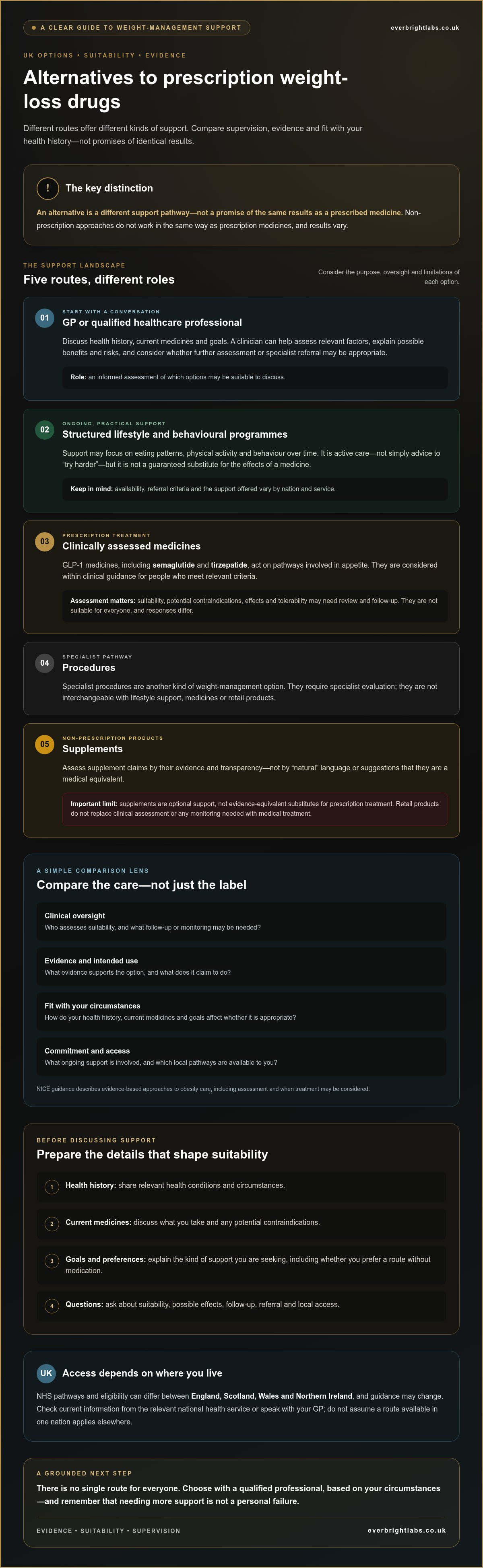
Plan your next steps: a UK checklist for discussing weight-loss support
A prepared conversation can help turn uncertainty into a practical plan. Before deciding, gather the information a healthcare professional needs to assess your circumstances and explain suitable options. NHS pathways and eligibility can vary across the UK, so check current guidance from the health service for your nation rather than relying on outdated or general advice.
Prepare for a healthcare conversation
Use this sequence to organise your thoughts before an appointment with a GP, pharmacist or other qualified professional:
- 1. Set out your goals. Note what you hope to improve and what kind of support you’re looking for, including whether you’d prefer to discuss options that don’t involve medication.
- 2. Record your health history. List relevant conditions, previous weight-management approaches and any concerns about side effects or access.
- 3. Bring a complete medicines list. Include prescribed medicines and supplements, with doses if you know them. Don’t stop or alter prescribed treatment without advice from your prescriber.
- 4. Write down questions. Ask which options may be suitable, what monitoring they involve, what risks to consider and what support is available if a treatment isn’t appropriate or needs to change.
- 5. Agree the next step. Clarify who to contact, when progress will be reviewed and what to do if you experience concerning symptoms.
Set realistic measures of progress
Weight may be one measure, but it needn’t be the only one. Discuss appropriate ways to track progress with your healthcare professional, such as changes to sustainable habits, activity or wellbeing, alongside any clinical measures relevant to you. Agree how often to review these measures and what would prompt a change in the plan.
There’s no single timeline or outcome that applies to everyone. Response depends on the approach and individual circumstances, so be wary of claims promising a particular rate of weight loss. For balanced public guidance, read the NHS information on managing your weight, then confirm local pathways with the relevant national health service or a healthcare professional.
This framework can help you assess the alternatives to prescription weight loss drugs uk in light of your health history, rather than choosing based on bold claims. Supplements are optional products, not a replacement for prescribed treatment or clinical care. If you’re considering one as a small part of a wider approach, you can explore Everbright Labs’ transparent supplement approach and review product information carefully before deciding.
Where a stimulant-free supplement may fit alongside wider support
A supplement may be something an adult chooses to consider within a broader approach to weight management, but it isn’t a prescription alternative or a stand-alone treatment. “Stimulant-free” describes a product’s positioning, not proof that it causes weight loss or is suitable for everyone. Assess evidence for any proposed effect ingredient by ingredient. A biological mechanism alone doesn’t establish a meaningful outcome for people.
How to assess a supplement responsibly
Before considering a product, read its current label and check:
- Ingredients and amounts: Look for clear disclosure of what’s included and how much per serving.
- Directions and warnings: Follow the label, and don’t assume a product is risk-free because it’s sold without a prescription.
- Suitability and interactions: Ask a pharmacist or another qualified healthcare professional if you take medicines, have a health condition, or are unsure whether it’s appropriate for you.
- Evidence and claims: Check what research supports each ingredient and whether a claim is relevant to the product and its stated use. Promises of results equivalent to GLP-1 medicines are a reason to be cautious.
These checks help separate transparent product information from claims that go beyond the evidence. A supplement shouldn’t delay a conversation with a healthcare professional or replace prescribed treatment.
A measured next step with Everbright Labs
Everbright Labs sells supplements, not prescription weight-loss medicines or in-person nutritional coaching. The company describes Fat Metaboliser as stimulant-free and says its ingredients are fully disclosed. Its products are manufactured in GMP and HACCP certified UK facilities. Everbright Labs was founded and formulated by a Chemical Engineer and an Applied Biologist. These details provide context about the company and its approach; they aren’t proof that a supplement produces a particular clinical outcome.
If you’re weighing up alternatives to prescription weight loss drugs uk, keep clinical advice and your individual health needs at the centre of the decision. Fat Metaboliser is optional and shouldn’t be treated as equivalent to medicine or as a substitute for care. Review the Fat Metaboliser product information for its current label details, then discuss suitability with a qualified healthcare professional if you have questions.
Choose your next step with confidence
The right approach to weight management depends on your health history, goals and clinical needs. Compare options by their evidence, supervision, risks and ongoing commitment, and speak with a GP or qualified healthcare professional before changing prescribed treatment or adding a supplement. NHS pathways can vary across the UK, so check current guidance for your nation.
Supplements may be an optional part of wider support, but they aren’t substitutes for prescription medicines or clinical care. If you’re considering alternatives to prescription weight loss drugs uk, prioritise clear information and realistic expectations over promises of equivalent results.
Everbright Labs was founded and formulated by a Chemical Engineer and an Applied Biologist. The company states that its products are made in GMP and HACCP certified UK facilities, with fully disclosed ingredients and stimulant-free positioning. Check current product-label details, and ask a healthcare professional about suitability if you’re unsure.
Explore Everbright Labs’ stimulant-free supplement information as an optional resource. For product details, review the current label and speak with a healthcare professional if you have questions about suitability.
Frequently Asked Questions
Are there alternatives to prescription weight loss drugs in the UK?
Yes. Options may include structured behavioural or nutrition support, clinician-led care and, for some people, specialist procedures. Which routes are appropriate depends on your health needs and current guidance. Supplements are a separate category, not equivalent to prescription treatment. If you’re researching alternatives to prescription weight loss drugs uk, discuss your circumstances with a GP or qualified healthcare professional and check current NHS or national health-service pathways, which can differ across the UK.
Can supplements replace prescription weight-loss medicines?
No. Don’t assume supplements can replace prescribed medicines or produce comparable clinical effects. Evidence and permitted claims depend on the ingredient and product, and some supplements may interact with medicines or be unsuitable for particular health conditions. Don’t stop or change a prescription without speaking to your prescriber. A pharmacist or clinician can review the full ingredient list alongside your medicines and health circumstances before you decide whether a product is appropriate.
Is there a natural alternative to Ozempic in the UK?
No supplement should be presented as a proven equivalent to semaglutide, the medicine in Ozempic. “Natural” doesn’t automatically mean effective or risk-free, and a proposed biological mechanism doesn’t prove comparable weight-loss effects. Depending on your needs, options may include clinician-supported behaviour change or other treatments assessed by a professional. Discuss your goals and medical history with a GP or qualified healthcare professional, rather than relying on products claiming to deliver the same results.
What happens if I stop taking a prescription weight-loss medicine?
What happens after stopping depends on the medicine, your health and the plan agreed with your prescriber. Appetite or weight may change, but individual experiences vary. Don’t stop treatment or alter your dose without medical advice. Contact your prescriber before making a change to discuss possible effects, ongoing support and a suitable plan. If you’ve already stopped and feel unwell or are concerned about symptoms, seek advice from a healthcare professional.
How do I find NHS weight-management support in the UK?
Start by speaking with your GP or checking official NHS or national health-service information for your home nation. Referral routes, eligibility and service availability can differ across England, Scotland, Wales and Northern Ireland, and may change. A healthcare professional can discuss your circumstances and help identify appropriate options. Check that guidance is current, and don’t assume a service or eligibility rule described for one UK nation applies in another.
Are stimulant-free weight-loss supplements safe to take with medication?
Not necessarily. Stimulant-free doesn’t mean risk-free, and supplement ingredients may still interact with medicines or be unsuitable for certain health conditions. Read the complete product label, including amounts and warnings, and ask a pharmacist or clinician to review it alongside your medicines and health history before starting. A supplement isn’t a replacement for prescribed care. If you’re unsure about a product’s suitability, wait for professional advice rather than guessing.
Share:
Stimulant-Free Fat Burner UK: A Science-Led Guide for 2026
Combining Supplements and Diet for Best Results