


More supplements don’t necessarily mean better results. If you’re trying to support your energy, weight or general wellbeing, conflicting advice about what to take and when can make a simple routine feel complicated. The key to combining supplements with diet for best results is to start with what you eat, then identify whether there’s a specific gap a supplement could reasonably address.
You don’t need a perfect diet before considering supplements. Food provides the foundation, while a well-chosen product may have a targeted role. But adding products without checking your usual intake, serving sizes and overlapping ingredients can lead to unnecessary expense or excessive intake, rather than a clearer benefit.
This guide explains how to review your diet and product labels, consider timing and relevant health factors, and build a practical routine you can sustain. You’ll also learn when advice from a GP, pharmacist or registered dietitian is important, particularly if you take medicines or have a health condition. The aim isn’t to take more, but to make each choice purposeful.
Key Takeaways
- Start by identifying a clear goal or possible dietary gap before choosing a supplement.
- Food, nutrient form and individual factors can affect absorption, so follow product directions rather than assuming every supplement works best with a meal.
- For combining supplements with diet for best results, compare labels and serving sizes to spot overlapping ingredients.
- Keep a brief record of what you eat and take, then reassess whether each supplement still has a useful purpose.
- Use a varied, sustainable diet as your foundation, and seek professional advice when health conditions or medicines could affect your choices.
Combining supplements with diet starts with the question: what does your diet need?
Combining supplements with diet for best results begins with your usual eating pattern, not a list of popular products. Supplement-and-diet integration means using a product to complement food when there’s a clear reason, rather than treating it as a replacement for meals or a shortcut to wellbeing. If you’re asking what are dietary supplements, they’re products intended to add nutrients or other substances to the diet. Their role depends on the ingredient, your circumstances and the reason for taking them.
Start by naming the purpose. Are you trying to address a particular eating pattern, follow general nutrient guidance or respond to a need identified by a clinician? These are different situations. A broad goal such as “feel healthier” doesn’t, by itself, show that you need a supplement. Nor does a diagnosed deficiency call for guesswork: its cause, severity and appropriate response should be assessed with a qualified health professional.
What does a balanced diet already contribute?
A varied diet supplies energy and protein, fibre for digestive health, and micronutrients that support the body’s many functions. Different foods contribute different components, so considering your eating pattern over time is more useful than judging a single meal. Individual needs can vary with life stage, health conditions, eating habits and other personal factors.
One missed meal, a symptom or avoiding a particular food doesn’t prove that your diet is inadequate. A food exclusion may be well planned, and a symptom can have causes unrelated to nutrition. Look at what you typically eat and drink over several days. Note recurring patterns, such as regularly missing a food group, rather than drawing conclusions from one meal, and consider whether your diet is sustainable and varied before deciding that something is missing.
When might a supplement have a clear purpose?
A supplement may be worth considering where food choices are restricted, an established eating pattern makes certain nutrients harder to obtain, or a clinician has identified a specific need. These examples aren’t diagnoses or proof that a particular product is appropriate. Check current NHS guidance for general UK advice on nutrients and life stages, then seek individual guidance if your situation doesn’t fit general recommendations.
If you have persistent symptoms, a medical condition, or take prescribed medicines, speak with a GP, pharmacist or registered dietitian before trying to self-treat. They can help distinguish a dietary concern from another health issue and advise whether assessment is needed.
A supplement can add nutrients, but it cannot reproduce a varied diet. Keep that distinction in view: the aim is to identify a specific, relevant role for a product, not to build a routine around assumptions or replace the broader contribution of food.
How food and supplements interact: absorption, function and realistic expectations
A nutrient’s effect depends partly on what happens after it’s eaten. Digestion, the nutrient’s chemical form, the rest of the meal and individual factors can all influence how much is absorbed and used. That’s why a result observed with one ingredient, dose or eating pattern shouldn’t automatically be treated as a rule for every person or product.
A familiar food-based example is iron from plant foods, known as non-haem iron. Vitamin C in foods such as peppers or citrus fruit can help the body absorb it. This illustrates how meal composition may matter, but it isn’t an instruction to add a vitamin C supplement whenever you eat iron-containing foods. The appropriate approach depends on your diet and needs; follow supplement directions and seek professional advice if you have a diagnosed deficiency.
A plausible absorption mechanism is not, by itself, proof of a meaningful health benefit in people. A nutrient interaction may be biologically credible, yet that doesn’t establish that combining products will improve an outcome that matters to you. Evidence from a particular study may apply only to its participants, dose and circumstances. For a broader, evidence-based perspective on food and nutrition, see The Nutrition Source.
Do some nutrients work better together?
“Synergy” describes the possibility that nutrients influence one another, such as by affecting absorption or a related biological process. It isn’t a guarantee that taking two supplements together produces better results. The iron and vitamin C example is most useful in its food context: vitamin C-containing foods can support absorption of non-haem iron, but whether a supplement pairing is appropriate depends on the person and the product. For more detail, see our guide to improving nutrient absorption for metabolic health.
Does taking a supplement with food matter?
There’s no single timing rule for every supplement. Some products are directed to be taken with food, while others may have different instructions. Meals can also affect tolerability or absorption for certain ingredients. Check the specific label rather than applying a general rule, and ask a pharmacist or other qualified professional if instructions are unclear or medicines could be involved.
If you’re assessing a product against your diet and goals, review its ingredients and directions before deciding whether it fits your routine. You can check the available information for Fat Metaboliser as one product to consider, not as a replacement for food or lifestyle habits.
Compare supplement combinations without overlooking overlap or safety
There are different levels of complexity to consider. A food-first approach focuses on meeting needs through everyday meals. A single targeted supplement may have a clearer purpose if a particular need has been identified or professional guidance supports its use. A multi-product stack adds more ingredients and instructions to track, but more products don’t necessarily provide more benefit. They can increase unnecessary exposure, especially when ingredients overlap.
Assess your total intake from food and every supplement, not each label alone. A nutrient may appear in several products as well as fortified foods. If you’re combining supplements with diet for best results, a simple label comparison can help reveal duplication before you add another product.
How can you spot duplicated ingredients?
Put the labels side by side and compare the full ingredient names, amounts per serving and recommended serving sizes. Check multivitamins, individual nutrient products and combination formulas, including botanical ingredients. Where relevant, include fortified foods in your overall review. Different names or forms may make overlap less obvious, so ask a pharmacist if you’re unsure whether two ingredients are equivalent.
Don’t exceed the serving directions or assume that combining products is safe because each label gives instructions for that product on its own. Nor should you infer a safe upper intake from a label comparison: appropriate amounts depend on the ingredient and your circumstances. If the total is unclear, pause and seek qualified advice rather than trying to calculate a personal limit without reliable guidance.
When should you ask a GP or pharmacist first?
Get tailored advice before adding supplements if you take prescribed medicines, are pregnant or breastfeeding, or have a diagnosed health condition. An ingredient may be unsuitable for you or may affect treatment, and general product information can’t account for every medical history. A GP or pharmacist can help you check relevant risks. Consult current NHS guidance for general UK information, while recognising that it isn’t a substitute for individual advice.
Don’t stop or alter prescribed medication in favour of a supplement, or change your treatment plan without clinical guidance. If you already use several products, take their packaging or a clear list of ingredients and serving directions to your appointment. That gives a professional a more complete picture and helps keep the decision focused on purpose, overlap and safety rather than the number of products in your routine.
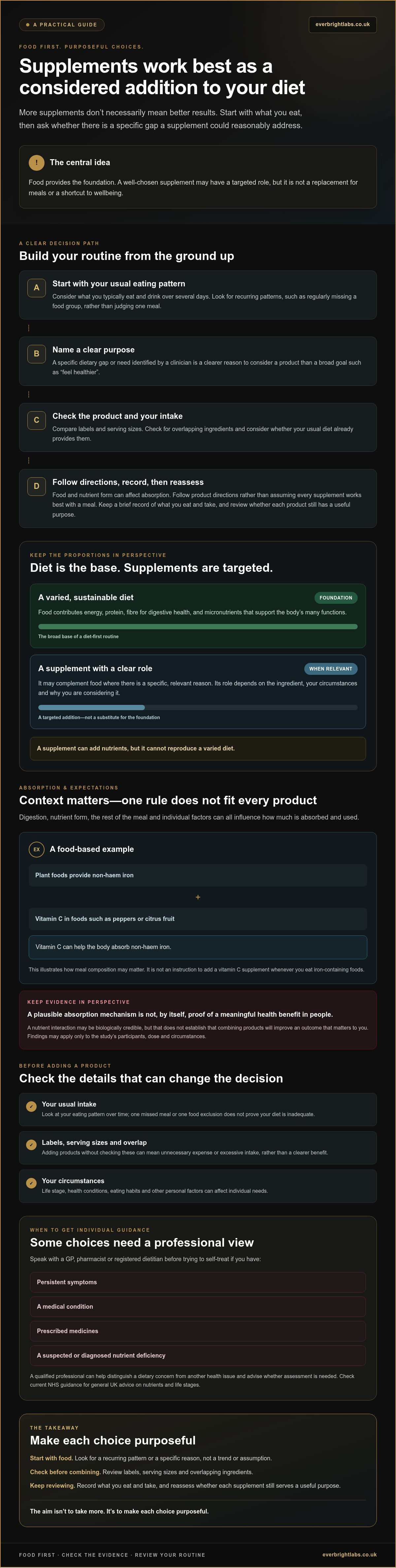
How to combine supplements with your diet: a practical step-by-step plan
A clear process can make supplement decisions less confusing and easier to review. Before adding anything, keep a short record of your usual meals, drinks and current supplements. It doesn’t need to be a calorie count or a restrictive food plan. The aim is to notice your normal pattern and give yourself a useful baseline.
- Clarify the goal. Name the specific reason you’re considering a supplement, rather than relying on a broad promise.
- Review your diet. Record what you typically eat and drink over several days, including fortified foods and any consistent restrictions.
- Check whether there’s a need. Compare your pattern with relevant guidance, and seek professional advice if symptoms, a health condition or a suspected deficiency are involved.
- Compare labels. Check the product’s purpose, ingredients, amounts per serving, directions, warnings and overlap with anything else you take.
- Reassess. Review whether the product still has a clear rationale, and discuss any concerns with a qualified professional.
Make changes methodically. If you introduce several products or alter multiple habits at once, it becomes harder to tell what has changed or what may be affecting how you feel. Track relevant habits and wellbeing consistently, but don’t treat a short-term change as proof that a supplement caused it. Other factors, including sleep, stress and routine, can influence how you feel.
What should you check before choosing a supplement?
Match the product’s stated purpose to a specific need, then read the full label rather than relying on a headline claim. Check ingredient names and quantities, serving directions, warnings and potential overlap with your current products. If you’re assessing Fat Metaboliser’s ingredients and directions, review the current product information and consider how it fits your diet and goals. It shouldn’t replace food or lifestyle habits.
How can you keep the routine manageable?
Keep only products with a clear reason for being there, and follow each label’s own directions. A simple note of meals, supplements and relevant changes can support a later review without turning eating into a test. If you want a routine that’s easier to assess, start with fewer changes and add nothing else until you’ve considered the first one.
Thoughtful choices matter more than a crowded routine. For readers assessing combining supplements with diet for best results, the useful next step is to compare purpose, label details and personal context, then seek advice where the answer isn’t clear. Explore Everbright Labs supplements and review their ingredient information and directions before deciding whether a product suits your goals.
Make supplements part of a sustainable diet-first routine
A supplement is more likely to fit a routine when it has a defined purpose and doesn’t displace habits that support health over time. Keep meals varied and your approach realistic: an elaborate plan that’s hard to maintain may be less useful than steady habits that work with everyday life. Combining supplements with diet for best results means treating a product as optional support, not as a substitute for food, prescribed treatment or sustainable lifestyle choices.
Assess any product against your actual routine. Ask whether its stated purpose complements a clear goal, whether its ingredients suit your individual circumstances, and whether the label explains the amounts and directions. Consider your existing supplements and fortified foods too, so a new product doesn’t add unnecessary overlap. Set realistic expectations: transparent information can help you make an informed choice, but it can’t guarantee a particular outcome.
How should you assess a product against your own routine?
Start with the current product label. Read the full ingredient list, serving directions and warnings, and check whether the product’s intended purpose makes sense alongside your eating pattern and goals. If you take medicines, have a health condition, or are unsure whether an ingredient is appropriate, ask a GP or pharmacist before using it. A product should fit your circumstances, not dictate your diet.
Broader guidance on sustainable metabolic support can also help keep food choices and expectations in perspective. A supplement shouldn’t be treated as a replacement for balanced meals or a guarantee of changes to weight or health.
What is a sensible next step if you are considering a supplement?
Keep the decision measured: review your usual diet, identify a specific reason, check the label and consider whether the product still has a useful role when you reassess your routine. Add only what has a clear rationale, and follow its own serving directions. If the reason for taking it remains uncertain, pause and seek qualified advice rather than adding more products.
Everbright Labs says its ingredients are fully disclosed and its products are manufactured in GMP- and HACCP-certified UK facilities. Those details can help you review the formulation and manufacturing information, but they don’t establish that a product is right for every person. Fat Metaboliser is a stimulant-free supplement for metabolic support, and one optional product to assess against your diet and goals, not a replacement for food or lifestyle habits. Review the Fat Metaboliser formulation and check its current ingredient information and directions.
Build a routine that works for you
Start with your usual diet and a clear reason for considering a supplement. A varied, sustainable eating pattern remains the foundation, whilst checking ingredients, serving directions and possible overlap helps you make a more considered choice. Remember, combining supplements with diet for best results is about purposeful support, not taking more products or expecting guaranteed outcomes.
If Fat Metaboliser may fit your goals, assess its current formulation and directions alongside your individual circumstances. Everbright Labs was founded and formulated by a Chemical Engineer and an Applied Biologist, and its products are manufactured in GMP- and HACCP-certified UK facilities. These details can inform your review, but your needs and the product label still matter.
Keep your choices simple, seek qualified advice if you have health or medication questions, and focus on a routine you can sustain with confidence.
Frequently Asked Questions
Can you take supplements with food?
Yes, some supplements can be taken with food, but directions vary by product and ingredient. A meal may affect absorption or help with tolerability for certain ingredients, whilst other products have different instructions. Check the label for the product you’re using rather than assuming one rule applies to all. If you take medicines or have a relevant health condition, ask a pharmacist whether the supplement and its directions are suitable for you.
Which supplements should not be taken together?
There isn’t one universal list of supplement pairs that everyone must avoid. The concern depends on the ingredients, their amounts, your diet and personal circumstances. For example, two products may both contain the same vitamin, mineral or botanical, increasing your total intake without a clear reason. Compare ingredient lists and serving directions across products, then ask a pharmacist or clinician to review them if you’re uncertain.
Do supplements work better when taken with a balanced diet?
A balanced diet supports overall nutrient intake, while a supplement may have a targeted role if there’s a specific need. Combining supplements with diet for best results means considering how a product fits your eating pattern, rather than expecting it to compensate for an unbalanced diet. Neither a varied diet nor a supplement guarantees a particular health outcome. Follow the label, and seek professional advice if you’re addressing a diagnosed deficiency.
Can food improve the absorption of supplements?
It can matter for some ingredients. Meal composition may influence digestion, absorption or tolerability, and interactions between nutrients can also play a role. For example, vitamin C in food can support absorption of non-haem iron from plant foods, but that doesn’t mean everyone should take an additional supplement. Follow the product’s directions and use evidence-based guidance for your circumstances. Ask a pharmacist if advice is unclear or medicines are involved.
How do you know if you need a supplement?
Consider your usual eating pattern, any restricted food choices, life stage and health circumstances before deciding. A symptom on its own can’t confirm a nutrient deficiency, since it may have other causes. General NHS guidance can help you understand nutrient advice, but it may not address individual needs. If you have ongoing symptoms, a medical condition or concerns about a possible deficiency, speak with a GP, pharmacist or registered dietitian.
Is it safe to take several supplements at the same time?
It depends on the ingredients, serving sizes, your total intake and individual circumstances. Check every label for duplicated vitamins, minerals or botanical ingredients, including amounts per serving, and don’t exceed the stated directions. Also consider relevant fortified foods as part of your overall intake. Ask a GP or pharmacist to review your products if you take medicines, are pregnant or breastfeeding, or have a health condition.
Can supplements replace a healthy diet?
No. Supplements don’t reproduce the range of nutrients and other components supplied by a varied diet, and they shouldn’t replace balanced meals. Their role is more targeted: a product may help address a specific dietary need or support an appropriate goal when there’s a clear reason to use it. Start by reviewing what you usually eat, check product ingredients and directions, and seek qualified advice if you’re unsure what’s right for you.
Share:
Alternatives to Prescription Weight Loss Drugs UK: A Balanced 2026 Guide
Foods That Boost Cellular Energy: What to Eat and Why