


What if avoiding stimulants is only the first step, not proof that a fat burner works? If caffeine leaves you jittery, disrupts your sleep or simply doesn’t suit you, it makes sense to look for a stimulant free fat burner uk shoppers can assess carefully. But “stimulant-free” describes the formula, not its effectiveness, safety for every person or ability to cause fat loss.
It’s understandable to want an alternative to products built around a temporary surge in energy. This guide will help you compare ingredient lists and serving amounts, assess whether claims are supported, and check the information on UK supplement labels. The aim is to make a considered choice, not to treat bold marketing as evidence.
We’ll explain what stimulant-free does and doesn’t tell you, outline practical checks for transparency and suitability, and consider how a supplement fits alongside sustainable health habits. The focus is on what’s disclosed and what the evidence can support, not an exaggerated promise to “burn” fat.
Key Takeaways
- For a stimulant free fat burner uk shoppers are considering, check the full ingredient list and serving amounts rather than relying on front-of-pack promises.
- Separate a proposed ingredient mechanism from evidence of meaningful outcomes in people. Supporting metabolism isn’t the same as directly causing fat loss.
- Compare caffeine content, ingredient disclosure, evidence and the clarity of claims side by side.
- Review the complete label, manufacturer information and personal suitability, and follow the stated directions rather than exceeding them.
- Assess Everbright Labs Fat Metaboliser against the same checklist. Check its disclosed ingredients and current label without assuming stimulant-free means suitable for everyone.
What does “stimulant-free fat burner” mean for UK shoppers?
A stimulant-free fat burner is a food supplement described as formulated without stimulating ingredients such as caffeine. “Fat burner”, however, is a marketing term, not a scientific category that guarantees a particular effect. For anyone searching for a stimulant free fat burner uk retailers sell, the label is a starting point for checking the formula, not evidence that it will cause weight loss.
Avoiding caffeine can make sense if it brings on jitters, affects your sleep or doesn’t suit your routine. People can respond differently, and avoiding stimulants doesn’t mean all stimulants are inherently unsafe. A supplement is also distinct from a medicine or clinically supervised weight-management treatment. Supplements are not a substitute for medical care and must not claim to treat or cure disease. For broader context, the principles of healthy weight management include more than choosing a supplement.
Which ingredients should shoppers check for on the label?
Read the full ingredient list, not just the front-of-pack description. Look for caffeine stated directly, and check whether ingredients such as guarana or green tea extract are included. These can contain caffeine, but their presence alone doesn’t tell you how much a serving provides. Check any separately stated caffeine content and ask the manufacturer for clarification if the amount isn’t clear.
Next, compare the serving size with the directions and work out the total from all daily servings. Consider other caffeine sources in your routine, such as coffee or tea. A “stimulant-free” claim on the front doesn’t replace checking the complete, current label.
What does stimulant-free not tell you?
The term doesn’t establish how well a product works, how its ingredients are dosed, how rigorously its claims are supported or whether it’s suitable for you. Check ingredient amounts, look for evidence relevant to the specific claim, and consider your health circumstances and any medicines you take. If you’re pregnant, breastfeeding, managing a health condition or unsure about interactions, ask a health professional before use.
“Stimulant-free describes what a formula leaves out; it doesn’t prove that the product causes weight loss.”
In the UK, food supplements are regulated as food, not as medicines. That distinction matters: a supplement may be described in terms of permitted nutritional or physiological functions, but that doesn’t make it a clinically tested weight-management treatment. Judge the wording and evidence for each claim on its own merits, rather than treating the absence of caffeine as proof of effectiveness, quality or universal suitability.
How stimulant-free supplements relate to metabolism and weight management
Metabolism is the set of processes through which your body uses energy to maintain vital functions and support movement. Over time, body weight is influenced by energy balance: the relationship between energy consumed through food and drink and energy used by the body. Sleep, activity, appetite, health and other factors can affect this balance. It’s more complex than a single ingredient or product can address.
A supplement may be designed around a proposed biological mechanism, such as influencing a process involved in nutrient metabolism. But a plausible mechanism isn’t the same as evidence that people taking the ingredient experience a meaningful, sustained change in weight or body composition. Stimulant-free describes a formulation choice; it doesn’t determine whether a product affects energy balance.
For more category context, read the science of fat burners. The practical question isn’t simply whether an ingredient has a biological role, but whether the evidence supports the specific benefit being claimed.
Why “fat burning” claims need careful interpretation
Laboratory or mechanistic research can suggest how an ingredient might act, but it doesn’t by itself show that the effect produces meaningful weight change in real-world use. A temporary sensation, such as feeling warmer or more energised, also isn’t proof of sustained fat loss. Changes in body composition are a different outcome and need appropriate evidence over time.
Be cautious with dramatic or guaranteed results. Claims promising rapid, effortless or certain weight loss deserve closer scrutiny because a proposed mechanism cannot establish that outcome for every person. Assess a stimulant free fat burner uk shoppers are considering by its evidence and label, not by how forcefully its marketing describes “burning” fat.
What evidence is useful when assessing an ingredient?
Look for relevant human research, then compare the studied ingredient, form and dose with what the product actually provides. Evidence from a different dose or combination may not apply. Small studies and short follow-up periods can also limit what researchers can conclude, while results from a specific group may not generalise to everyone.
Evidence for an ingredient alone doesn’t automatically validate a finished product containing it. Product-specific benefits require evidence that fits the actual ingredient, dose and formulation, alongside clear wording about the outcome studied. For a practical product-label example, review Everbright Labs Fat Metaboliser against those questions. A supplement should complement, not replace, sustainable habits and appropriate health advice.
Does stimulant-free mean ineffective? Compare products by evidence and transparency
No. “Stimulant-free” describes a formulation choice, not whether a supplement is effective or ineffective. Removing caffeine may suit someone who wants to avoid its stimulating effects, but it doesn’t tell you whether the remaining ingredients, their amounts or the finished formula support a particular outcome. A stimulant free fat burner uk shoppers compare deserves the same evidence checks as any other supplement.
Use the label to compare information you can verify. Don’t assume one type of formula will produce better weight-loss results simply because it is stimulant-free.
| What to compare | What to look for |
|---|---|
| Caffeine content | Check for caffeine and caffeine-containing ingredients in the full ingredient list, not only front-of-pack wording. |
| Ingredient disclosure | Look for each ingredient listed clearly, rather than grouped into a blend that hides individual amounts. |
| Serving amounts | Check the quantity of each ingredient per serving and compare it with the directions. |
| Evidence | Ask whether relevant human research supports the specific ingredient, amount and benefit being discussed. |
| Claim clarity | Prefer specific, measured wording over promises of rapid or guaranteed weight loss. |
How to assess a supplement label and its claims
Start with the complete label and product information. If the amounts aren’t clear, it’s difficult to compare the formula with ingredient research. Testimonials may describe an individual experience, but they don’t establish that a product caused the result or that others can expect the same outcome.
Manufacturer information can help you understand who makes a product and what quality controls are described. Everbright Labs says its supplements are made in GMP- and HACCP-certified UK facilities. This information relates to manufacturing standards; it isn’t proof of clinical effectiveness.
For product-specific detail, read the Fat Metaboliser ingredient breakdown, then compare any ingredient or amount discussed there with the current product label. Labels can change, so check the live information before drawing conclusions.
When should a supplement claim raise questions?
Pause over claims promising guaranteed, rapid or effortless weight loss. In Great Britain, check whether health claims are authorised and appropriately worded using the current nutrition and health claims register. Broad phrases such as “boosts metabolism” need context: what benefit is meant, and what evidence supports it?
The Advertising Standards Authority (ASA) and the Committee of Advertising Practice (CAP) provide guidance on advertising claims. Their guidance is a useful reference when judging marketing language, but a confident claim or quality certification should never replace evidence for the specific product and outcome.
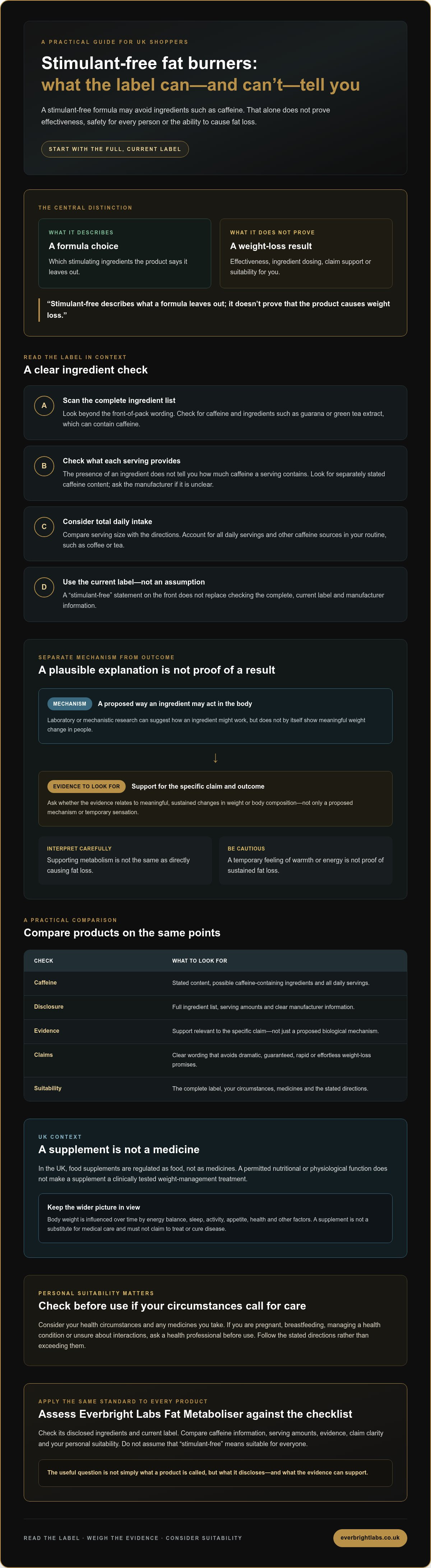
A practical UK checklist for choosing a stimulant-free fat burner
Use this checklist to move from a front-of-pack promise to information you can actually assess. It can help you compare a stimulant free fat burner uk shoppers might consider without assuming that a particular formula will deliver a specific result.
- 1. Read the complete label. Check the full ingredient list, the amount of each ingredient per serving, serving directions and relevant allergen information. If amounts are hidden in a blend or the label is unclear, you can’t readily compare the formula with evidence for individual ingredients.
- 2. Check the evidence against the formula. Look for human research relevant to each ingredient and compare the researched form and dose with the product’s stated serving. Don’t assume that a study on an ingredient proves the finished supplement has the same effect.
- 3. Examine the claims. Ask what a benefit statement specifically means and whether suitable evidence supports it. Treat guaranteed, rapid or effortless weight-loss promises as a reason to look more closely, not as proof of effectiveness.
- 4. Review manufacturer information. Look for clear product details, contact information and explanations of manufacturing quality and traceability. If a certification is mentioned, check what it covers and whether the detail can be verified. Certification information does not establish clinical effectiveness.
- 5. Consider personal suitability. Stimulant-free doesn’t mean free from possible interactions, sensitivities or ingredient-specific cautions. Consider your health circumstances and any other supplements you use.
Before buying, check that the label you’re reading is current. Follow the stated directions and don’t exceed them, even if you’re hoping for faster results. A related way to compare product evidence and claims is outlined in this guide to effective fat metaboliser supplements in the UK.
How to think about safety and personal suitability
Ingredients can affect people differently, and a product’s stimulant-free description doesn’t rule out a reaction or interaction. If you’re pregnant or breastfeeding, have a health condition, or take regular medicines, speak with a GP or pharmacist before use. They can help you assess the complete ingredient list in light of your circumstances. If any label detail is unclear, seek clarification rather than guessing.
To assess a product against these points, explore Everbright Labs and review the available product information and current label before deciding whether it suits your needs.
How to assess Everbright Labs Fat Metaboliser against your needs
Everbright Labs Fat Metaboliser can be assessed using the same criteria as any other supplement. The company describes its products as stimulant-free and their ingredients as fully disclosed, but those descriptions aren’t a guarantee of weight loss, proof of clinical effectiveness or confirmation that a product suits everyone.
Use the Everbright Labs Fat Metaboliser product page to check the current information directly. Compare it with your priorities: avoiding stimulants, seeing each ingredient and amount clearly, understanding the directions, and finding claims that are specific rather than overstated. Don’t rely on a general product description if the current label provides more detailed information.
What readers should confirm on the current product page
Before deciding, review the complete ingredient list and serving amounts on the live label. Product details can change, so check the current page rather than relying on an older article or a remembered ingredient list. Read the directions carefully and consider whether the stated serving fits your routine. Don’t exceed it.
Assess any benefit wording on its own terms. Ask what outcome is being described and whether the wording matches the evidence and applicable UK requirements for claims. Everbright Labs reports that its products are manufactured in GMP- and HACCP-certified UK facilities. This is company-provided information about manufacturing standards, not evidence that the product produces a particular result.
There’s no need to treat one feature as decisive. A stimulant-free description may matter if you’re trying to avoid caffeine, while ingredient disclosure can help you make a more informed comparison. Neither establishes universal suitability. Weigh the information against your own needs and the evidence for the specific product and claims.
Choose a measured next step, not a quick fix
A supplement should not replace a balanced, sustainable approach to weight management. If you’re unsure whether an ingredient is appropriate for you, especially if you have a health condition, are pregnant or breastfeeding, or take regular medicines, ask a GP or pharmacist before use.
If the product’s current label and stated directions align with your priorities, you can examine it further without assuming a guaranteed outcome. Review Everbright Labs Fat Metaboliser and make your decision based on the disclosed information, evidence and personal suitability.
Choose with clarity, then take a steady next step
A stimulant-free label can help you avoid ingredients you’d rather not take, but it isn’t evidence that a supplement will cause weight loss. For a stimulant free fat burner uk shoppers are assessing, the more useful questions are whether ingredients and serving amounts are disclosed, whether claims match relevant evidence, and whether the product suits your circumstances.
Everbright Labs describes its products as stimulant-free, with fully disclosed ingredients, and says they’re manufactured in GMP- and HACCP-certified UK facilities. The company also states that its formulations are developed by a Chemical Engineer and an Applied Biologist. These details offer context about the formulation and manufacturing approach, not a guarantee of clinical results. Check the current Fat Metaboliser label and product information before deciding.
If it aligns with your priorities, review Everbright Labs Fat Metaboliser and make a considered choice. Pair any supplement decision with sustainable health habits, and seek qualified advice if suitability is uncertain. A measured approach can help you move forward without relying on exaggerated promises.
Frequently Asked Questions
Are stimulant-free fat burners effective for weight loss?
They may support a specific physiological function, but “stimulant-free” alone doesn’t show that a product causes weight loss. Assess the evidence for the actual ingredients, amounts and finished formula, and distinguish a proposed mechanism from outcomes demonstrated in people. Results from ingredient research may not apply to every product or individual. A supplement is best considered alongside sustainable eating and activity habits, not as a replacement for them.
Can a stimulant-free fat burner still contain caffeine?
A product described as stimulant-free shouldn’t be assumed to contain no caffeine unless its full label supports that description. Check for caffeine itself and ingredients such as guarana or green tea extract, which may contain caffeine. The amount can depend on the ingredient and formulation, so don’t infer it from the name alone. Review the complete ingredient list, serving size and directions, and ask the manufacturer if caffeine content is unclear.
How do I choose a stimulant-free fat burner in the UK?
Compare transparent labels, not just promotional claims. Check whether each ingredient and its amount per serving are disclosed, whether directions are clear, and whether relevant human evidence supports the stated benefit at a comparable dose. Review manufacturer and product information, and treat guaranteed or rapid weight-loss promises cautiously. For a stimulant free fat burner uk shoppers are considering, personal suitability matters too, particularly if you have a health condition or take medicines.
Is stimulant-free the same as safe for everyone?
No. Stimulant-free describes a formulation choice; it doesn’t rule out sensitivity to other ingredients, interactions with medicines or other individual considerations. Read the full label and follow the stated directions. If you’re pregnant or breastfeeding, have a health condition, take regular medicines or aren’t sure whether a product is appropriate, ask a GP or pharmacist before use. A product description cannot determine your individual suitability.
What should I look for on a fat-burner supplement label?
Look for the complete ingredient list, amounts per serving, serving directions and relevant allergen information. Check for caffeine and caffeine-containing ingredients even if the front label uses stimulant-free wording. Compare any stated benefits with evidence for the actual ingredient and amount, and be wary of vague claims or hidden quantities in proprietary blends. Also review manufacturer details and product information. Follow the label directions rather than taking more than stated.
Do stimulant-free fat burners contain prescription weight-loss medicines?
Prescription weight-loss medicines are medicines, not ordinary food-supplement ingredients. A product described as a supplement should not be treated as a prescribed treatment, and the phrase “stimulant-free” doesn’t verify everything in a product. Buy from a source that provides clear product and manufacturer information, and check the complete label. Avoid products making medicine-like promises or with unclear contents; speak to a healthcare professional about prescribed treatment or concerns.
Share:
How to Reset Your Metabolism for Weight Loss: What Really Works in 2026
Alternatives to Prescription Weight Loss Drugs UK: A Balanced 2026 Guide