


Your metabolism isn’t a switch you can flip back to factory settings. If weight loss has slowed or feels harder than expected, it’s understandable to wonder how to reset your metabolism for weight loss, especially when advice online promises quick results. But a plateau doesn’t automatically mean your metabolism is damaged, and it isn’t a personal failure. The body can use less energy as weight changes, while appetite and everyday activity can also affect progress.
This guide explains what people mean by a “metabolic reset”, what metabolism does and which changes can realistically support weight management. You’ll learn how strength training, nourishing food, sleep and sustainable activity fit into a practical plan, and when it may be sensible to speak with a health professional. We’ll also cover how to assess supplement ingredients, evidence and safety, without treating any product as a reset or substitute for the foundations. The aim is a steady, informed approach, not another quick-fix promise.
Key Takeaways
- Learn what a “metabolic reset” can realistically mean, and why slower progress doesn’t prove your metabolism is broken.
- Understand how changing energy needs during weight loss can affect progress, without blaming yourself for a normal biological adaptation.
- Find out how to reset your metabolism for weight loss by focusing on sustainable habits rather than detoxes or severe restriction.
- Build a practical routine, track relevant behaviours and review longer-term patterns instead of reacting to a single weigh-in.
- Assess supplement ingredients, evidence and suitability carefully; Fat Metaboliser is an optional metabolic-support supplement, not a reset or weight-loss treatment.
What does “reset your metabolism for weight loss” really mean?
When weight loss slows despite your efforts, it can feel as though your body is working against you. That frustration is real, but a plateau doesn’t prove you’ve failed or damaged your metabolism. The phrase how to reset your metabolism for weight loss is common online, yet it can suggest that metabolism has a single setting that needs correcting. It doesn’t.
Metabolism describes the processes your body uses to convert and manage energy, from keeping your heart beating to moving your muscles and digesting food. No routine or supplement can switch it back to an earlier setting overnight. A more useful question is which factors affect your energy needs and daily habits, and what changes are realistic for you.
What is metabolism, in everyday terms?
Your body uses energy even when you’re resting, to support essential functions such as breathing and circulation. Basal metabolic rate (BMR) refers to the energy required for these basic functions under specific resting conditions. You can read more about Basal metabolic rate and how it differs from energy use across the whole day.
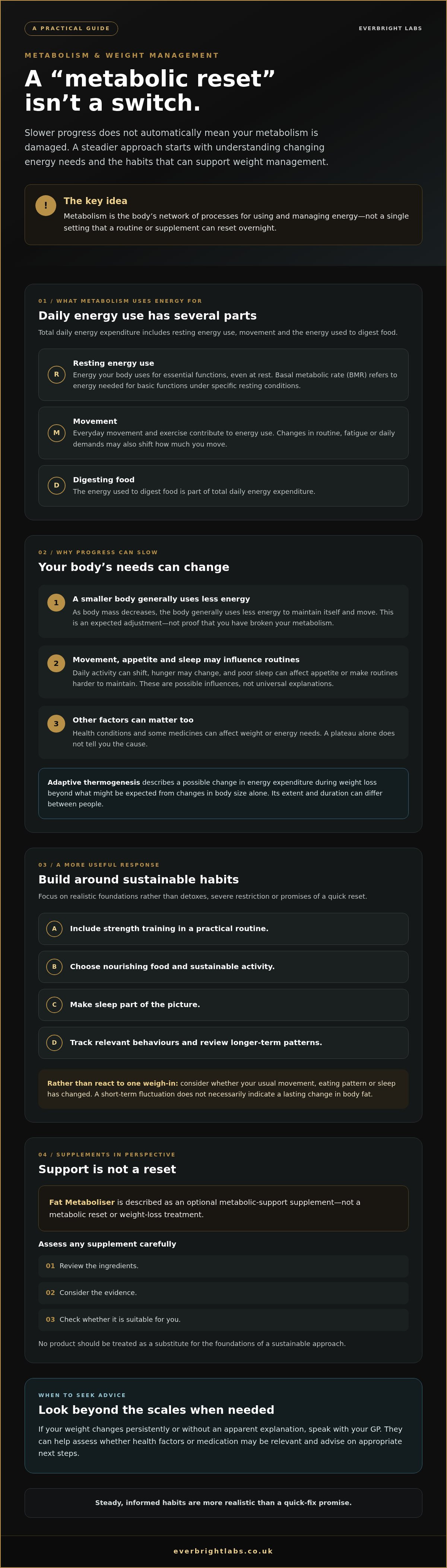
Total daily energy expenditure includes resting energy use, movement and the energy used to digest food. A day spent mostly at a desk still involves energy use at rest and for digestion; walking to the shops, taking the stairs or exercising adds movement-related expenditure. Body size and composition, among other factors, also influence total energy needs.
Metabolism is the body’s network of processes for using and managing energy, not a switch that can be reset on demand.
Is a slow metabolism always the reason weight loss stalls?
No. Weight trends reflect several interacting influences, including energy intake and expenditure, movement, appetite, sleep, health and some medicines. Energy balance describes the relationship between energy consumed and energy used over time, but it doesn’t capture every factor shaping someone’s health or make weight change a simple test of willpower.
As circumstances and body needs change, progress may slow for reasons that aren’t obvious from the scales alone. A short-term fluctuation also doesn’t necessarily indicate a lasting change in body fat. Look at patterns over time rather than drawing conclusions from one weigh-in.
If your weight changes persistently or without an apparent explanation, speak with your GP. They can help assess whether health factors or medication may be relevant and advise on appropriate next steps.
How metabolism adapts during weight loss, and what that means
If your weight loss slows, it can be tempting to conclude that your metabolism has stopped responding. A more measured explanation is that your body’s energy needs may have changed. As body mass decreases, the body generally uses less energy to maintain itself and move. That’s an expected adjustment, not proof that you’ve broken your metabolism.
What is adaptive thermogenesis?
Adaptive thermogenesis describes a possible change in energy expenditure during weight loss beyond what might be expected from changes in body size alone. The extent and duration can differ between people, so it shouldn’t be treated as a fixed response or used to predict exactly what will happen to you.
Adaptation can make continued weight loss more challenging, but it doesn’t mean your metabolism is permanently damaged. Claims that a particular routine can fully reverse this response need careful scrutiny. For broader context, Harvard Health Publishing explains how metabolism affects weight loss.
Why can weight loss change the body’s energy needs?
A smaller body typically requires less energy for basic functions and movement. The amount you move also matters: if a new routine, fatigue or daily demands lead you to walk less or spend more time sitting, your overall energy expenditure may shift. These changes can be subtle and easy to miss in a busy week.
Appetite and sleep may also influence behaviour and energy intake. Some people find hunger changes as their weight changes; poor sleep can affect appetite and make established routines harder to maintain. These are possible influences, not universal explanations. Medicines and health conditions can affect weight or energy needs too, so it’s unwise to assume every stall has the same cause.
Before making a drastic adjustment, consider whether your usual movement, eating pattern or sleep has changed. Reviewing those patterns can offer more useful clues than chasing a rapid “reset”. The phrase how to reset your metabolism for weight loss may frame the problem as a faulty internal switch, but weight management is shaped by interacting factors rather than one mechanism alone.
If you suspect a medical cause, take medication that may be relevant, or experience a substantial unexplained change in weight, seek advice from your GP. They can assess your circumstances rather than relying on a generic explanation. If you’re considering a supplement alongside broader habits, review the available ingredient and product information for Fat Metaboliser and consider whether it’s suitable for you.
Which weight-loss habits support metabolism, and which reset claims to question?
Rather than chasing a dramatic metabolic change, focus on habits you can maintain. They won’t “reset” metabolism, but they can support general health and make weight management more practical. Sustainable habits support weight management; they don’t reset metabolism like a switch.
Which everyday habits are reasonable starting points?
Choose regular movement that fits your circumstances, whether that’s walking, cycling, gardening or another activity you enjoy. If appropriate for you, include strength-based exercise. Resistance work can help maintain muscle during weight loss, but you don’t need to start with an intense or complicated programme. Begin at a level you can repeat and build gradually.
Aim for balanced, nourishing meals that suit your preferences and needs, rather than severe restriction or a rigid menu. Include a range of foods and enough to support everyday functioning. There’s no single eating pattern that works for everyone, and an approach that leaves you exhausted or constantly hungry may be difficult to sustain.
Sleep and stress management matter to overall wellbeing and can influence how manageable healthy routines feel. A regular bedtime or a short wind-down routine may be a helpful starting point. Neither is a guaranteed weight-loss switch, and struggling with sleep or stress isn’t a personal failing.
How can you spot an unrealistic metabolism-reset claim?
Be cautious of guaranteed weight loss, rapid transformations, or claims that a product repairs or resets metabolism. A striking testimonial isn’t the same as reliable evidence that a product causes lasting results. Detoxes and severe restriction may promise a quick change, but they don’t offer a dependable shortcut to sustainable weight management.
Before considering a supplement, check whether its ingredients and amounts are clearly disclosed, what evidence supports the claims, and whether it’s suitable alongside your health conditions or medicines. Ask a GP, pharmacist or another qualified health professional if you’re unsure, particularly if you take medication or have an existing condition.
For a closer look at how to assess supplement claims, see The Science of Fat Burners: A Guide to Sustainable Metabolic Support in 2026. Apply the same careful approach to any product: look for transparent information and realistic wording, not a promise that it can replace nourishing food, movement and other supportive habits.
How to build a realistic metabolism-supporting plan for weight loss
A useful plan doesn’t need to overhaul your life. Choose a small number of habits you can repeat, record what’s relevant, then review the pattern before deciding whether to adjust. This turns “how to reset your metabolism for weight loss” into a practical process for supporting weight management, rather than a search for an overnight fix.
- Choose a routine that fits your life. Select movement you can maintain and meals that provide adequate nourishment. Take account of your health, mobility, preferences, work and caring responsibilities. A plan that works on paper but clashes with your day is unlikely to be sustainable.
- Track a few useful behaviours. You might note walks or strength sessions, meal patterns, sleep and how consistently you followed your routine. Keep it manageable. Tracking should help you understand your habits, not become a source of pressure.
- Review and adjust. Look for patterns over time. If a routine feels exhausting, difficult to follow or unsuitable, adapt it rather than responding with stricter rules. Where possible, change one practical element at a time so you can judge whether it suits you.
How can you track progress without chasing daily changes?
One weigh-in can be affected by short-term fluctuations, so avoid treating it as a verdict on your efforts. If weighing is appropriate and helpful for you, use consistent conditions and compare readings over time rather than reacting to each one. You can also track non-scale indicators such as strength, energy, how you feel during everyday activity, and whether your routine is becoming more consistent.
There’s no single rate of progress or fixed timeline that everyone should expect. If tracking your weight causes distress, focus on behaviours and wellbeing measures, or discuss another approach with a qualified professional.
When should you speak to a GP or another qualified professional?
Seek advice if your weight changes substantially without an obvious explanation, you have persistent symptoms, or you’re concerned that a medicine may be affecting your weight or appetite. Don’t stop or alter prescribed treatment without speaking to the clinician responsible for your care. Before starting a supplement, ask a GP or pharmacist about suitability and possible interactions, especially if you take medicines or have a health condition.
If you’re considering an optional supplement as one part of a wider routine, review the Fat Metaboliser product information and assess its disclosed ingredients, evidence and suitability. It isn’t a substitute for a realistic plan or professional advice.
Can a supplement reset your metabolism? A balanced look at Fat Metaboliser
No supplement should be described as resetting metabolism or guaranteeing weight loss. Metabolism involves many processes in the body, not a single setting that a capsule can switch back. If you’re searching for how to reset your metabolism for weight loss, treat supplement claims as one part of a wider evidence check, not a replacement for sustainable habits or medical advice.
Everbright Labs’ Fat Metaboliser is positioned as a stimulant-free supplement for metabolic support. That describes its intended category, not proof that it resets metabolism, treats a condition or produces a particular weight-loss result. Whether to use it is a personal choice, and it shouldn’t be treated as essential to a weight-management plan.
What should you check before choosing a metabolic-support supplement?
Read the current label and product information rather than relying on a headline or a social-media testimonial. Check:
- Ingredients and amounts: Look for a full ingredient list and clear quantities, so you can understand what the product contains.
- Directions and warnings: Follow the stated use and check cautions for relevant circumstances.
- Evidence and claims: Ask whether the evidence supports the specific claim being made, rather than a broader promise of rapid or guaranteed weight loss.
- Personal suitability: Consider your health, medicines and other supplements. If you’re pregnant, managing a health condition or taking medication, ask a GP or pharmacist before use.
For more detail on the product’s listed ingredients, see Understanding the Ingredients in Everbright Labs Fat Metaboliser. Check that any article or product information you consult reflects the current formulation, and don’t assume an ingredient’s presence proves a weight-loss effect.
Where does Everbright Labs Fat Metaboliser fit?
It may be considered as an optional supplement within a broader approach, but it isn’t a metabolism reset or a weight-loss treatment. Before deciding, weigh the available evidence and product information against your needs, and seek professional advice if you’re uncertain about safety or suitability. A supplement shouldn’t displace a plan built around habits you can maintain.
If you’ve reviewed the information and want to consider it as an optional part of your approach, explore Fat Metaboliser.
Build progress through steady, informed choices
A metabolism isn’t a switch you can reset, and a slower rate of weight loss doesn’t mean you’ve failed. Body size and daily energy needs can change over time, so focus on habits you can sustain and review patterns rather than reacting to a single weigh-in. Movement, nourishing meals and supportive sleep routines can all contribute to a realistic approach, while unexplained changes or persistent symptoms are reasons to seek professional advice.
So, how to reset your metabolism for weight loss? Reframe the goal: support your health and weight management with consistent choices, not quick fixes or guaranteed results. Supplements are optional, and any claims should be weighed against disclosed ingredients, evidence and your personal circumstances.
Everbright Labs’ Fat Metaboliser is a stimulant-free supplement for metabolic support, not a metabolism reset or weight-loss treatment. The company was founded and formulated by a Chemical Engineer and an Applied Biologist, and its products are manufactured in UK facilities described as GMP and HACCP certified. To review the product information, explore Fat Metaboliser. Choose a next step that feels safe and manageable for you.
Frequently Asked Questions
Can you really reset your metabolism for weight loss?
No, metabolism can’t be switched back to an earlier setting on demand. The phrase “reset” is often used to describe habits that support weight management, such as regular movement, adequate nourishment and sleep. If you’re wondering how to reset your metabolism for weight loss, focus on sustainable changes rather than a quick fix. A plateau doesn’t mean you’ve failed or permanently damaged your metabolism.
How long does it take to reset your metabolism?
There’s no established timeframe, because metabolism isn’t a device that can be reset. Energy needs and weight trends may change as your body and daily routine change, and individual responses vary. Be cautious of plans promising a metabolic reset within a set number of days. Instead, choose manageable habits and review how they’re working over time. Seek professional advice if you have persistent concerns or symptoms.
Does metabolism slow down when you lose weight?
It can, because a smaller body generally needs less energy to maintain itself and move. Energy expenditure may also adapt during weight loss, although the degree and duration differ between people. This is a normal physiological response, not proof that your metabolism is broken. Appetite, activity, sleep, medicines and health can also affect weight trends, so a plateau doesn’t point to one definite cause.
Can eating more reset a slow metabolism?
No, simply eating more isn’t a proven way to reset metabolism. If you’ve been restricting food severely, eating more may help you meet your nutritional needs, but it won’t automatically reverse metabolic adaptation and may change your weight. Avoid extreme restriction or abrupt changes based on online claims. If you’re unsure whether your eating pattern is appropriate, ask a GP or registered dietitian for advice tailored to you.
Can exercise boost your metabolism enough to lose weight?
Exercise supports health and increases energy use during movement, while strength-based activity can help maintain muscle. But its effect on weight varies, and exercise alone doesn’t guarantee weight loss. Choose activity you can sustain and adapt it to your ability and health. A combination of regular movement and nourishing, manageable eating habits may be more practical than relying on intense workouts to produce a specific result.
Do metabolism supplements help with weight loss?
No supplement should be described as resetting metabolism or guaranteeing weight loss. Products marketed for metabolic support vary, so check the full ingredient list, amounts, evidence and warnings before deciding. Everbright Labs’ Fat Metaboliser is positioned as a stimulant-free supplement for metabolic support, not a treatment or reset. Ask a GP or pharmacist about suitability and possible interactions if you take medicines, are pregnant or manage a health condition.
When should I speak to a GP about unexplained weight changes?
Speak to your GP if your weight changes substantially without an obvious explanation, if the change persists, or if it occurs alongside ongoing symptoms. Mention any recent medicine changes or concerns about appetite and energy. Don’t stop or alter prescribed treatment without professional advice. A GP can consider your individual circumstances and whether further assessment is appropriate, rather than assuming that metabolism alone explains the change.
Share:
GMP-Certified Supplements in the UK: What GMP Means in 2026
Stimulant-Free Fat Burner UK: A Science-Led Guide for 2026