


A GMP claim isn’t proof that a supplement works. If you’re searching for “GMP certified supplements uk meaning”, you’re likely trying to work out whether the wording on a label reflects a meaningful quality check or a broader product endorsement. GMP refers to controls over how a supplement is made, not evidence that it’s effective, suitable for everyone or approved as a medicine.
That distinction matters because UK food supplements are regulated as food products, and GMP certification isn’t the same as product approval. To understand what a claim tells you, check the facility, the certificate’s scope and current status, and what checks are applied to finished products. This guide explains what GMP is designed to control, what it can’t guarantee, and how to assess manufacturing claims alongside ingredient transparency and product evidence. It also looks at Everbright Labs’ statement that its products are made in GMP- and HACCP-certified UK facilities, and what shoppers can reasonably conclude from it.
Key Takeaways
- The GMP certified supplements uk meaning is best understood as a set of manufacturing controls, not a measure of whether a supplement delivers a claimed benefit.
- Consistent procedures, records, hygiene and traceability help manage quality from incoming ingredients through to packing and batch release.
- Before relying on a GMP claim, check who issued the certificate, which facility and activities it covers, and whether it is current.
- Facility certification isn’t the same as government approval of each supplement or evidence that every finished batch has been independently tested.
- Everbright Labs states that its supplements are made in GMP- and HACCP-certified UK facilities. Check the certificate details alongside ingredient transparency and product evidence.
What does GMP mean for supplements in the UK?
If you’re searching for the GMP certified supplements uk meaning, the key distinction is straightforward: GMP describes controls over how a product is manufactured. It doesn’t show that an ingredient delivers a particular health outcome or that a regulator has endorsed the finished supplement.
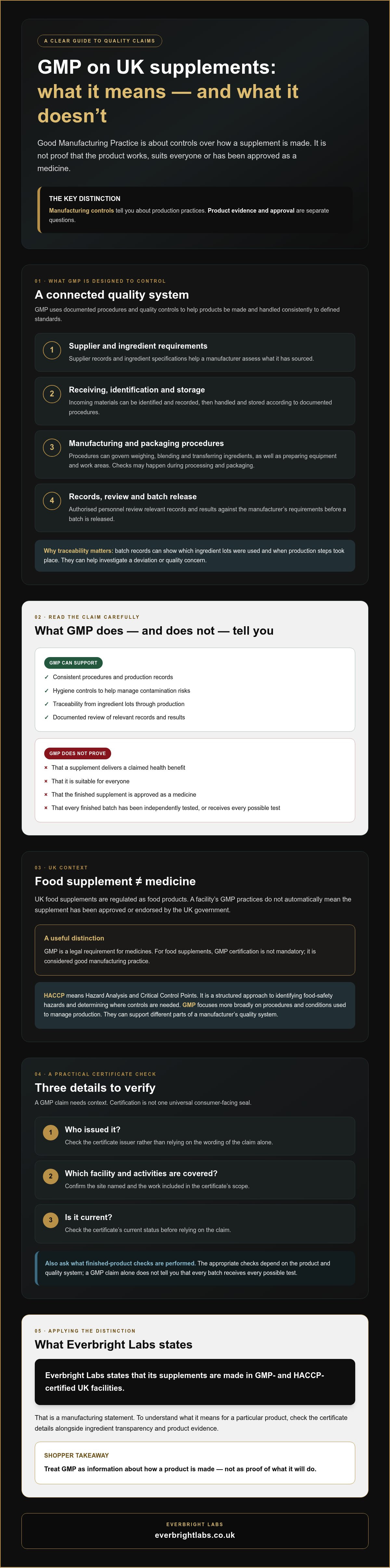
In brief: Good Manufacturing Practice (GMP) is a system of documented procedures and quality controls designed to help products be made and handled consistently to defined standards. A GMP claim needs context. Check who issued the certificate, which site it covers and what activities are in scope. GMP isn’t one universal consumer-facing seal.
What does Good Manufacturing Practice cover?
GMP can apply to the processes used to receive and handle ingredients, manufacture a product, package it and keep production records. Its principles are part of the broader concept of Good Manufacturing Practice. In practical terms, hygiene controls help manage contamination risks, while written procedures give staff a consistent way to carry out tasks.
Records make those processes traceable. For example, a batch record may show which ingredient lots were used, when production steps took place and whether required checks were completed. If a step falls outside the documented process, records can help the manufacturer identify and investigate the deviation, then decide how to manage it.
These controls support consistency and accountability. They don’t establish that a supplement’s ingredients will produce a specific biological effect.
Does GMP mean the supplement is approved in the UK?
No. Food supplements are regulated as food products; following GMP at a manufacturing facility doesn’t automatically make a supplement a medicine or mean it has been approved. The Food Standards Agency provides guidance on food supplements. Manufacturing controls and product authorisation or endorsement are separate questions.
GMP is a legal requirement for medicines, but GMP certification itself isn’t mandatory for food supplements; it is considered good manufacturing practice. A certificate should not be read as proof that a supplement has been approved by the UK government or that it works. Check the issuer, site and scope, then assess the product’s ingredients and evidence separately.
How GMP controls work from ingredients to finished supplements
GMP is a linked system of controls, not just an inspection at the end of production. Details vary by manufacturer and product, but a typical process starts with assessing suppliers and defining ingredient requirements. When materials arrive, staff identify and record them, then handle and store them according to documented procedures.
During production, procedures can govern how ingredients are weighed, blended and transferred, and how equipment and work areas are prepared. Checks may also take place during processing and packaging. Before a batch is released, authorised personnel review relevant records and results against the manufacturer’s requirements. The appropriate checks depend on the product and quality system, so a GMP claim shouldn’t be taken to mean every batch receives every possible test.
Where do ingredient checks and traceability fit?
Supplier records and ingredient specifications help a manufacturer assess what it has sourced. Identification and lot details then record which materials went into a particular production run. If a quality concern arises, those records can help trace affected materials and batches, investigate what happened and decide what action is needed. Ask what checks are performed rather than assuming a particular laboratory test is routine.
Written procedures and production records support repeatability. If a recorded step differs from the approved process, the manufacturer can document and assess the deviation rather than relying on memory or informal accounts. The UK Medicines and Healthcare products Regulatory Agency explains its approach to MHRA GMP inspections. This guidance concerns the relevant medicines GMP framework and shouldn’t be mistaken for proof that a food supplement has been individually approved.
What are HACCP and GMP, and how do they differ?
HACCP means Hazard Analysis and Critical Control Points. It is a structured approach to identifying food-safety hazards and determining where controls are needed. GMP focuses more broadly on the procedures and conditions used to manage production. The approaches may support different parts of a manufacturer’s quality system. For either claim, check the named standard, certificate issuer, covered site and scope.
Manufacturing consistency is not proof of clinical effectiveness. Records and process controls can help show how production was managed; they can’t establish that a supplement delivers a claimed health benefit. That requires separate evidence about the product and its ingredients.
What GMP certification does not prove about a supplement
GMP certification can provide information about controls at a manufacturing site. It can’t, by itself, show that a supplement produces a claimed benefit. Consistent production is a quality aim; evidence of an effect must come from research relevant to the specific ingredient, amount and intended use.
Does GMP certification prove a supplement works?
No. An audit of manufacturing practices looks at how production is managed; it doesn’t test whether taking a supplement improves a health outcome. To assess a claim, look for evidence relating to the specific ingredient and amount, and consider whether the research measures an outcome relevant to the claim. Evidence about an ingredient doesn’t automatically establish that a finished product has the same effect.
This applies to weight-management and general wellness claims too. A facility’s credentials don’t validate them. The official UK government guidance on food supplements can help clarify the food-product context, but a manufacturing certificate shouldn’t be interpreted as approval of an individual product or its claims.
Is GMP the same as third-party testing or product approval?
No. These terms refer to different checks, and none is a substitute for the others.
- A GMP audit or certificate concerns the manufacturing site, processes and stated scope of the assessment.
- A laboratory test concerns a sample and specific properties or substances tested. It doesn’t establish that the product works, and a test report should identify its scope, sample and date.
- Regulatory authorisation or approval is a separate regulatory matter. A facility certificate alone doesn’t mean each supplement has received government approval.
Third-party testing may offer useful additional information, but ask what was tested, by whom and whether the result applies to the product or batch you’re considering. Don’t assume a testing claim means every batch has undergone every possible analysis.
GMP also isn’t a guarantee of zero risk, suitability for every person or identical results between people. Individual responses can differ, and a product may not be appropriate for everyone. For the GMP certified supplements uk meaning, keep the conclusion precise: manufacturing controls can support consistent processes, but they aren’t clinical evidence, a universal safety assurance or proof of efficacy.
How to check a GMP claim on a UK supplement
A GMP claim is more useful when you know exactly what it refers to. If you’re asking about the GMP certified supplements uk meaning, check the details behind the wording, then assess the label separately. You don’t need to conduct a formal audit. A few focused questions can show whether a claim is specific and verifiable.
Which details should you ask a supplement brand for?
If certificate details aren’t readily available, ask the brand or certifying organisation for them. Check these points:
- Who issued it? Identify the certifying or auditing organisation rather than relying on an unexplained badge.
- Which site does it cover? Confirm the manufacturing facility’s name and location. A brand’s registered office or warehouse may not be the production site.
- What is the scope? Establish which activities are covered, such as manufacturing or packaging, and whether the credential applies to a facility, a particular process or another part of the supply chain.
- Is it current? Check the certificate’s validity dates or confirm its status with the issuer. If the information isn’t public, ask the brand for clarification.
Clear answers help define the claim’s limits. If a brand says a product is GMP certified, ask whether it means the facility making it holds a relevant credential or whether it is claiming a separate product-specific certification. Don’t assume these statements mean the same thing.
How should you read a supplement label alongside GMP claims?
Manufacturing credentials don’t replace basic label checks. Look for named ingredients and the quantity per serving, so you can see what the product contains rather than relying on a general quality slogan. Check that directions and relevant warnings are clear, and look for batch identification and contact details for the responsible business. These details help you identify the product and know whom to contact with a query.
A seal without a named issuer, a broad claim with no facility details or an answer that doesn’t clarify scope are reasons to ask for more information. You may need to confirm exact certification details with the brand or certifying organisation. Keep your questions proportionate: you’re looking to understand what was certified, not assess the entire manufacturing system yourself.
For a practical label check, review the ingredient and serving information for Timeless NAD+ Support, then consider separately what any manufacturing claim does and doesn’t establish.
What Everbright Labs’ UK manufacturing statement means for shoppers
Everbright Labs states that its supplements are manufactured in UK facilities certified to GMP and HACCP standards. This gives shoppers a specific manufacturing claim to examine, but the statement alone doesn’t establish which organisation issued each certificate, which site and activities it covers, or whether the credentials are current. Confirm those details with the brand or certifying organisation before relying on them.
How should shoppers interpret Everbright Labs’ manufacturing information?
Read the claim as company-provided information about manufacturing, not as proof that an individual supplement has been approved by the government or shown to produce a particular result. To understand its scope, ask which facility makes the product, who issued the certificate, what activities it covers and whether it remains valid. If the answer is unclear, request clarification rather than inferring details from a logo or general quality statement.
Everbright Labs also states that it fully discloses product ingredients. That lets you assess the formulation separately by reviewing the named ingredients and their stated amounts, rather than treating manufacturing credentials as a substitute for label information. Neither ingredient transparency nor a facility credential, on its own, establishes that a product will suit everyone or deliver a claimed outcome.
What is a sensible next step after checking GMP?
Use the manufacturing statement as one part of your decision, then examine the product information itself. Compare ingredients and serving amounts with what you’re looking for, read the directions and warnings, and assess the evidence for any relevant health claim independently. If certification scope remains uncertain, ask a focused question: “Which UK manufacturing site is covered, and what does the certificate apply to?”
That is the practical GMP certified supplements uk meaning: a claim about manufacturing controls that needs context, not a shortcut for judging a supplement’s effects. Review what’s disclosed and distinguish what is documented from what still needs verification.
If you’d like to examine the information for yourself, review Timeless NAD+ Support’s ingredient details alongside its product information before deciding whether it meets your needs.
Make your next supplement choice with clearer questions
The GMP certified supplements uk meaning is about how manufacturing is controlled, not whether a supplement works. Documented procedures and traceability can support consistent production, but GMP alone doesn’t establish efficacy, guarantee suitability for every person or mean that a product has government approval.
Before relying on a certification claim, check who issued it, whether it’s current, which manufacturing site it covers and what activities fall within its scope. Then assess the product separately: review its named ingredients, serving amounts, warnings and the evidence behind any relevant claims. These steps help distinguish a manufacturing standard from information about the supplement itself.
Everbright Labs states that its supplements are manufactured in GMP- and HACCP-certified UK facilities and that its ingredients are fully disclosed. Treat these statements as starting points, and verify the current certificate details and scope rather than assuming what they cover.
To review the brand’s products and ingredient information, explore Everbright Labs supplements and ingredient information. Start with the label, check the manufacturing claim and choose the product information that best fits your needs.
Frequently Asked Questions
What does GMP-certified mean on a supplement label?
It generally means the manufacturer claims that a facility or process follows Good Manufacturing Practice controls. These may cover documented procedures, hygiene, ingredient handling and production records. The wording isn’t one universal consumer-facing seal, so check what was certified, who issued the certificate, which site it covers and whether it’s current. A facility credential shouldn’t be taken as proof that the finished supplement has been separately assessed.
Are GMP-certified supplements approved by the UK government?
No. A GMP certificate doesn’t mean the UK government has approved or endorsed an individual food supplement. In the UK, food supplements are regulated as food products, and manufacturing credentials are separate from product approval. A facility’s GMP status also doesn’t automatically make its supplements medicines. Treat claims of government approval as a separate statement that needs specific, verifiable evidence.
Does GMP certification prove that a supplement is safe or effective?
No. GMP relates to manufacturing controls; it doesn’t establish that a supplement works, is suitable for every person or carries no risk. Effectiveness needs to be assessed using evidence relevant to the specific ingredient, amount and claimed outcome. Manufacturing standards may help manage production quality, but they can’t replace evidence about the product or determine how an individual will respond to it.
How can I check whether a supplement manufacturer is GMP-certified?
Ask the brand or certifying organisation for the certificate issuer, covered manufacturing site, scope and current validity. Check that the listed activities match the claim being made, such as manufacturing or packaging, rather than assuming a certificate covers every site or product. If details aren’t published, request clarification. A clear response should help you understand what the credential applies to without relying only on a logo.
Is GMP the same as HACCP for food supplements?
No. GMP concerns procedures and controls used to manage manufacturing quality, while HACCP, or Hazard Analysis and Critical Control Points, is an approach to identifying food-safety hazards and deciding where controls are needed. They can support different parts of a food manufacturer’s quality system. If a brand claims both, check the named standards and what each certificate covers rather than treating the terms as interchangeable.
Do UK supplement brands have to use GMP-certified manufacturers?
GMP certification itself isn’t a mandatory certification for UK food supplements. However, supplements must be made in line with applicable food safety requirements. The absence of a GMP certificate doesn’t by itself show that a product is unlawful or poorly made, just as having one doesn’t prove a product works. Assess the specific manufacturing claim and the product information separately.
What is the difference between GMP certification and third-party testing?
GMP certification concerns whether a facility or process meets the requirements within a stated audit or certification scope. Third-party testing concerns a particular sample and the properties or substances analysed. Ask who performed the test, what was tested and whether the result relates to the product or a specific batch. Neither a test report nor a manufacturing certificate, on its own, proves that a supplement is effective.
Share:
Weight Loss Without Heart Palpitations: Safer Steps for 2026
How to Reset Your Metabolism for Weight Loss: What Really Works in 2026