


What if the signs of a slowing metabolism are genuine, but don’t prove that metabolism is the cause? If your weight is changing despite familiar routines, or you feel more tired and less able to keep up, it’s understandable to look for an explanation. Online symptom lists can make these changes sound like a diagnosis, but they can have many causes.
Metabolism describes the processes your body uses to keep you alive, including converting food into energy. It can influence how much energy your body uses, but fatigue, weight changes and reduced stamina alone can’t show that it has slowed. Sleep, stress, medicines and health conditions may also play a part, so blaming yourself or reaching for a quick fix may not help.
This guide explains what the signs of a slowing metabolism can and can’t tell you, what else might account for changes, and when it’s sensible to speak to your GP. You’ll also find practical next steps, including what to note about your symptoms and how to assess claims about metabolism tests or supplements.
Key Takeaways
- Metabolism includes more than energy use at rest. Body composition, movement and daily routines can all affect your energy needs.
- The signs of a slowing metabolism can overlap with other causes, so symptoms alone can’t identify what’s happening.
- Gradual weight changes, ongoing fatigue and shifts in temperature tolerance need to be considered alongside other possible explanations.
- Prepare for a GP appointment by noting when changes began, how long they’ve lasted and any relevant changes in sleep, activity or medicines.
- Supplements aren’t a diagnosis or a guaranteed way to change metabolic rate. Check the ingredients and claims, and seek advice if you’re unsure whether a product is suitable for you.
What are the signs of a slowing metabolism, and what do they mean?
Changes in weight, energy or body composition can be frustrating, especially when your routines feel familiar. They aren’t a personal failing, but they don’t point to one cause on their own. Metabolism describes the interconnected chemical processes through which the body uses, stores and releases energy. These include breaking substances down and building them up. Metabolism offers a broader overview of these processes.
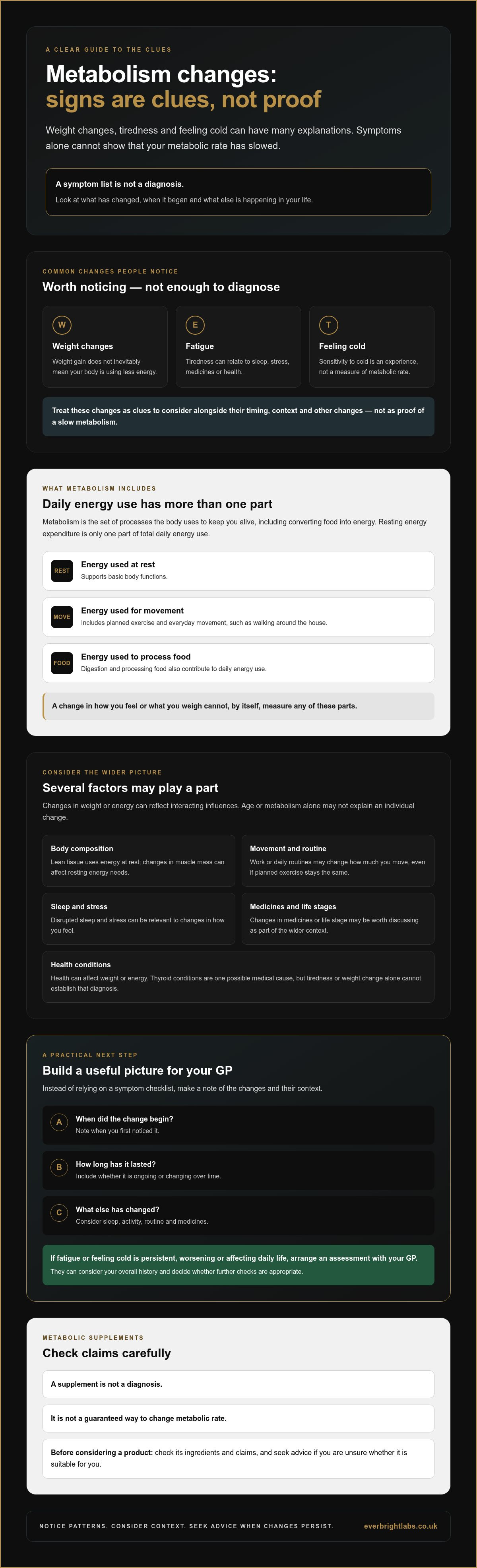
At a glance: Weight gain, tiredness or feeling cold are sometimes described as signs of a slowing metabolism, but none proves that metabolic rate has fallen. Treat symptoms as clues to consider alongside their timing, context and other changes, not as a diagnosis.
Resting energy expenditure, the energy your body uses to maintain basic functions at rest, is only one part of total daily energy use. Movement and the energy used to digest and process food also contribute. A change in how you feel or what you weigh can’t, by itself, measure any of these components. No symptom list can independently diagnose a slow metabolic rate.
Is unexplained weight gain a sign of a slower metabolism?
Weight can change for several interacting reasons, so gain doesn’t inevitably mean your body is burning fewer calories. Food intake, everyday movement, sleep, medicines, life-stage changes and health can all be relevant. For example, a shift to less active work may alter daily energy use even if planned exercise stays the same. Look at patterns over time and any wider changes rather than treating weight alone as proof.
Can tiredness or feeling cold reveal a metabolic problem?
Fatigue and increased sensitivity to cold have many possible explanations, including changes in sleep, stress, medicines or health. They’re experiences, not measurements of metabolic rate or a clinical diagnosis. If either symptom is persistent, worsening or affecting daily life, arrange an assessment with your GP. They can consider your overall history and decide whether further checks are appropriate.
The useful question isn’t simply whether a symptom appears on a metabolism checklist. Consider what has changed, when it began and whether other factors could help explain it. This can help you avoid self-diagnosis while recognising when a lasting change deserves medical advice.
Why metabolism may change: age, muscle, health and daily routines
Your body’s daily energy use comes from more than its resting needs. It also includes energy used for movement, from planned exercise to walking around the house, and the energy needed to digest and process food. These parts can shift with your body composition and routine, so a change in weight or energy doesn’t automatically mean your metabolism has slowed.
Metabolic rate describes energy use; body weight reflects the combined influence of energy intake, energy expenditure and other biological and life factors. This distinction helps put the signs of a slowing metabolism in context. Harvard Health Publishing explains what can and cannot influence metabolic rate, including why metabolism alone doesn’t explain every change on the scales.
How do age and muscle mass affect energy use?
Lean tissue uses energy at rest, so body composition can influence resting energy needs. If muscle mass changes, those needs may change too, although this is only one part of total daily energy use. Activity patterns can shift alongside body composition. For example, a change in work or routine may mean less movement, while strength activity may help maintain muscle. Age can be one influence, but it isn’t a complete explanation for an individual’s weight or energy changes.
Which health and lifestyle factors deserve consideration?
Look at the wider context rather than attributing a change to age or metabolism alone. Sleep disruption, shifts in activity or eating patterns, medicines and life-stage changes may all be relevant. Health conditions can affect weight or energy as well. Thyroid conditions are one possible medical cause, but tiredness or weight change alone can’t establish that diagnosis.
If you’re trying to make sense of changes after 40, our guide to why metabolism may change after 40 explores age-related factors without treating age as the sole cause. If symptoms persist, note changes in sleep, routine or medicines to discuss with your GP. This context can help a clinician assess what may be contributing and whether further checks are appropriate.
Slow metabolism or something else? How to interpret common changes
Weight, energy and temperature changes can feel connected, but they may have different causes or reflect several factors at once. A symptom can be a reason to investigate, not a diagnosis. Consider the signs of a slowing metabolism alongside how long changes have lasted, what else has changed and how they affect daily life.
| Observed change | Possible explanations | Sensible next step |
|---|---|---|
| Gradual weight gain | Changes in eating patterns, activity, sleep, medicines, life stage or health may contribute. Lower energy expenditure is only one possibility. | Consider what has changed over time. Seek advice if the gain is unexplained, persistent or concerning. |
| Ongoing tiredness | Sleep disruption, stress, medicines and a range of health issues may affect energy. Tiredness doesn’t measure metabolic rate. | Note when it began and whether it’s worsening or interfering with everyday activities. Discuss persistent fatigue with a GP. |
| Feeling unusually cold or warm | Temperature sensitivity can be affected by health, medicines and surroundings, amongst other factors. It isn’t specific to a metabolic condition. | Record when it occurs and any accompanying changes. Ask a GP for advice if it persists or concerns you. |
Could thyroid problems explain weight or energy changes?
Hypothyroidism, in which the thyroid gland produces too little thyroid hormone, is one possible cause a clinician may consider when assessing symptoms such as tiredness or weight change. These symptoms can also occur for other reasons, so they can’t confirm thyroid disease. A GP may consider your medical history, examine you and arrange blood tests if appropriate. Test results need clinical interpretation, not self-diagnosis.
When should persistent symptoms be discussed with a GP?
Contact your GP about changes that are persistent, unexplained, worsening or concerning, particularly if they’re affecting daily life. You don’t need to identify the cause before asking for help. For severe or rapidly developing symptoms, seek urgent advice. In England, NHS 111 can help with urgent concerns that aren’t life-threatening; call 999 or go to A&E for a life-threatening emergency. Routes can vary across the UK, so check current NHS guidance on when to call 999 and follow the advice for your nation.
Age alone doesn’t explain every change. Harvard Health Publishing discusses evidence that challenges simple assumptions about how metabolism changes over the lifespan. That’s another reason to assess your symptoms and circumstances rather than relying on a checklist.
What to do if you think your metabolism is slowing
Noticing possible signs of a slowing metabolism can prompt concern, but guessing at the cause rarely gives a clear answer. A simple record of changes can help you see patterns and give a GP useful context. Tracking is for awareness and discussion, not a way to diagnose a metabolic condition.
Use this step-by-step plan:
- Observe the pattern. Note what has changed, when it began, whether it’s ongoing and how it affects daily life. If you’re tracking weight or energy, focus on the overall pattern rather than reacting to a single day.
- Review the context. Consider recent changes in sleep, activity, eating patterns, stress or life stage. Record medicines and supplements too, as these may be relevant to discuss with a clinician.
- Seek advice. Contact your GP if changes are persistent, unexplained, worsening or concerning. You don’t need to work out the cause before making an appointment.
- Agree suitable next steps. Ask what possible causes may warrant assessment, whether any checks are appropriate and when to follow up. Base next steps on your circumstances and clinical advice, not a generic online checklist.
How can you prepare for a GP appointment?
Bring a brief timeline: when symptoms started, how they’ve changed and what you’re finding harder to do. List current medicines and supplements, including any recent changes, and mention relevant changes in sleep, activity or life stage. Don’t stop prescribed treatment without speaking to your prescriber. You can also ask what possible explanations should be considered and what follow-up would make sense.
Which everyday habits support overall metabolic health?
Focus on sustainable foundations rather than trying to force your metabolic rate to change. Regular movement that fits your ability and routine, with suitable strength-building activity where appropriate, supports general health. Balanced, adequate eating and consistent sleep are also useful foundations. They aren’t a substitute for assessing persistent symptoms, and they don’t guarantee weight change or a faster metabolism.
Avoid crash diets, extreme exercise and products promising a rapid metabolic boost. If you’re considering supplements, assess the label and claims carefully. Discuss them with a GP or pharmacist if you have health concerns or take medicines. You can review Everbright Labs’ Fat Metaboliser product information as an optional supplement, not as a way to diagnose or treat a slow metabolism. The product is described as stimulant-free, and its ingredient information can help you assess whether it’s relevant to your preferences.
Metabolic supplements: what they can and cannot do
Supplements may provide nutritional support, but that’s different from diagnosing a health problem, treating its cause or reliably changing your metabolic rate. The signs of a slowing metabolism can’t be confirmed or corrected simply by taking a product. If weight, energy or other changes persist, seek appropriate medical advice rather than using a supplement as a substitute for assessment.
Can a supplement diagnose or reverse a slow metabolism?
No. A supplement isn’t a diagnostic test and can’t establish whether you have a thyroid condition or another health issue. Nor should a product be assumed to reverse a slow metabolism, cause weight loss or correct an underlying condition. Evidence and authorised health claims depend on the ingredient, dose and intended use, so a claim about one ingredient doesn’t automatically apply to every product or formulation.
Before using a supplement, read its current label and check whether it’s suitable for you. Ingredients can interact with medicines or be inappropriate in some circumstances. If you take prescribed medicines, have a health condition, are pregnant or breastfeeding, or are unsure about suitability, ask a pharmacist or GP—you can check out Prime Response Pharmacy for professional pharmacy guidance. Don’t stop prescribed treatment to try a supplement.
How to assess supplement claims without being misled
Look for clear, fully disclosed ingredient information and evidence that relates to the actual formulation and the specific claim being made. Be cautious of guaranteed results, dramatic timelines or promises to target one symptom. A product’s name or marketing language isn’t proof that it changes metabolic rate.
Everbright Labs describes its Fat Metaboliser as stimulant-free. That description doesn’t establish that it diagnoses, treats or reverses a slow metabolism, and it shouldn’t be viewed as a proven remedy. Check current label information and any authorised UK health claims before deciding whether it’s relevant to you. To review the formulation, explore Fat Metaboliser ingredients and formulation as part of an informed choice, not as a replacement for medical advice.
Take the next step with clarity, not guesswork
Changes in weight, energy or temperature can raise questions, but the signs of a slowing metabolism can’t identify the cause on their own. Metabolism is only part of a wider picture shaped by your body, health and daily routines. If changes persist, worsen or concern you, speak with your GP rather than relying on a symptom list or supplement to provide a diagnosis.
Keep the next step practical: note what has changed, consider the surrounding context and seek advice where needed. Sustainable habits can support general wellbeing, but be wary of promises to rapidly boost metabolism or guarantee results.
If you’re considering a supplement, review its formulation and claims with care. Everbright Labs’ products are made in GMP and HACCP certified UK facilities, and the company was founded and formulated by a Chemical Engineer and an Applied Biologist. These details can inform your product research, but they don’t establish a supplement as a treatment for a slow metabolism.
If a stimulant-free supplement fits your informed choice, explore Everbright Labs and review the Fat Metaboliser formulation. Make your decision with care, and ask for medical support when you need it.
Frequently Asked Questions
Is unexplained weight gain always a sign of a slow metabolism?
No. Weight can change for several reasons, including shifts in eating patterns, activity, sleep, medicines, body composition and health. Metabolism is one part of a wider picture, and weight gain alone can’t identify the cause or show that your body is using less energy. If the change is persistent, unexplained or concerning, discuss it with your GP rather than assuming your metabolic rate is responsible.
Can a slow metabolism make you tired or feel cold?
These symptoms can have many possible explanations and don’t prove that your metabolism is slow. Persistent tiredness or feeling unusually cold may be worth discussing with a healthcare professional, particularly if the symptoms are new, ongoing or affecting daily life. A clinician can consider your wider health history and decide whether an assessment or tests are appropriate. Avoid trying to diagnose yourself from an online symptom list.
How do you know if your metabolism is slowing down?
There isn’t a reliable checklist of everyday symptoms that confirms a slowing metabolism. Changes in weight, energy or body composition may prompt questions, but they can be influenced by many factors. A clinician can assess your symptoms in context and arrange investigations if appropriate. Note what has changed and when it began, then seek advice if the changes persist, worsen or cause concern. The signs of a slowing metabolism aren’t a diagnosis.
Can thyroid problems cause weight gain and fatigue?
Yes, thyroid conditions can be among the medical causes a clinician considers, but weight change and fatigue can also have many other explanations. Those symptoms alone can’t confirm a thyroid problem. If they persist or concern you, contact your GP and describe when they started and how they affect you. Your clinician can decide whether your medical history, an examination or blood tests are appropriate for your situation.
Does metabolism naturally slow with age?
Metabolic needs and body composition can change over time, but age alone doesn’t explain every shift in weight or energy. Activity, muscle mass, sleep, medicines, health and life-stage changes may all be relevant. Don’t assume a new symptom is inevitable or simply age-related. If changes are persistent or unexplained, discuss them with a healthcare professional who can consider your individual circumstances and whether further assessment is useful.
Can you speed up a slow metabolism naturally?
Be cautious of promises to dramatically speed up metabolism. Regular movement, suitable strength-building activity, balanced eating and adequate sleep can support general health, but they don’t guarantee a change in metabolic rate or resolve an underlying medical cause. Choose sustainable habits that suit your health and routine. Avoid extreme diets, punishing exercise plans and products marketed as quick fixes, and seek professional advice if symptoms persist.
Do metabolism supplements work, and are they safe?
Effects and safety depend on the specific ingredients, amounts, evidence, medicines and your health circumstances. Marketing claims alone don’t prove a product is effective, and a supplement can’t diagnose or treat an underlying condition. Read the current product label and check whether the claims apply to that formulation. If you have a health condition, take medicines or are unsure about suitability, ask a pharmacist or GP before using it.
Share:
Combatting Age-Related Fatigue: The Science of Restoring Cellular Energy
Weight Loss Without Heart Palpitations: Safer Steps for 2026