

What if feeling more tired than you used to isn’t a failure of willpower, but a change in how your cells produce and use energy? Persistent brain fog, slower recovery after activity and reaching for caffeine just to get through the day can make ageing feel like an uphill climb. Combatting age-related fatigue starts with understanding the biology behind those changes, not simply pushing harder.
Ageing can affect cellular processes involved in energy production, including pathways that rely on NAD+. This molecule supports essential functions in the body, though research into whether raising NAD-related biomarkers consistently improves everyday health outcomes is still developing. Caffeine may temporarily make you feel more alert, but it doesn’t address the underlying causes of fatigue.
In this article, you’ll learn how cellular energy changes with age and explore practical, science-led ways to support everyday energy. We’ll look at the roles of NAD+ and mitochondria alongside sleep, nutrition, movement and stress management, so you can identify useful starting points and know when persistent tiredness needs attention.
Key Takeaways
- Learn how persistent fatigue differs from ordinary tiredness, and why changes in cellular energy production may be part of the picture.
- Understand how mitochondria, NAD+ and ATP work together to support the energy your cells use.
- See why caffeine can temporarily mask sleepiness rather than create energy, and consider habits that support more sustainable alertness.
- Explore practical approaches to combatting age-related fatigue, including sleep, nutrition, movement and potential nutrient support.
- Find out how Everbright Labs’ stimulant-free approach and Timeless NAD+ Support, formulated with NR, fit into the wider conversation about cellular health.
Beyond "Feeling Tired": The Biology of Age-Related Fatigue
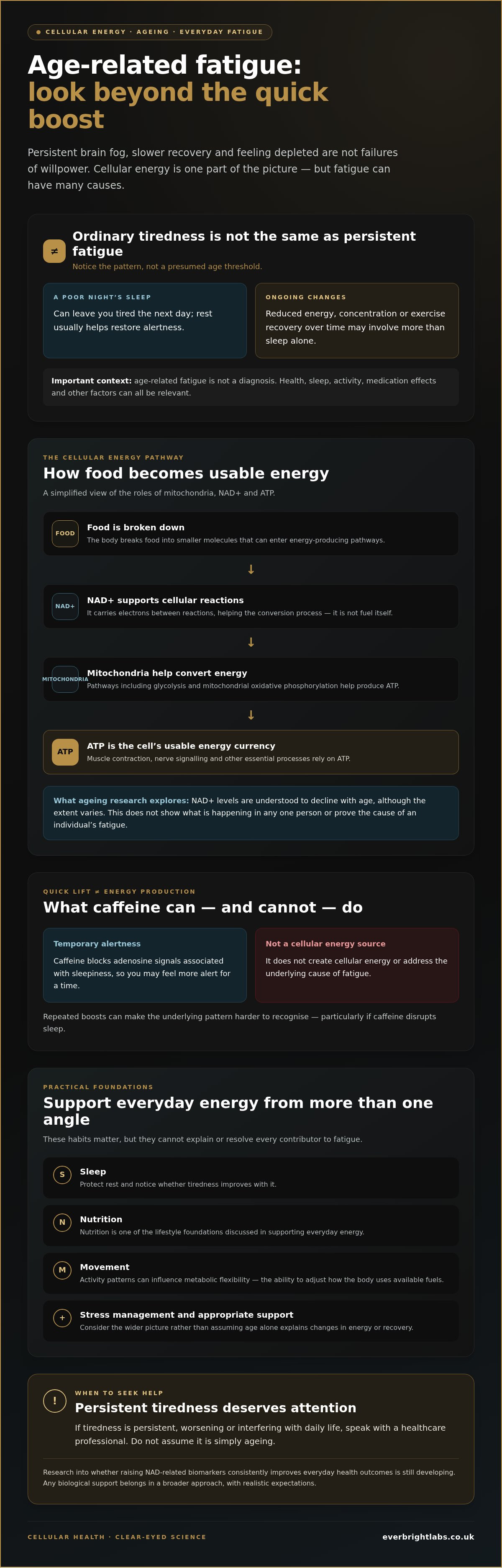
A poor night’s sleep can leave you tired the next day, and rest usually helps restore alertness. Persistent fatigue is different. If your energy, concentration or exercise recovery remain reduced over time, the cause may involve more than sleep alone. Age-related fatigue describes a possible shift in the systems that produce and use energy. It isn’t a diagnosis, and ongoing tiredness can have many causes.
One process researchers study is cellular senescence. Senescent cells stop dividing but don’t always leave the body; they can release signals that affect nearby cells and tissues. This is one part of the biology of ageing, not a direct explanation for every afternoon slump. Mitochondria, which help supply cells with usable energy, are also relevant to ageing research. The mitochondrial theory of ageing explores how mitochondrial changes may contribute to the ageing process.
The 30-Year Turning Point
There isn’t a universal, evidence-backed birthday when energy suddenly declines, or one statistic that describes everyone’s experience. Changes can emerge gradually and vary with health, sleep, activity and other factors. Taking longer to recover after exercise or finding an afternoon dip harder to shake may be worth noticing, but neither is proof of an age-related problem.
Metabolic flexibility is the body’s ability to adjust how it uses available fuels, including carbohydrates and fats. It helps the body adapt to changing demands, such as moving from rest to exercise. Age alone doesn’t determine this capacity, but activity patterns, nutrition and health can influence it. Pay attention to changes in recovery and day-to-day energy rather than assuming there is a particular age threshold.
Why Lifestyle Changes Aren’t Always Enough
It can be dispiriting to eat well, stay active and protect your sleep yet still feel depleted. Those habits remain foundational, but they can’t explain or resolve every contributor to fatigue. Medication effects, health conditions and biological changes may also play a part. If tiredness is persistent, worsening or interfering with daily life, speak with a healthcare professional rather than assuming it’s simply ageing.
Traditional “energy boosters” may make you feel temporarily more alert without addressing why energy feels low. Caffeine, for example, blocks adenosine signals associated with sleepiness; it doesn’t create cellular energy. Relying on repeated boosts can make it harder to recognise the underlying pattern, particularly if caffeine disrupts your sleep. Combatting age-related fatigue means looking beyond a quick lift and considering biological factors alongside diet, movement and rest.
If changes in weight or energy have left you wondering what happens to metabolism after 40, our guide to why metabolism may slow down after 40 explores related factors. Lifestyle foundations matter, but some people may also consider evidence-informed biological support as part of a broader approach, with realistic expectations and appropriate professional guidance.
The Mitochondrial Engine: How NAD+ Levels Dictate Your Vitality
Mitochondria are often described as the cell’s power plants because they help convert energy from food into a form cells can use. They’re not the only part of the energy system, and fatigue has many possible causes. The National Institute on Aging’s guide to Fatigue in Older Adults is a useful reminder that persistent tiredness shouldn’t automatically be attributed to ageing alone.
Nicotinamide adenine dinucleotide, or NAD+, is a coenzyme involved in numerous cellular reactions, including those that help mitochondria generate energy. NAD+ levels are understood to decline with age, although the extent varies. A population-level estimate can’t show what’s happening in any one person, and low NAD+ shouldn’t be assumed to explain an individual’s fatigue. It is one reason NAD+ is relevant to research on cellular ageing.
ATP: The Currency of Human Energy
Adenosine triphosphate (ATP) is the cell’s immediately usable energy currency. Muscle contraction, nerve signalling and other essential processes rely on ATP. In broad terms, the body breaks down food into smaller molecules. Through pathways including glycolysis and mitochondrial oxidative phosphorylation, energy from those molecules helps produce ATP. NAD+ carries electrons between reactions in this process, supporting the conversion rather than acting as fuel itself.
Ageing can affect mitochondrial function and other parts of this interconnected system, but there isn’t one universal point at which energy production “breaks down”. Sleep, health conditions, nutrition and activity also influence how a person feels. The useful question is not simply how to feel stimulated, but how to support the body’s underlying energy processes. In short, NAD+ is a coenzyme involved in reactions that help mitochondria convert nutrients into usable cellular energy.
Sirtuins and the Repair Mechanism
Sirtuins are enzymes involved in cellular processes such as gene regulation and stress responses. They require NAD+ to function, which is why researchers study the relationship between NAD+ availability, cellular maintenance and ageing. Calling them “longevity genes” can overstate the science: sirtuins don’t guarantee longevity, and a relationship between NAD+ and cellular repair doesn’t prove that raising NAD+ will resolve fatigue.
For readers exploring this pathway, Everbright Labs’ Timeless NAD+ Support with NR is one example of a supplement formulated with a NAD+ precursor. It isn’t a substitute for investigating persistent symptoms or for the foundations of health, such as adequate sleep and a balanced diet. Combatting age-related fatigue calls for realistic expectations: cellular energy is one part of the picture, not a single switch that explains or fixes everything.
The Stimulant Trap: Why Caffeine Cannot Fix Ageing Fatigue
A coffee can make a demanding afternoon feel more manageable, but alertness isn’t the same as newly produced energy. Caffeine works mainly by blocking adenosine receptors. Adenosine builds during waking hours and contributes to sleep pressure; when its signal is temporarily masked, you may feel less sleepy even though your body still needs rest.
“Borrowed energy” can be a useful description, as long as it’s not taken literally. Caffeine doesn’t drain a fixed energy reserve, but its effects can wear off while the original tiredness remains. Regular use can also lead to dependence, and reducing intake may bring temporary symptoms such as headache or fatigue. That cycle can encourage another dose without addressing why your energy is low.
The Impact on Sleep Architecture
Caffeine taken later in the day can make it harder to fall asleep or affect sleep quality, though sensitivity and timing differ between people. Poorer rest may then contribute to tiredness the next day. A consistent sleep schedule and a wind-down routine help support circadian rhythm, the body’s internal timing system. They’re foundations for wellbeing, not a guaranteed way to reverse age-related changes in cellular function.
Metabolic Stress and Jitters
Some people experience palpitations, jitteriness or a temporary rise in heart rate or blood pressure after caffeine. Responses vary with dose, health, medication and individual sensitivity; age alone doesn’t establish that everyone over 40 will react more strongly. Persistent or concerning symptoms warrant advice from a healthcare professional. Caffeine-related changes in cortisol are not the same as evidence of “adrenal fatigue”, a term that shouldn’t be used as a diagnosis.
A more sustainable approach supports everyday energy without relying on stimulants to mask sleepiness. It starts with sleep, balanced nutrition and regular activity, while recognising that persistent fatigue may need medical assessment. Biological support is different from stimulation: it aims to support normal cellular processes rather than create a rapid sensation of alertness. Research into NAD+ and cellular communication is still developing. Harvard Medical School has discussed findings on restoring cellular communication, but these findings shouldn’t be treated as proof that a supplement will resolve fatigue.
Everbright Labs takes a stimulant-free approach to its formulations, including Timeless NAD+ Support, which uses the NAD+ precursor NR. This is a product option to explore, not a substitute for sleep, a balanced lifestyle or clinical advice. Combatting age-related fatigue means distinguishing a temporary alertness boost from broader support for cellular health, and setting realistic expectations for both.
A Science-Led Protocol for Combatting Age-Related Fatigue
There’s no single supplement or routine that reliably reverses fatigue. Start with the foundations: consistent sleep, balanced meals and regular movement. If tiredness persists or affects daily life, seek medical advice to check for underlying causes before assuming it’s an age-related energy decline.
Nicotinamide riboside (NR) is a precursor the body can use to make NAD+, a coenzyme involved in cellular energy metabolism. Human studies show that oral NAD+ precursors can raise related biomarkers, but whether this consistently improves everyday energy or other health outcomes remains uncertain. Treat supplementation as a considered option, not a guaranteed solution, and check its suitability with a healthcare professional, particularly if you take medication or have a health condition.
Nutritional Co-factors for Energy
Mitochondrial nutrients are often discussed in this context, but their roles and the evidence for them differ. CoQ10 participates in mitochondrial energy production, whilst PQQ is being researched for its possible effects on mitochondrial function. L-carnitine helps transport fatty acids into mitochondria for use in energy metabolism; acetyl-L-carnitine is one form. B vitamins act as co-factors in reactions that release energy from food, but taking more than you need isn’t necessarily beneficial. Chromium and choline have roles in normal metabolism, yet neither should be presented as a guaranteed fix for energy dips or blood sugar swings.
Supplements are most relevant when they address a specific need, and formulations vary. If you’re considering a product, review its disclosed ingredients and quantities rather than relying on broad promises. Everbright Labs’ Fat Metaboliser supplement is one option to examine; check its ingredient information and consider whether it suits your circumstances.
Biological Rhythms and Recovery
Build “energy hygiene” around repeatable cues rather than a rigid schedule. Get outdoor light soon after waking where practical, keep wake and sleep times reasonably consistent, and add brief movement breaks during sedentary periods. A short walk after a meal can be a manageable way to introduce movement. Match demanding tasks to the times you tend to feel most alert, then protect the evening wind-down that helps prepare you for sleep. In addition to daily routines, home wellness technologies—such as molecular hydrogen devices developed by Pureffect—are increasingly explored by those seeking targeted support for recovery and cellular vitality.
Non-sleep deep rest (NSDR) describes guided relaxation practices, such as body scans or quiet, focused rest. These may help some people feel calmer, but evidence doesn’t establish NSDR as a way to rejuvenate cells or replace sleep. Nutrient absorption depends on the nutrient, food and individual context. For practical information, see this overview of nutrient absorption for metabolic health.
If you’re considering a product related to cellular energy, explore Timeless NAD+ Support with NR and assess its ingredients alongside your needs. A steady routine and realistic expectations matter: biological support works best as part of a broader plan, not as a substitute for sleep, nutrition, movement or medical assessment.
Everbright Labs: Precision Support for Your Cellular Health
Everbright Labs takes a science-led, stimulant-free approach to supplements. Its formulations are developed by a Chemical Engineer and an Applied Biologist, with fully disclosed ingredients rather than vague proprietary blends. Products are manufactured in UK facilities certified to GMP and HACCP standards. This information can help you assess a product alongside the evidence for its ingredients.
For people exploring cellular energy support, Timeless NAD+ Support uses nicotinamide riboside (NR), a precursor the body can use to produce NAD+. Human research shows that oral NAD+ precursors can raise related biomarkers, but evidence that this reliably improves fatigue or everyday vitality is still developing. It’s best viewed as one possible part of a broader approach, not a treatment or guaranteed result.
Why We Use Timeless Nicotinamide Riboside
NR is one of the NAD+ precursors studied in human research. However, it wouldn’t be accurate to claim it has superior bioavailability to other precursors without clear comparative evidence. Timeless NAD+ Support also contains trans-resveratrol and wheat germ extract providing spermidine, as stated in the product’s daily-serving information. Check the label for ingredient quantities and suitability, and ask a healthcare professional for advice if you take medicines or have a health condition.
Rules for novel foods and supplements can change, so avoid relying on broad online claims about NR’s UK status. Check current official guidance and product information for the specific ingredient and formulation. Transparent labelling helps you assess what’s included; it doesn’t, by itself, establish that a supplement is suitable for everyone or will relieve fatigue.
The Everbright Labs Bundle: A Broader Approach
The Everbright Labs Bundle brings together the brand’s NAD+ and metabolic support products. The rationale is to address different biological areas, including cellular energy pathways and fat metabolism, rather than treating them as interchangeable. That doesn’t prove that combining supplements is more effective or that the bundle will improve energy. Consider your individual needs, review each product’s ingredients and directions, and avoid duplicating nutrients from other supplements.
For combatting age-related fatigue, supplements should sit alongside the basics: consistent sleep, balanced nutrition and regular movement. Persistent or worsening tiredness deserves medical assessment, since it can have causes beyond ageing or cellular energy. If you’re considering NR support, review the disclosed ingredients in Timeless NAD+ Support as part of an informed decision.
Take a Steadier Approach to Cellular Energy
Age-related fatigue isn’t simply a matter of willpower. Mitochondria, NAD+ and other biological processes help explain how cells produce energy, while sleep, nutrition, movement and health conditions also shape how you feel. Caffeine may temporarily mask sleepiness, but it can’t replace the foundations of recovery or explain persistent exhaustion.
Combatting age-related fatigue starts with a sustainable approach: support daily habits, investigate ongoing symptoms with a healthcare professional, and treat supplements as one possible part of the picture. Research into NAD+ precursors is developing, so realistic expectations matter.
Everbright Labs brings a science-led perspective to this area. Its formulations are developed by a Chemical Engineer and an Applied Biologist, use fully disclosed ingredients and are manufactured in UK facilities certified to GMP and HACCP standards. Timeless NAD+ Support uses NR, an NAD+ precursor, but it isn’t a guaranteed fix or a substitute for medical advice.
To explore Everbright Labs’ supplement range and consider whether Timeless NAD+ Support suits your needs, visit Everbright Labs. Make an informed choice by reviewing the product information and seeking professional advice if you’re unsure.
Frequently Asked Questions
What is the main cause of age-related fatigue?
There isn’t one main cause; persistent fatigue can have several contributors. Ageing may affect cellular energy processes, including mitochondrial function and NAD+ metabolism, but sleep disruption, stress, medication effects and health conditions can also play a part. Don’t assume tiredness is an inevitable part of getting older. If it persists, worsens or interferes with daily activities, speak with a healthcare professional to investigate possible causes.
How long does it take for NAD+ supplements to start working?
There’s no reliable, established timeframe for noticing an energy benefit from an NAD+ precursor supplement. Human studies indicate that oral precursors such as NR can change NAD-related biomarkers, but that doesn’t confirm when, or whether, someone will feel different. Results may vary, and supplements aren’t a rapid fix for fatigue. Follow the product label, and discuss ongoing symptoms or supplement use with a healthcare professional.
Can I take NAD+ support if I already drink coffee?
Drinking coffee doesn’t automatically mean you can’t take an NAD+ support supplement, but suitability depends on your health, medicines and the product’s full ingredients. Everbright Labs’ Timeless NAD+ Support is described as stimulant-free, so it doesn’t add caffeine as an energy-boosting ingredient. Caffeine can still affect sleep or cause unwanted effects for some people. Check the label and ask a healthcare professional if you’re unsure.
Is age-related fatigue the same as chronic fatigue syndrome?
No. Age-related fatigue is a broad description of low energy that may occur alongside ageing; it isn’t a specific diagnosis. Chronic fatigue syndrome, also known as myalgic encephalomyelitis (ME/CFS), is a complex, long-term condition involving substantial fatigue and other symptoms. A person’s tiredness alone can’t establish whether they have ME/CFS. Seek medical advice for persistent fatigue, especially if it limits daily life or comes with other symptoms.
Why does Everbright Labs use NR instead of NMN?
Everbright Labs uses nicotinamide riboside (NR) as the NAD+ precursor in Timeless NAD+ Support. The company’s stated formulation choice doesn’t establish that NR is superior to other precursors or that it will relieve fatigue. Human research on oral precursors is developing, and changes in biomarkers don’t necessarily translate into noticeable benefits. Review the product’s ingredient information and discuss suitability with a healthcare professional if needed.
Are there any side effects to combatting fatigue with cellular supplements?
Side effects depend on the supplement, its ingredients and the individual, so “cellular support” shouldn’t be assumed to be risk-free. Some ingredients may cause unwanted effects or interact with medicines. Read the full label, follow its directions and consult a healthcare professional before use if you have a health condition, take medication or are unsure whether a product is suitable. Stop taking it and seek advice if you experience a concerning reaction.
How does metabolic health affect my daily energy levels?
Metabolic health relates to how the body processes and uses nutrients, including glucose and fats. These processes help supply energy to cells, so factors such as nutrition, activity, sleep and underlying health can influence how steady your energy feels. An afternoon slump isn’t enough to diagnose a metabolic problem. Regular meals, balanced nutrition and movement can support general health, while persistent tiredness merits discussion with a healthcare professional.
Is it possible to reverse age-related mitochondrial decline?
It isn’t yet established that age-related mitochondrial changes can be fully reversed in people. Research continues into ways to support mitochondrial function, but no supplement can be presented as a proven reversal of ageing or a guaranteed fatigue remedy. Regular physical activity, adequate sleep and balanced nutrition support overall health. If fatigue continues despite these foundations, seek medical advice rather than assuming mitochondrial decline is the cause.
Share:
Long-Term Benefits of Metabolic Support: A Science-Led Guide
Signs of a Slowing Metabolism: What Your Symptoms Can, and Cannot, Tell You