


The best supplement for an active person over 50 may be no supplement at all. If you walk, cycle, train or simply want to keep moving comfortably, it’s understandable to wonder whether age-targeted formulas can help with energy, strength or recovery. Supplements for active over 50s uk are best judged by the need they address and the evidence behind them, not the number on the label.
This guide explains how to compare supplement types by purpose, evidence, safety and fit with an active lifestyle. You’ll also see where food, training and recovery may matter more than another product, and why health conditions or medicines can make professional advice important before starting something new.
We’ll distinguish established guidance from trend-led promises, explain practical checks for ingredients and product quality, and outline sensible next steps. The aim isn’t a quick fix or a one-size-fits-all list, but a clearer way to decide whether a supplement has a useful role in your routine.
Key Takeaways
- Age alone doesn’t determine whether you need a supplement; start with a specific goal and your usual diet.
- Compare supplements for active over 50s uk by their intended purpose, evidence, clear labelling and potential cautions.
- Supplements can complement a varied diet, but they can’t replace balanced meals, training or recovery.
- Check for possible interactions with medicines or health conditions, and make one considered change at a time.
- Assess Everbright Labs options by their purpose and disclosed formulation, using the same evidence and safety criteria as for any supplement.
What should active adults over 50 consider before choosing supplements?
Wanting to stay strong, mobile and active is a good reason to review your habits, but turning 50 doesn’t automatically mean you need supplements. Ask whether a particular nutrient or product addresses a genuine gap or a defined goal in your routine. Your diet, activity, health history and medicines all influence what may be appropriate, so an age label alone can’t establish personal suitability.
A food supplement is a concentrated source of nutrients or other substances intended to add to the diet. For a straightforward overview of what dietary supplements are, see the general background on their purpose and forms. In practical terms, a supplement may add to a varied diet for a defined nutritional purpose; it isn’t a treatment for a health condition.
Start with your goal, not an age-labelled formula
Choose one specific goal before comparing products. You might be checking whether your diet provides enough of a nutrient, looking for practical support around training, or considering general wellbeing. These aims call for different evidence. A broad “50+” label describes a target audience, not what you personally need or whether a formula suits your circumstances.
Also distinguish maintaining an active routine from addressing a diagnosed health concern. If you have persistent symptoms, a known deficiency or a condition affecting diet or exercise, don’t try to solve it by choosing a supplement from the shelf. Speak with a GP or pharmacist, particularly if you take prescribed medicines, because some ingredients can interact with treatment.
Check the foundations before adding a supplement
Supplements are best considered as an addition, not a substitute for everyday foundations. Before buying, review whether your usual meals offer variety and adequate protein, and whether you’re drinking enough for your activity and circumstances. Regular movement matters too. Strength and balance activities can support an active lifestyle, while sleep and recovery help your body respond to exercise.
These basics aren’t a training plan, and they won’t resolve every nutritional gap. They do help clarify what you’re asking a supplement to do. If your goal relates to changes in body weight or energy as you age, read more about metabolism changes after 40 before treating an age-related product claim as an explanation.
For supplements for active over 50s uk, start with your goal, then consider your diet, health history and medicines. This gives you a more useful basis for comparing evidence than choosing by age alone.
How to compare supplements for active adults over 50
Once you’ve identified a goal, compare products by ingredient, amount provided and evidence for the outcome you’re considering. A nutrient’s role in the body doesn’t prove that every product containing it delivers a meaningful benefit. Research may also use a particular dose or population, so it won’t always apply directly to a finished formula.
A category name alone doesn’t establish effectiveness. The relevant question is whether the disclosed ingredients, amounts and evidence fit your specific goal. This matters when comparing broad terms such as “active ageing” or “metabolic support”.
Which supplement categories may be relevant to an active lifestyle?
These categories may be worth considering when they match an individual need. They aren’t a checklist for every active adult.
| Goal | Evidence question | Label check | Key caution |
|---|---|---|---|
| Address a possible vitamin or mineral gap | Is there a reason to suspect low dietary intake or a specific need? | Which nutrient, and how much per serving? | More isn’t automatically better; consider health conditions and medicines. |
| Make protein intake more convenient | Would a product solve a practical gap in your usual meals? | How much protein does a serving provide? | It’s an option for convenience, not a requirement if food meets your needs. |
| Explore metabolic or cellular support | Does evidence support the ingredient for the precise benefit claimed? | Are the ingredients and quantities fully stated? | Don’t assume a broad claim means better performance or longer life. |
For context on age-related dietary considerations, the British Nutrition Foundation outlines UK nutrition needs for over 50s. Use this guidance to frame questions about your diet, rather than assuming a general recommendation means every product or dose is right for you.
What to look for on a supplement label
Check the ingredient names and quantities, serving instructions, warnings and manufacturer information. A vague “proprietary blend” can make it difficult to tell how much of each ingredient you’ll receive or to compare it with the evidence. Clear quantities make assessment more practical, although transparency alone doesn’t prove a product works.
Look for traceable quality details, too. Everbright Labs fully discloses its ingredients and manufactures its products in GMP- and HACCP-certified UK facilities. If you’re assessing metabolic-support claims, read the science of fat burners, then compare the explanation with the product’s actual label. You can also review the Fat Metaboliser formulation against your goal and the same criteria. For supplements for active over 50s uk, evidence, amount and personal fit matter more than category labels.
Are supplements for active over 50s safe and worth considering?
A supplement may be useful if it fills a specific dietary gap or offers a practical way to support a defined goal. But “natural” and “50+” don’t mean suitable for everyone. Ingredients can cause unwanted effects or interact with medicines, and a product may offer little value if it doesn’t match your needs. Weigh potential convenience against uncertainty, personal relevance and ongoing cost.
| Potential benefit | What remains uncertain | Practical check |
|---|---|---|
| Convenience, such as making a nutrient easier to include in your routine | Whether you need that nutrient or already get enough through food | Review your diet and the amount stated on the label |
| Targeted support for a specific goal | Whether the evidence applies to your circumstances and the finished product | Look beyond broad claims to the ingredient, quantity and research |
| A product designed for an age group or active lifestyle | Whether the formula suits your health, medicines and other supplements | Consider personal advice before use if you have risk factors |
For supplements for active over 50s uk, “worth considering” means there’s a clear reason to use a product, its formulation is transparent, and its possible benefits make sense for you. It doesn’t mean it will improve performance or resolve symptoms.
When should you check for interactions or personal risks?
Get advice from a GP or pharmacist before starting a supplement if you take medicines, manage a diagnosed condition, have an allergy or have a planned procedure. Bring the product label, or a list of its ingredients, so they can consider the actual formulation. Check labels before combining products, too, as different formulas can contain overlapping ingredients. There’s no single safety rule that applies to everyone.
Persistent fatigue, pain or another new symptom deserves medical assessment rather than an attempt to mask it with a supplement. Symptoms can have different causes, so it’s important to identify them before deciding whether a product has a role.
How to assess evidence without overreading marketing
Separate three things: wording permitted for a product, early or preliminary research, and evidence that a specific outcome occurs in people. An authorised health claim has a defined meaning; it isn’t proof that every product using related language will deliver a noticeable result. Similarly, a study of one ingredient, dose or group doesn’t automatically validate a finished product with a different formulation.
Look for the precise claim and the evidence behind it, not just phrases such as “clinically studied”. In Great Britain, food supplements mustn’t claim to treat, prevent or cure disease. Keep that distinction in mind: a supplement may complement a routine, but it isn’t a substitute for medical care.
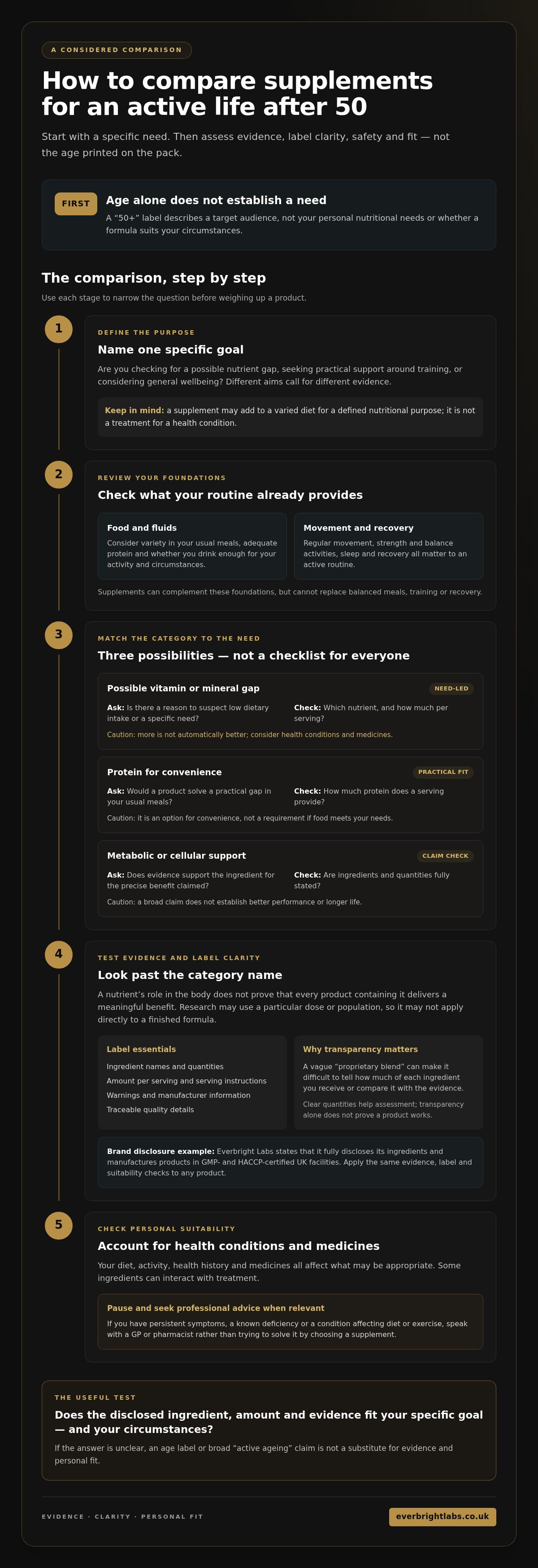
How to choose and use a supplement alongside an active routine
A supplement is most useful as part of a considered routine, not as a replacement for the habits that support it. Food, regular movement, strength and balance work, sleep and recovery all remain central. A product can’t compensate for an inconsistent routine, and taking several new supplements at once makes it harder to tell what, if anything, is helping.
A simple decision sequence before you buy
Use this process to move from a general intention to a choice you can review:
- Define one goal. Write down what you want to support and what a useful, realistic change would look like in everyday life.
- Assess your diet. Consider whether meals or a practical adjustment to your routine could address the need before adding a product.
- Compare the evidence. Match the product’s stated purpose and disclosed ingredients to your goal. For metabolic-support products, read about effective fat metaboliser supplements in the UK and distinguish evidence about an ingredient from claims about a finished formula.
- Check suitability. Read the full label, including serving instructions and warnings. If you take medicines or manage a health condition, seek advice from a GP or pharmacist before use.
- Review your experience. Follow the product-label directions and keep track of use, relevant changes and any unwanted effects.
Make one considered change at a time. Starting several products together can make it difficult to identify which one might be linked to a change or an unwanted effect. There’s no guaranteed timeline for results, so don’t treat a lack of quick change as a reason to increase use or add more products.
Review suitability and your experience over time
Keep a simple note of what you’re taking and how it fits around your usual meals and activity. If concerning symptoms arise, stop taking the product and seek appropriate advice. Don’t use a supplement to mask persistent fatigue, pain or other new symptoms; those warrant medical assessment. If your goal relates to changes in body weight, you can also explore age-related metabolic changes without assuming that a supplement is the answer.
For supplements for active over 50s uk, choose by purpose, use only as directed and reassess whether the product remains relevant to your routine. Explore Everbright Labs supplements and assess each option against your goal and its disclosed formulation.
How Everbright Labs fits into a considered supplement comparison
Assess Everbright Labs by the same criteria as any other supplement: purpose, disclosed formulation, evidence and personal suitability. Its products are stimulant-free, use fully disclosed ingredients and are manufactured in GMP- and HACCP-certified UK facilities. These details explain the company’s approach, but they don’t establish that a product is right for everyone or will produce a particular result.
What Everbright Labs makes transparent
Everbright Labs was founded and formulated by a Chemical Engineer and an Applied Biologist. These backgrounds provide context for its formulation approach, while its stated manufacturing standards and ingredient disclosure give you information to consider when comparing products. Transparency is a practical starting point: it lets you review what a product contains against its stated purpose and your own circumstances.
Before making a decision, read the current product label for the full ingredient list, quantities, directions and warnings. A transparent label helps you assess a formula, but it isn’t a substitute for checking evidence or considering advice from a healthcare professional if you have relevant health or medication concerns.
Choose by purpose, then decide whether a product fits
Fat Metaboliser is Everbright Labs’ product for metabolic support. That describes its intended category, not a guarantee of weight change. If this matches your goal, compare its current details with the evidence for the ingredients and claims, and consider how it fits alongside your usual routine. Review the Fat Metaboliser product details before deciding whether it merits further consideration.
Timeless NAD+ Support is designed to support cellular energy and healthy ageing. This purpose shouldn’t be read as a promise of greater vitality, improved performance or longer life. Consider whether the stated aim matches your goal, then assess the current formulation and label information. The Timeless NAD+ Support product details can help you examine the option in context.
For supplements for active over 50s uk, there’s no need to choose a product simply because it’s age-targeted. Compare the details carefully, consider whether the purpose fits your needs, and make an informed choice without expecting a quick fix.
Make your next supplement choice with confidence
Start with a specific need, not an age-labelled formula. Compare the ingredients and evidence with that goal, then consider your diet, activity, health history and medicines before deciding. A supplement may have a role, but it doesn’t replace balanced food, consistent movement or recovery.
For supplements for active over 50s uk, a measured choice is more useful than chasing a quick fix. Everbright Labs was founded and formulated by a Chemical Engineer and an Applied Biologist. Its products are stimulant-free, use fully disclosed ingredients and are manufactured in GMP- and HACCP-certified UK facilities. These details can help you assess the company’s approach, while your own needs remain central.
Compare product purposes and current label information, and seek advice from a GP or pharmacist if medicines or a health condition could affect suitability. Explore Everbright Labs’ science-led supplements and decide whether an option fits your goals. A thoughtful, steady approach can help you keep active with greater clarity and confidence.
Frequently Asked Questions
Which supplements are worth considering for active adults over 50?
Supplements are worth considering when they address a specific nutritional need or practical goal, not simply because you’ve reached a certain age. For supplements for active over 50s uk, start by reviewing your diet, activity, health conditions and medicines. Some UK guidance recommends vitamin D at certain times of year or life stages, but other products should be chosen according to individual need. Ask a GP or pharmacist if you’re unsure.
Can supplements improve energy or exercise performance after 50?
Some supplements may be relevant to a defined nutritional need, but age-targeted products can’t guarantee more energy or better exercise performance. Tiredness may relate to sleep, diet, recovery, medicines or an underlying health issue. If fatigue is persistent or new, seek medical advice rather than trying to mask it with a product. For training goals, consider food, hydration, regular activity and recovery alongside any supplement you’re assessing.
Are supplements for over 50s safe to take with prescription medicines?
Not always. Ingredients can interact with prescription medicines, and suitability may also depend on a diagnosed condition, allergy or planned procedure. Before starting a supplement, show its full label to your GP or pharmacist, including ingredient quantities and warnings. Check before combining products as well, since their ingredients may overlap. Don’t stop or change prescribed treatment to accommodate a supplement without advice from the clinician responsible for your care.
How much protein do active adults over 50 need each day?
There isn’t one daily amount that suits every active adult. The UK adult Reference Nutrient Intake for protein is 0.75 g per kilogram of body weight per day, as set by the Scientific Advisory Committee on Nutrition. This is a population reference, not an individual training prescription. Your needs and suitable food choices may depend on body size, activity, health and diet. A protein supplement can be convenient, but isn’t automatically necessary.
What should I look for on a supplement label in the UK?
Check that the label identifies the product as a “Food supplement” and gives ingredient names, quantities, recommended daily dose and relevant warnings. UK labels should also state not to exceed the recommended dose, that supplements shouldn’t replace a varied diet, and that they should be kept out of reach of children. Look for clear manufacturer details, read the full ingredient list, and follow the label directions.
Do active adults over 50 need a multivitamin?
No, being active or over 50 doesn’t automatically mean you need a multivitamin. Whether one is useful depends on your usual diet, individual circumstances and any identified nutrient gaps. A broad formula may include nutrients you already get enough of, so review its ingredients and amounts rather than assuming more coverage is better. UK guidance recommends vitamin D in specific circumstances, but that doesn’t make a multivitamin necessary for everyone.
Is it better to get nutrients from food or supplements?
Food should usually be the foundation: a varied diet supplies nutrients alongside energy, protein and other components that a supplement may not provide. A supplement can be useful as a targeted addition when there’s a specific reason, but it shouldn’t replace meals or a balanced diet. Consider what you regularly eat first, then assess whether a product addresses a genuine gap. If health conditions affect your diet, seek individual advice.
Share:
Foods That Boost Cellular Energy: What to Eat and Why
Cellular Rejuvenation Supplements: What Does the Science Actually Say?