


What do supplements for cellular repair actually do? It is more accurate to think of them as potential support for the body’s normal maintenance processes, not as a way to fix damaged cells. The phrase can sound like a promise of treatment, particularly when marketing blurs the line between biological research and proven results.
It is reasonable to ask whether a nutrient can make a meaningful difference. Cells constantly carry out processes that maintain their function, but a supplement cannot be assumed to repair damage or prevent disease. Evidence also varies: a change in a biological marker does not automatically mean a noticeable health benefit.
This article explains what cellular maintenance and repair involve, which nutrients may support normal cell function, and how to assess the evidence behind supplement claims. We will also look at products positioned around cellular energy and healthy ageing, including Timeless NAD+ Support, without presenting them as repair treatments. The aim is to help you make a measured decision based on biology, not quick-fix promises.
Key Takeaways
- Understand cellular repair as part of the body’s normal maintenance and response to damage, not as a direct effect promised by a supplement.
- Assess supplements for cellular repair by distinguishing support for normal function from changes in biomarkers and evidence of meaningful health outcomes.
- Compare nutrient categories by their proposed role and the strength and limitations of the research behind them.
- Start with your health goal, examine the evidence and claim, then decide whether a supplement is a relevant and cautious choice.
- Timeless NAD+ Support is positioned around cellular energy and healthy ageing. Everbright Labs states that its ingredients are fully disclosed and its products are made in GMP- and HACCP-certified UK facilities.
What does cellular repair mean, and can supplements support it?
“Cellular repair” describes the ordinary processes by which cells maintain their structures, replace worn or damaged components, and respond to problems. It is not a single switch that a product can turn on. Cells carry out these tasks as part of ongoing biological activity, with different processes responding to different kinds of wear or damage.
It is understandable to look for ways to support this activity, particularly when supplement claims promise to restore vitality or address age-related change. But cellular health is broader than energy levels or appearance. It includes the integrity of cell structures, the handling of genetic information, and the ability to carry out specialised functions. A claim about one marker or pathway does not necessarily show that a person’s cells work better overall.
Cellular maintenance is the body’s regulated upkeep of cell components and response to damage, not an outcome that can be attributed to a supplement by default. This distinction matters when assessing supplements for cellular repair: a nutrient may contribute to normal physiology, but that does not mean a capsule directly repairs cells.
What happens when cells maintain and replace components?
Cells continually make, modify and break down proteins, membranes and other components. Some are replaced through routine turnover; others are repaired or removed when they become faulty. These processes are regulated and vary by cell type and circumstance. They do not follow one universal reset programme.
Think of a cell as a working kitchen: equipment is cleaned, ingredients are restocked and damaged items are dealt with as needed. The kitchen is not made new each time a task is completed. Likewise, maintenance helps cells keep functioning, but it does not erase every effect of time or damage.
What can a supplement realistically contribute?
Nutrients provide materials or help support physiological processes. Their relevance depends on the nutrient, a person’s diet and needs, and the claim being made. If a nutrient is already available in sufficient amounts, taking more does not automatically make a process work better. A plausible biological mechanism is a reason to investigate an ingredient, not proof of a meaningful benefit in people.
Keep different levels of evidence separate. Research may show that an ingredient interacts with a pathway in a laboratory or affects a biomarker in a human study. Neither finding alone establishes a noticeable health improvement or proves that damage has been repaired. DNA repair, for example, describes specific cellular mechanisms that correct certain forms of genetic damage. The DNA repair overview explains how varied these mechanisms are.
Read claims precisely. “Supports normal function” is not the same as “repairs damaged cells”, and a supplement should not be presented as reversing ageing or treating disease. A measured approach starts by asking what an ingredient is intended to do, what evidence supports that effect in humans, and whether the claim goes beyond the evidence.
How cellular maintenance, energy production, and repair pathways work
Cellular maintenance draws on several connected systems. Cells obtain nutrients from the body and use them as building materials, as inputs to chemical reactions, and as fuel for producing adenosine triphosphate (ATP), a readily usable form of energy. That energy supports routine work such as moving substances across cell membranes, making proteins and maintaining internal structures. Requirements differ between cell types and depend on what each cell is doing.
Repair is related to this activity, but it is not the same as energy production. A cell needs energy to carry out many processes, yet more energy or a change in one metabolic marker does not demonstrate that damaged components have been repaired. The National Cancer Institute’s cellular repair definition offers a concise reference. Specific repair processes depend on what has been damaged and how the cell responds.
Cellular pathways interact as a network, not as isolated switches that a single nutrient can simply turn on. This is why supplements for cellular repair should be assessed against a specific process and a relevant human outcome, rather than a broad promise about “cellular health”.
Where do mitochondria and NAD+ fit?
Mitochondria are key sites of ATP production, particularly through processes that use energy from food. They are important, but they are not the sole source of cellular energy or the only determinant of cell health. Cells also depend on other structures, nutrient availability, blood supply and coordinated biochemical activity.
Nicotinamide adenine dinucleotide (NAD+) is a molecule involved in metabolic reactions, including those that help transfer electrons as cells process nutrients. It also participates in other cellular processes. Its biological role is well established, but that alone does not prove that increasing NAD+ through a supplement improves a person’s health or repairs cell damage. Tiredness and other symptoms are not a reliable way to identify a specific NAD+ level. Readers can explore the article on recognising signs of low NAD+ levels for more context.
How do cells respond to damage and oxidative stress?
Cells monitor and manage damage through distinct mechanisms. DNA maintenance systems can detect and correct some changes to genetic material, while protein quality-control processes help refold, break down or replace proteins that are damaged or no longer needed. These are ongoing, regulated activities, not a universal repair response that can be guaranteed by taking a particular nutrient.
Oxidative stress describes an imbalance involving reactive oxygen species and the body’s capacity to manage them. These molecules can contribute to damage when their levels or effects are excessive, but they also have normal roles in cell signalling. The goal is not to eliminate all reactive oxygen species. Antioxidants participate in the body’s wider chemical systems, but taking an antioxidant supplement does not guarantee a beneficial reduction in oxidative stress or lead to repair.
For readers interested in the relationship between NAD+ and cellular energy, Timeless NAD+ Support is positioned around cellular energy and healthy ageing, not as a cellular-repair treatment. This keeps the product’s stated focus distinct from the broader biology of maintenance and repair.
Which supplement categories relate to cellular health, and what does evidence show?
Products described as supporting cellular health can contain very different ingredients, each aimed at different biological processes. Comparing them under a single “repair” label obscures the important questions: what role is proposed, what has actually been measured in people, and whether that outcome matters to health. The categories below are not a ranking, and none should be treated as a proven way to repair cells.
| Category | Proposed role | Evidence caveat | Practical question |
|---|---|---|---|
| Vitamins and minerals | Contribute to normal physiological functions, including energy metabolism and the production or maintenance of body structures. | A recognised nutrient role does not show that extra intake improves function when someone already has adequate intake. | Is there a relevant dietary gap or need, rather than a general promise of “cell support”? |
| NAD+ precursors, including NR and NMN | May affect NAD+ availability, a molecule involved in metabolic reactions. | Human trials have shown increases in NAD+ levels, but evidence for tangible functional benefits remains developing and can be inconsistent. | Does the research measure only NAD+ levels, or a meaningful outcome as well? |
| Antioxidant nutrients and compounds | Participate in systems that manage oxidation and normal cell processes. | A mechanism observed in laboratory research does not establish a health benefit in people. Oxidative processes also have normal roles. | Is there relevant human evidence for this ingredient and intended outcome? |
| Creatine | Supports energy-related processes in muscle cells. | Human research on muscle energy does not establish a general cellular-repair effect. | Does the evidence relate to the tissue and goal I care about? |
| Spermidine and fisetin | Investigated for possible effects on cellular processes. | Evidence remains early-stage. Mechanisms or preliminary findings are not proof of a benefit in everyday health. | Are claims based on robust human outcomes or mainly preliminary research? |
How should readers interpret NAD+ support and antioxidant claims?
NAD+ is involved in energy metabolism, so a change in its level may show that an ingredient affects a relevant biological marker. On its own, it does not demonstrate repaired damage, improved day-to-day function or a longer healthy lifespan. Similarly, an antioxidant’s ability to interact with reactive molecules is a proposed mechanism, not a guarantee of benefit. The article on how NMN works in the body can provide further background on this precursor. NMN research should not be read as proof that every NAD+-related supplement produces the same results.
What can human studies establish about supplements?
Give greater weight to relevant human trials and systematic reviews than to laboratory findings alone. Check whether the research tested the same ingredient and formulation, at a comparable dose, in a population like the one being discussed. Also look at what researchers measured: a biomarker may change without a corresponding improvement in how people feel or function.
Small studies and short follow-up periods can leave important uncertainty, while differences in study design make results harder to compare. For supplements for cellular repair, the most useful evidence would support a specific, relevant human outcome, not just a plausible pathway or an appealing label. This keeps ingredient-specific findings in proportion.
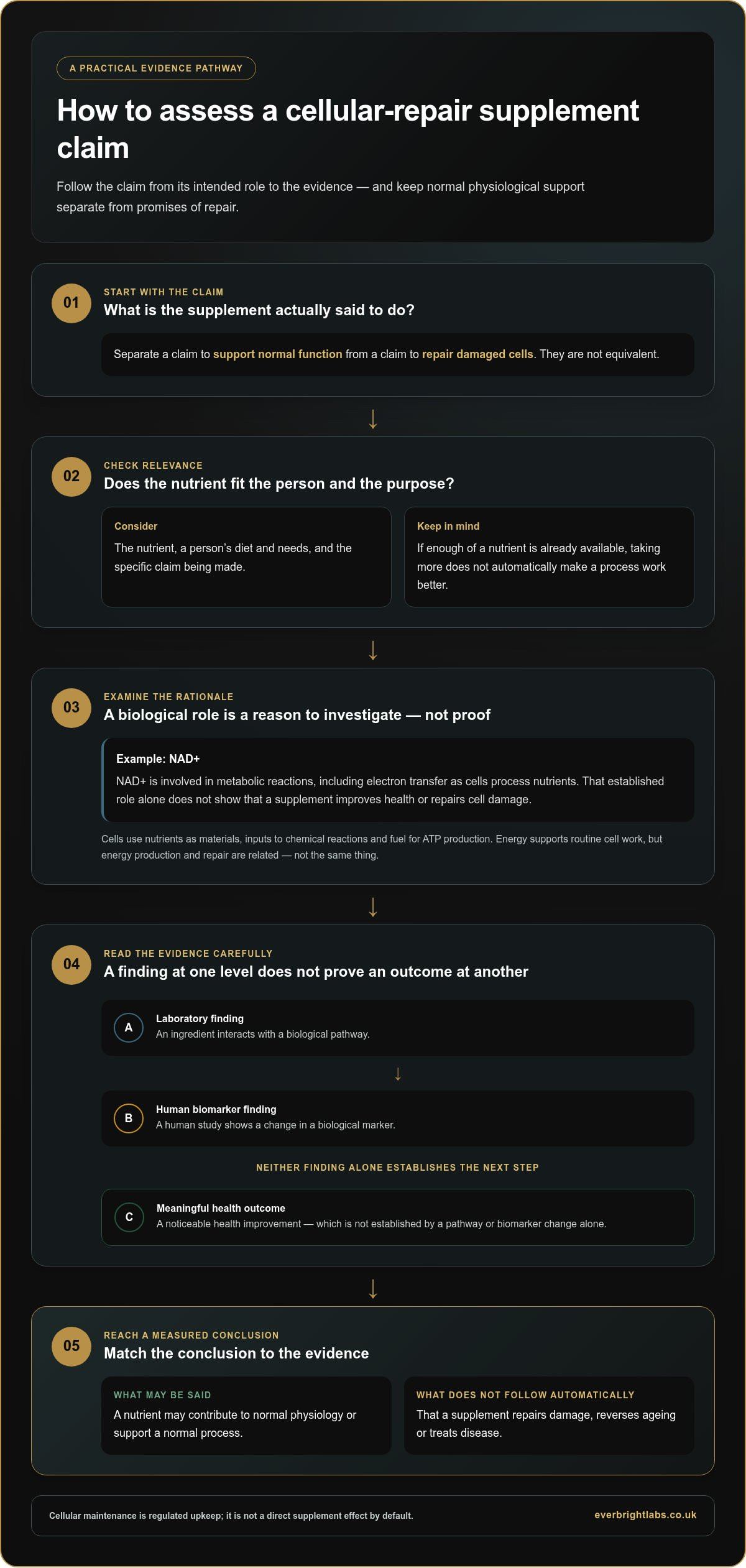
How to assess cellular repair supplement claims and choose carefully
A clear label and a scientific-sounding mechanism are not enough to establish that a supplement will deliver a meaningful benefit. Use this checklist to move from your health goal to a considered decision, without treating “cellular repair” as a guaranteed result.
- Define your health goal. Be specific about what you hope to support, such as normal energy metabolism. Persistent or unexplained symptoms need assessment, not a guess that a particular cellular pathway is responsible.
- Identify what the claim actually promises. Does it describe support for normal function, a measured biomarker, or a clinical outcome such as improved symptoms or day-to-day function? These are different levels of evidence. A change in a marker does not automatically demonstrate a benefit you can feel.
- Match the evidence to the ingredient and outcome. Look for human research on the same ingredient and formulation, with a relevant population and outcome. Evidence for a similar compound, a laboratory mechanism or one biomarker may not answer your question.
- Read the whole label. Check that ingredients are fully disclosed, serving information is clear and directions are provided. Consider whether the product’s stated purpose matches your goal and whether its marketing stays within what the evidence supports.
- Consider safety and quality information. Supplements do not replace a varied diet, prescribed care or professional advice. GMP and HACCP certification describe manufacturing systems; they do not prove clinical efficacy. A clear ingredient list and manufacturing information help you assess a product, but neither guarantees a health outcome.
- Make a cautious decision. Weigh the evidence, label transparency, safety and realistic expectations together. If the evidence does not support the promised outcome, or the claim is vague, it is reasonable not to proceed.
In brief, evaluate the evidence, ingredient transparency, safety and realistic expectations before deciding whether a supplement is appropriate.
Which label and evidence details deserve attention?
Check the precise ingredient, the amount per serving and the directions, then compare these with the research rather than relying on a category name or a familiar-sounding compound. Study results can vary with formulation, dose, population and outcome measured. A claim about “cellular support” is difficult to assess unless it identifies the normal function the product is intended to support.
Everbright Labs states that its ingredients are fully disclosed and its products are made in GMP- and HACCP-certified UK facilities. These details relate to transparency and manufacturing systems. They are not proof that a product repairs cells or produces a particular clinical result.
When should someone seek advice before supplementing?
Speak with a GP or pharmacist before taking a supplement if you use medicines, have a diagnosed condition, are pregnant or are breastfeeding. They can help consider possible interactions and whether supplementation is suitable. Do not stop or change prescribed treatment to use a supplement instead.
If a symptom persists, is unexplained or is affecting daily life, seek medical assessment rather than trying to self-treat it with supplements for cellular repair. For a measured approach to ingredient transparency and product information, explore Everbright Labs’ supplement range.
A measured approach to cellular health with Everbright Labs
Understanding the biology helps set realistic expectations: cellular energy, healthy ageing and cellular repair are related topics, but they are not interchangeable outcomes. A supplement’s positioning describes its intended focus; it does not establish that it repairs damaged cells or produces a particular result. A careful decision starts with a specific goal, evidence for that goal and clear product information.
How does Timeless NAD+ Support fit this topic?
Timeless NAD+ Support is positioned around cellular energy and healthy ageing. That makes it relevant to readers interested in these areas, but it should not be understood as a cellular-repair treatment. A product’s stated purpose is distinct from what independent human studies establish, and a biological rationale or change in a marker alone does not prove a meaningful health outcome.
Everbright Labs was founded and formulated by a Chemical Engineer and an Applied Biologist. That scientific background provides context for its approach to formulation, but it is not clinical evidence of efficacy. The company states that its ingredients are fully disclosed and its products are made in GMP- and HACCP-certified UK facilities. These facts relate to ingredient transparency and manufacturing systems; they do not guarantee a particular effect.
For readers whose interest is specifically cellular energy, cellular energy support describes the product’s positioning without implying that it repairs cells.
What does a responsible next step look like?
Before choosing among supplements for cellular repair, write down the health goal you want to address. Read the ingredient list and serving information, then compare the product’s stated purpose with the evidence for its ingredient and outcome. Keep expectations proportionate: support for a normal function is not the same as proof of improved health, and no supplement should replace a varied diet, prescribed care or appropriate professional advice.
Review any medicines you take and consider whether a GP or pharmacist should advise you before starting a supplement, particularly if you have a diagnosed condition, are pregnant or are breastfeeding. If your concern involves persistent or unexplained symptoms, seek medical assessment rather than assuming a supplement is the answer.
Cellular health can also prompt questions about visible changes, including skin ageing. These are related interests, but an explanation of one should not be treated as evidence that a supplement can change the other. Keep the distinction between a proposed mechanism, a product’s positioning and a demonstrated human outcome in view.
If Timeless NAD+ Support’s stated focus aligns with your goal, explore its ingredient information and positioning at your own pace. A measured choice fits your needs, reflects the available evidence and does not rely on promises of quick repair.
Make your next step informed and realistic
Choosing whether to use supplements for cellular repair starts with a more useful question: what specific health goal are you trying to support, and what evidence would count as meaningful progress? That shift keeps a biological mechanism in perspective and helps you avoid treating broad promises as personal outcomes. If you are uncertain about suitability, medicines or ongoing symptoms, speak with a GP or pharmacist before making changes.
Everbright Labs’ approach is informed by formulation from a Chemical Engineer and an Applied Biologist. Its products are made in GMP- and HACCP-certified UK facilities, with fully disclosed ingredients. These details offer useful context when reviewing a supplement, while remaining distinct from proof of clinical benefit.
A considered choice does not need to be a quick one. Take time to compare your goal with the product’s stated purpose and the evidence behind it. Explore Everbright Labs’ science-led approach to cellular health and review the supplement range to find a product whose stated focus aligns with your needs.
Frequently Asked Questions
Can supplements repair damaged cells?
No supplement should be assumed to repair damaged cells directly. Some provide nutrients used in normal biological processes, but whether taking them helps depends on the nutrient, a person’s needs and the evidence for the specific outcome. A supplement cannot be relied on to fix the cause of an injury, illness or ongoing symptom. Treat claims about supplements for cellular repair cautiously, especially if they promise a rapid or guaranteed result.
Which nutrients are involved in normal cellular repair?
Several nutrients contribute to the processes cells use to maintain themselves. Protein supplies amino acids for making proteins; vitamins and minerals act in many metabolic reactions, while fats contribute to cell membranes. For these nutrients to be utilised, digestive health must also support effective absorption—a focus of specialised supplement brands like Healthy Gut. The relevant nutrients depend on the process and the person’s nutritional status. This does not mean that taking a high-dose supplement improves repair. A varied diet is a practical starting point, and a clinician can assess suspected deficiencies.
Is NAD+ support the same as cellular repair?
No. NAD+ is involved in metabolic reactions, including those connected with energy production, and also participates in other cellular processes. Supporting a pathway involving NAD+ is not equivalent to showing that damaged cells have been repaired. Research may measure NAD+ levels without establishing a change in symptoms, function or long-term health. Check what an ingredient study actually measured before treating a biomarker result as a personal benefit.
How long does it take for cellular health supplements to work?
There is no reliable universal timeline. Studies differ in their ingredients, participants, duration and outcomes, and a change in a laboratory marker may not be noticeable in daily life. Do not assume that a longer course will produce a stronger effect, or use a lack of improvement as a reason to increase the amount. Follow the product label, and seek professional advice if symptoms persist or worsen.
Are cellular repair supplements safe to take with medication?
Not always. Ingredients in supplements can affect medicines or may be unsuitable with certain health conditions, and risks depend on the specific products involved. Before starting one, show the ingredient label to a pharmacist or GP, particularly if you take regular medication or use several supplements. Do not stop, replace or alter prescribed treatment without medical advice. If you notice a concerning reaction after taking a supplement, seek appropriate medical help.
Can diet and lifestyle support cellular maintenance?
Yes. A varied diet helps provide the nutrients the body uses for normal functions, while regular physical activity, optimal hydration and adequate sleep support broader health. For instance, maintaining proper fluid and mineral balance is essential for basic membrane transport and cellular function, as explored in hydration resources by My Wellness. Meals that include a range of foods also help avoid relying on one ingredient as a complete solution. These habits do not guarantee that cellular damage is prevented or repaired, but they offer a more comprehensive foundation than expecting a single supplement to do the work.
How can I tell whether a cellular repair supplement claim is evidence-based?
Look for a clearly stated ingredient, a specific intended outcome and human research that tested the same ingredient for that outcome. Check whether the study measured a biomarker, symptoms or everyday function, and whether its participants resemble you. Laboratory research can explain a possible mechanism, but it does not establish a real-world benefit by itself. Be wary of claims that promise to treat disease, reverse ageing or deliver guaranteed cellular repair.
Share:
Can’t Lose Weight Even with a Calorie Deficit? What to Check
NAD+ for Healthy Ageing: What the Evidence Says in 2026