

Could raising NAD+ in cells help us age well, or does that go further than the evidence? Interest in nad+ for healthy aging is growing, but the science draws an important distinction: oral precursors such as nicotinamide riboside can raise NAD+ levels in humans, while benefits for everyday health or anti-ageing remain unproven. Changes may also differ between tissues, so one measure cannot tell the whole story.
If conflicting claims have left you unsure what to believe, you’re not alone. NAD+ supports essential cellular processes, but changing a biomarker is not the same as demonstrating a meaningful health outcome. This article explains NAD+ in accessible terms, considers what research can and cannot show about healthy ageing, and offers practical checks for assessing supplement claims and formulations.
We’ll use Timeless NAD+ Support as an example of how to examine disclosed ingredients and amounts without promising results the evidence doesn’t support. It is stimulant-free and contains no caffeine. This product is a food supplement and is not intended to replace a varied diet and healthy lifestyle.
Key Takeaways
- Understand how NAD+ supports cellular reactions, and why its biological role alone doesn’t prove that supplements prevent ageing.
- Learn to read research on nad+ for healthy aging by distinguishing laboratory findings and biomarker changes from demonstrated health outcomes.
- Use a practical checklist to compare ingredient identity, disclosed amounts, evidence quality, suitability and directions, without assuming a higher dose is better.
- See how Timeless NAD+ Support’s disclosed serving composition illustrates label transparency, not proof of an anti-ageing benefit.
- Consider suitability, including the wheat germ extract warning for people with wheat allergy or coeliac disease.
What is NAD+ and what role might it play in healthy ageing?
Nicotinamide adenine dinucleotide, usually shortened to NAD+, is a coenzyme: a molecule that helps enzymes carry out chemical reactions inside cells. It exists in two main forms, NAD+ and NADH, which cells convert between as they process nutrients and manage metabolism. This role matters, but it doesn’t make NAD+ a treatment for ageing or show that taking a supplement prevents age-related changes.
NAD+ is essential to cellular activity, but its role in cells is not proof that raising NAD+ through supplements extends lifespan or improves healthy ageing. Healthy ageing is a broad outcome shaped by interacting biological processes and lifestyle factors, not a single molecule acting as an ageing switch. That distinction helps put claims about nad+ for healthy aging into perspective.
What does NAD+ do inside cells?
NAD+ participates in oxidation-reduction reactions, which transfer electrons as cells break down nutrients and use their components. Put simply, it helps biochemical processes pass energy from one reaction to another. NAD+ also supports enzymes involved in other cellular functions, so it sits within a wider network rather than controlling one isolated pathway.
Mitochondria are cellular structures where many stages of energy metabolism take place. NAD+ and NADH contribute to these processes, but that doesn’t mean a supplement changes how someone feels. For a broader overview of NAD+’s coenzyme role and cellular functions, see What is NAD+?
Does NAD+ naturally change with age?
Research has reported age-related changes in NAD+ in some contexts, but the pattern isn’t consistent enough to describe a universal decline throughout the body. Findings can differ according to the tissue examined, how NAD+ is measured and who takes part in a study. Laboratory and animal findings also can’t automatically establish what happens in people.
Some research suggests changes may be more apparent in particular tissues, such as muscle, while blood measurements don’t consistently show the same age-related pattern. This makes it difficult to draw conclusions about an individual’s NAD+ status from age alone, or to assume a change in one sample reflects every tissue.
Feeling tired or noticing changes in day-to-day wellbeing can have many possible explanations. These experiences aren’t, by themselves, a reliable way to identify low NAD+. If you’re exploring the topic because of symptoms, our guide to recognising signs of low NAD+ levels offers related context, but it shouldn’t replace medical assessment. The research question is more specific: can a precursor change NAD+ measures, and does that translate into meaningful health outcomes? These are separate claims and need to be assessed separately.
How NAD+ precursors affect cellular processes and ageing
A precursor is a substance the body can use to make another molecule. Nicotinamide riboside (NR) is one such precursor for NAD+ synthesis. Supplying a starting material may influence a biological pathway, but it doesn’t guarantee a particular result. The body regulates interconnected processes, and a change in one part of that system isn’t automatically a change in health, function or lifespan.
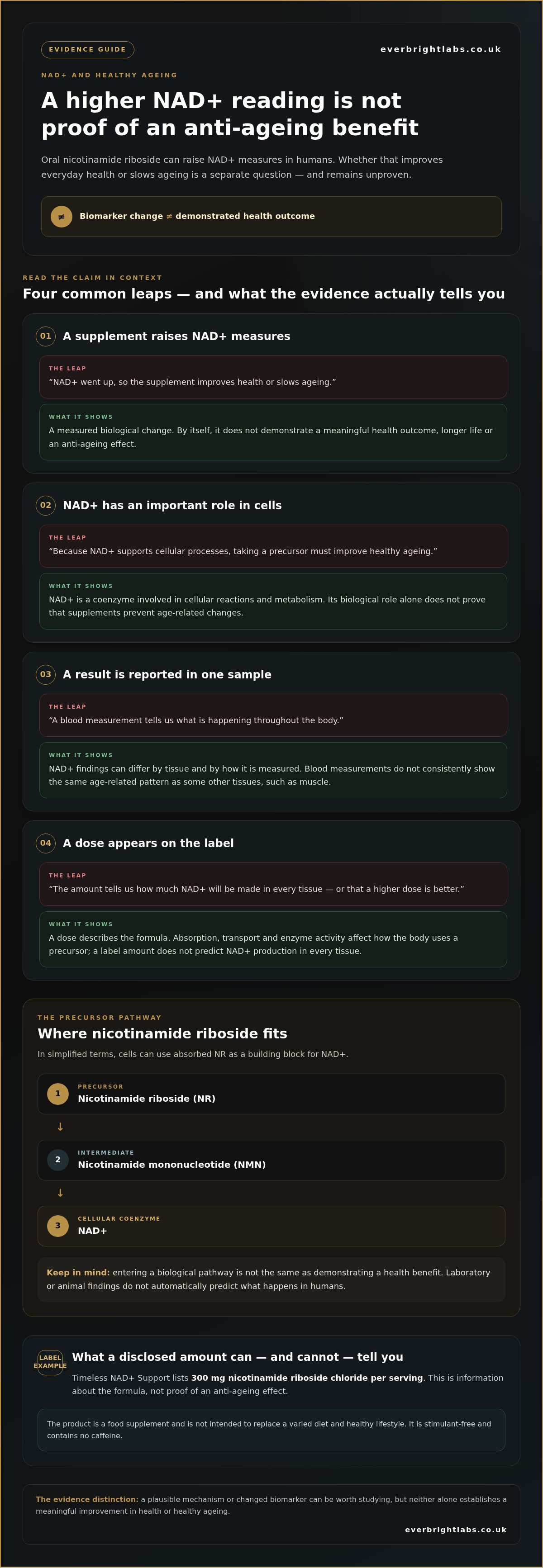
A rise in a measured NAD+ biomarker shows a biological change, not, by itself, a demonstrated healthy-ageing benefit. This distinction is central to assessing claims about nad+ for healthy aging: a pathway can be active without proving that a supplement prevents or slows age-related decline.
How does nicotinamide riboside relate to NAD+?
In simplified terms, the relationship works in stages. After NR is absorbed, cells can use it as a building block. Enzymes convert it first into nicotinamide mononucleotide (NMN), then into NAD+. How the body uses NR depends on processes such as absorption, transport and enzyme activity. A dose on a label therefore doesn’t tell you how much NAD+ will be made in every tissue.
Human studies have found that oral NR can affect NAD+ measures, but a higher reading doesn’t establish that people will live longer or experience improvement in a specific aspect of health. When comparing how NR and NMN are discussed as precursors, keep the same distinction in mind: evidence that a compound enters a pathway is different from evidence of a meaningful outcome. Study design and the outcome measured matter.
Where do mitochondria and sirtuins fit into the discussion?
Mitochondria are structures within cells that carry out important stages of energy metabolism. Sirtuins are a family of enzymes involved in cellular regulation; some rely on NAD+ to function. These links make mitochondria and sirtuins relevant subjects in ageing research, but they don’t show on their own that taking an NR supplement benefits these systems in people.
Laboratory experiments can isolate mechanisms and test how cells respond under controlled conditions. Animal studies can examine whole-organism effects, but species differ in physiology, dose response and lifespan. Neither type of evidence automatically predicts what will happen in humans. A plausible mechanism still needs to be tested against clinical outcomes, such as measurable changes in health or daily function, before it supports a practical claim.
For a real-world label example, Timeless NAD+ Support provides 300 mg nicotinamide riboside chloride per serving. That amount describes the formula, not proof of an anti-ageing effect. This product is a food supplement and is not intended to replace a varied diet and healthy lifestyle.
What does the evidence say about NAD+ supplements for healthy ageing?
Read the evidence in stages. Laboratory research can explain how a compound might work; animal studies can test effects in whole organisms; human trials can measure changes in people. Each stage answers a different question. A precursor can affect NAD+ measurements without showing that it improves health, prevents disease or extends life.
A 2026 systematic review concluded that oral NAD+ precursors show biological activity, but their clinical effectiveness for anti-ageing in humans is not definitively established. That’s the key distinction for anyone researching nad+ for healthy aging: a plausible mechanism or changed biomarker is not the same as a proven healthy-ageing outcome.
| Evidence type | What it can show | What it cannot establish alone |
|---|---|---|
| Laboratory research | How cells respond to a compound under controlled conditions, and which mechanisms may be involved. | Whether taking a supplement produces the same effect in a person or improves health. |
| Animal studies | How a biological process or intervention affects a whole organism in that model. | That people will experience the same effect, dose response or lifespan change. |
| Human biomarker trials | Whether a supplement changes measured indicators, such as NAD+ levels, in the people studied. | That a biomarker change means better function, disease prevention or longer life. |
| Clinical outcome trials | Whether an intervention affects specific health outcomes in participants over the study period. | Benefits beyond the population, duration and outcomes actually tested. |
What can human studies tell us so far?
Human trials of NR have reported changes in NAD+ measures, supporting the claim that an oral precursor can influence this biology. Interpret findings in context: who participated, how long the trial lasted, what tissue or marker was measured, and whether researchers assessed outcomes people can feel or clinically meaningful health measures. A biomarker result is not a substitute for those outcomes.
Short-term trials can provide information about measured changes and tolerability during the study. They can’t establish long-term effects on lifespan or age-related disease. Nor should results from one group be assumed to apply equally to people of different ages or health statuses. A reported finding that 300 mg NR raised NAD+ by approximately 51% needs to be considered alongside the original study’s population, measurement and limitations.
Which healthy-ageing claims need careful interpretation?
“Supports cellular health” is broad language, not proof that a supplement prevents or reverses ageing. Be cautious when a claim jumps from a change in a laboratory measure to a promise about vitality, disease risk or longevity without clinical evidence for that outcome. Current research does not establish a longevity guarantee. A more measured conclusion is that NAD+ precursors can affect biological measures, while meaningful anti-ageing benefits in humans remain uncertain.
How can you assess an NAD+ supplement responsibly?
Use the label and the evidence together. A clear formula lets you identify what you’d be taking, while research helps you judge what an ingredient has actually been shown to do. Whether reviewing targeted capsules or everyday options from wellness retailers like Vitammies, a delivery format or larger dose is not, by itself, proof of better results.
Work through this checklist before considering a product:
- Identify the ingredient. Check whether the label names nicotinamide riboside (NR), another precursor or a different ingredient. Similar-sounding names aren’t interchangeable.
- Check the amount per serving. Look for a stated quantity for each ingredient, not just a proprietary blend. Note how many capsules make up one serving so you can compare like with like.
- Match claims to evidence. Check what the relevant research measured: a biomarker change, a short-term safety measure or a health outcome. Testimonials and explanations of a possible mechanism can’t answer that question on their own.
- Consider suitability. Read the warnings and intended-user information. In Great Britain, nicotinamide riboside chloride is authorised for food supplements up to 300 mg daily for adults; it isn’t authorised for people who are pregnant, breastfeeding or under 18. The Food Standards Agency’s novel foods guidance offers context on the UK framework.
- Follow the directions. Use only as the label directs, and don’t assume taking more will improve an outcome. If you have a medical condition or take prescription medication, consult your GP before use.
What should a transparent NAD+ label show?
A useful label names the ingredients and gives their amounts per serving. Timeless NAD+ Support, for example, states 300 mg nicotinamide riboside chloride, 300 mg wheat germ extract providing 3 mg spermidine, and 100 mg liposomal trans-resveratrol per serving. “Liposomal” describes a formulation approach; the term alone doesn’t demonstrate a clinical benefit. Wheat germ extract may affect people with wheat allergy or coeliac disease.
Disclosed amounts make formulas easier to compare, but they don’t show that one is more effective. A higher dose isn’t automatically better, and the amount on a label shouldn’t be confused with a proven effect in the body. Timeless is stimulant-free and contains no caffeine. Its recommended maximum is two capsules per day.
How should evidence, safety and everyday habits be weighed?
Look for research that matches the ingredient, dose and population described in a claim. Then check whether it measured a meaningful health outcome or only a biological marker. Consider study limitations and duration rather than relying on a headline or personal testimonial. Supplements should not replace everyday health habits.
For a concrete example of a fully disclosed NR formula, explore Timeless NAD+ Support.
Timeless NAD+ Support: a transparent example of an NAD+ formula
A transparent label lets you see what a formula contains and compare it with the evidence, without mistaking ingredient details for proof of an outcome. Timeless NAD+ Support is one example: its disclosed serving composition can be assessed on its own terms, but it isn’t evidence that NAD+ supplementation slows ageing. For anyone exploring nad+ for healthy aging, that distinction matters.
What is in Timeless NAD+ Support?
Each serving provides three named ingredients in stated amounts:
- 300 mg nicotinamide riboside chloride
- 300 mg wheat germ extract, providing 3 mg spermidine
- 100 mg liposomal trans-resveratrol
The formula is vegan, stimulant-free and contains no caffeine. It is made in the UK in GMP- and HACCP-certified facilities. These details describe the product and its manufacturing, not proof that the formula prevents ageing, treats disease or produces a specific health benefit. Wheat germ extract may affect people with wheat allergy or coeliac disease.
The recommended use is two capsules daily with food. Don’t exceed the stated serving. The product contains 60 capsules, a 30-day supply at the recommended use. The amounts above describe the formula per serving, so check serving directions when comparing labels. Disclosed ingredients and quantities make comparison more straightforward, but they don’t guarantee how an individual will respond or establish that one formula is more effective than another.
How should readers set realistic expectations?
NR is a precursor used in NAD+ synthesis, but a product’s ingredient list cannot show whether taking it will lead to a meaningful change in health or healthy ageing. Spermidine and trans-resveratrol are also ingredients in this formula; their presence shouldn’t be read as proof of a combined anti-ageing effect. Mechanistic ideas and findings from individual studies need to be weighed against relevant human outcomes.
Supplements aren’t a substitute for healthy habits, and no formula can guarantee a particular result. Individual results may vary. If you have a medical condition or take prescription medication, consult a GP before use. Keep expectations grounded in what the label states and what studies actually measure, rather than promises of rejuvenation or disease prevention.
To review the ingredients and serving details directly, explore Timeless NAD+ Support.
Make your next step an informed one
The most useful question isn’t whether NAD+ is the next longevity breakthrough. It’s whether a supplement fits your health priorities, has a clearly stated purpose and is supported by evidence relevant to that purpose. That approach keeps nad+ for healthy aging grounded in informed choices, rather than pressure to try every new trend.
Before adding anything to your routine, decide what you hope to learn or support, then read the label and research with that goal in mind. Keep expectations measured: a transparent formula helps you understand what’s in a product, but it can’t guarantee a personal result. Healthy ageing is a longer-term commitment shaped by choices beyond any single supplement.
To review the ingredients and serving details for Everbright Labs’ NAD+ formula, explore Timeless NAD+ Support.
Frequently Asked Questions
Can NAD+ supplements slow ageing?
Current evidence doesn’t establish that NAD+ supplements slow ageing in people. Some studies examine changes in NAD+ measures, but that doesn’t show that people live longer, avoid age-related disease or feel younger. For nad+ for healthy aging, treat claims about lifespan or rejuvenation cautiously unless they’re supported by human studies measuring those outcomes. A biological effect can be scientifically interesting without proving a practical benefit.
Does NAD+ decline as you get older?
Research suggests NAD+ may change with age, but the pattern isn’t uniform enough to assume everyone experiences the same decline. Results can depend on which tissue is tested and how levels are measured. Age alone can’t tell you your NAD+ status, and tiredness or other symptoms aren’t a reliable way to identify it. If a health change concerns you, discuss it with your GP rather than self-diagnosing.
What is the difference between NAD+ and nicotinamide riboside?
NAD+ is a coenzyme used in cellular processes; nicotinamide riboside, or NR, is a compound the body can use to make NAD+. They’re related, but they aren’t the same ingredient. A supplement listing NR provides a precursor, not NAD+ itself. This distinction also matters when reading research: a trial of NR investigates that precursor and its measured effects, not every possible NAD+ intervention.
How long does it take for an NAD+ supplement to work?
There’s no established timeframe for noticing a meaningful health or healthy-ageing effect from an NAD+ supplement. Research may measure changes in biological markers over a study period, but that doesn’t predict when, or whether, an individual will feel different. Don’t use a lack of noticeable sensation as a reason to increase the dose. Follow the product directions, and seek medical advice if you’re taking it to address a health concern.
Is nicotinamide riboside safe to take every day?
Daily use depends on the dose, the person and the product. In Great Britain, nicotinamide riboside chloride is authorised for food supplements up to 300 mg daily for adults, but it isn’t authorised for people who are pregnant, breastfeeding or under 18. That limit doesn’t guarantee suitability for everyone or establish the safety of every product or long-term use. Follow the label, and consult a GP if you have health concerns.
Can I take an NAD+ supplement if I take prescription medication?
Speak to your GP before combining an NAD+ supplement with prescription medication. The answer can depend on the medicine, your health and the supplement’s full ingredient list, so don’t rely on general online advice to rule out an interaction. Bring the product label and your current medication details to the discussion. Don’t stop, change or delay prescribed treatment to start a supplement unless your clinician advises you to do so.
What should I look for when choosing an NAD+ supplement?
Choose a product with clearly named ingredients, amounts per serving, straightforward directions and relevant warnings. Check that claims match human evidence, rather than testimonials alone. Timeless NAD+ Support is vegan, stimulant-free and contains no caffeine; its wheat germ extract may affect people with wheat allergy or coeliac disease. If you have a medical condition or take prescription medication, consult a GP.
Share:
Supplements for Cellular Repair: What the Science Says
Cellular Energy Decline Over 30: What Changes and What Helps?