
ATP production depends on a chain of enzyme reactions, not a single switch. The role of coenzymes in the body is to help enzymes carry out these reactions by transferring chemical groups or electrons. Many coenzymes are made from vitamins, linking nutrients from food with the way cells release energy.
If the terms “enzyme”, “cofactor” and “coenzyme” sound interchangeable, it’s easy to lose sight of what each does. The distinction matters: enzymes speed up reactions, while coenzymes assist particular steps in those reactions and can be reused.
This article explains what coenzymes are, how they work with enzymes and why they matter in cellular respiration and ATP production. It also covers how vitamin-derived coenzymes support pathways that turn nutrients into usable cellular energy, without treating vitamins as a quick fix for tiredness.
Key Takeaways
- Coenzymes assist enzymes by transferring electrons or chemical groups, helping specific reactions take place.
- Follow how NADH and other carriers link nutrient breakdown with ATP production in cellular respiration.
- Distinguish organic coenzymes, often derived from vitamins, from inorganic mineral cofactors such as magnesium and zinc.
- Learn which vitamin-derived molecules support key metabolic reactions, and how their roles differ across the body.
- See how understanding these pathways can help you make sense of cellular energy and metabolic support.
Coenzyme roles in enzyme reactions
Enzymes catalyse chemical reactions, while coenzymes assist specific steps by carrying electrons or chemical groups. Together, they support processes such as digestion and nutrient metabolism.
Enzyme Catalysis and Coenzyme Support
An enzyme catalyses a reaction by binding its substrate at an active site and lowering the activation energy needed for change. This lets reactions proceed efficiently under the conditions inside cells, without requiring a greater energy input.
A coenzyme is an organic molecule that assists an enzyme during a reaction. It may carry electrons, hydrogen atoms or chemical groups between molecules, then be reused in another reaction. Nicotinamide adenine dinucleotide, or NAD, transfers electrons in oxidation-reduction reactions. The enzyme binds the right substrate, while its coenzyme helps complete the chemical transformation.
Some enzymes also use inorganic cofactors, including calcium or zinc ions. “Cofactor” is the broader term: it includes organic coenzymes and inorganic ions. An enzyme that needs a helper cannot perform its usual reaction without the appropriate cofactor.
Coenzymes in Enzyme Regulation
Coenzymes support specific enzyme reactions and can influence which chemical groups or electrons are available at a particular step. Their binding and release help coordinate related reactions, rather than leaving each enzyme to function in isolation.
NAD, for example, alternates between NAD+ and NADH as it accepts and releases electrons. This cycle lets it participate in different stages of metabolism. Substrate availability and cellular conditions also influence enzyme activity, so coenzymes work within a wider regulatory system. This helps explain how nutrients that support coenzyme pathways contribute to normal biochemical function.
Coenzymes in Metabolism
In metabolism, coenzymes help enzymes transfer materials needed to break down or build molecules. Coenzyme A carries acetyl or other acyl groups between molecules. Thiamine pyrophosphate, derived from vitamin B1, supports decarboxylation reactions, while pyridoxal phosphate helps transfer amino groups.
Coenzymes support metabolism by moving electrons or chemical groups between reaction partners, enabling connected biochemical steps. NAD+ is another key carrier in redox reactions; NAD+ support relates to this molecule’s role in cellular pathways.
Can coenzyme supplements improve health, and what does the evidence show? Supplements containing coenzyme-related nutrients can support pathways that depend on those nutrients. Their biochemical roles explain why these ingredients are used to support normal metabolic function.
What are the risks or interactions of coenzyme supplements? Consider the specific ingredients alongside any medicines you take and existing health conditions. A pharmacist or GP can help assess whether a supplement is suitable for your routine.
Coenzymes in cellular respiration and ATP production
Cellular respiration transfers energy from nutrients into ATP through linked reactions. Electron-carrying coenzymes connect these reactions with the mitochondrial machinery that produces much of the cell’s usable energy.
ATP Production and Oxidative Phosphorylation
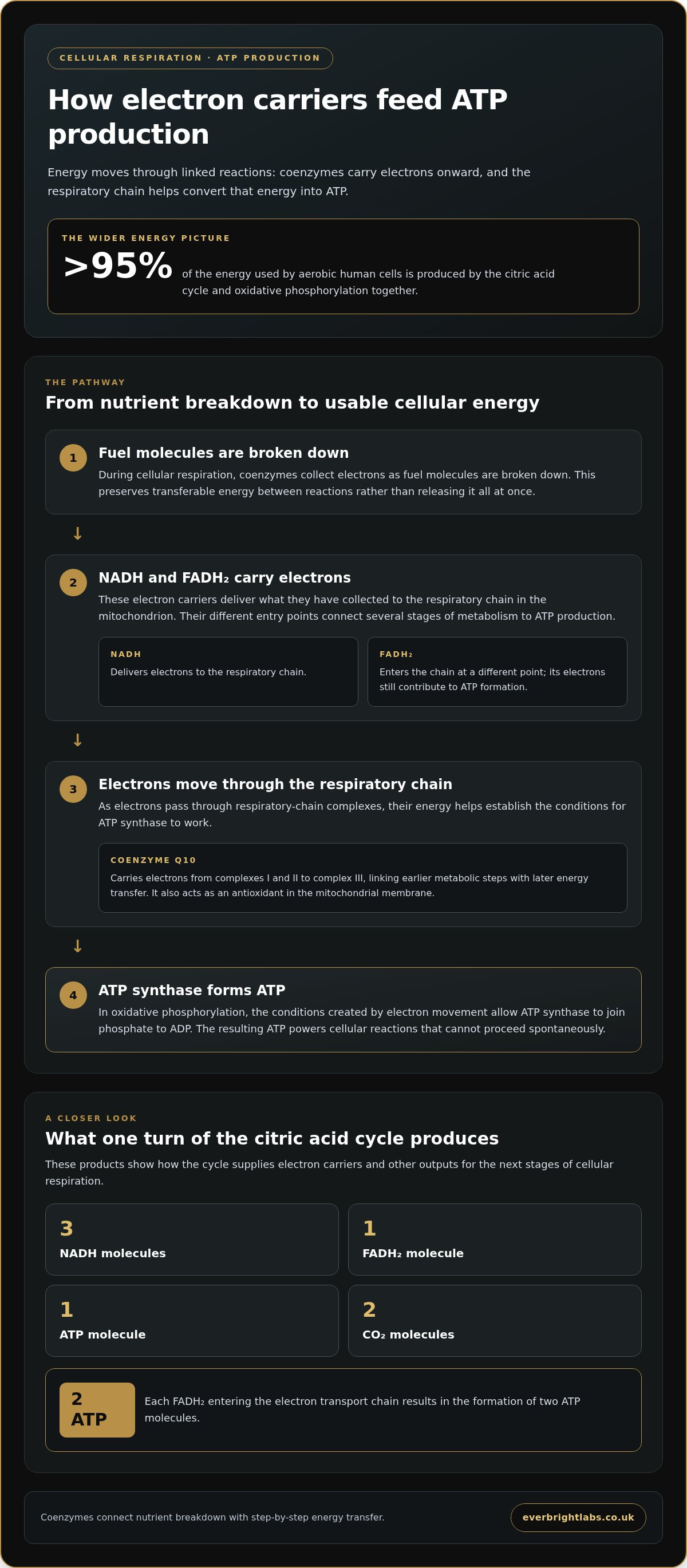
Oxidative phosphorylation uses electrons carried by NADH and FADH₂ to support ATP production. As electrons pass through respiratory-chain complexes, their energy helps establish the conditions for ATP synthase to join phosphate to ADP. This final stage converts energy stored in electron carriers into ATP, which cells use to power reactions that cannot proceed spontaneously.
Coenzyme Q10 carries electrons from complexes I and II to complex III. This movement links earlier steps in metabolism to the later stages of energy transfer. The citric acid cycle and oxidative phosphorylation together produce more than 95% of the energy used by aerobic human cells.
Mitochondrial ATP Production
Mitochondria produce ATP by coupling electron transfer with the addition of phosphate to ADP. The inner mitochondrial membrane houses the respiratory chain, where electron movement supports this process. This arrangement connects the breakdown of fuel molecules with ATP formation in a specialised cellular compartment.
Coenzyme Q10 operates within this electron-transfer sequence, carrying electrons between complexes I or II and complex III. It also acts as an antioxidant in the mitochondrial membrane. Coenzyme A contributes elsewhere in metabolism by helping the body produce fatty acids, which are important components of cellular processes and energy pathways.
NADH and FADH₂ Production
NADH and FADH₂ are electron carriers formed during cellular respiration. They collect electrons as fuel molecules break down, then deliver them to the respiratory chain. Their different entry points help explain how several stages of metabolism feed into mitochondrial ATP production.
During glycolysis, NAD+ accepts two electrons and H+ as glyceraldehyde 3-phosphate becomes 1,3-bisphosphoglycerate. In the citric acid cycle, one turn produces three NADH molecules, one FADH₂ molecule, one ATP molecule and two CO₂ molecules. These carriers preserve transferable energy between reactions, rather than allowing it to be released all at once.
FADH₂ enters the electron transport chain at a different point from NADH, and its electrons still contribute to ATP formation. Each FADH₂ entering the chain results in the formation of two ATP molecules. Together, these carriers show how coenzymes connect carbon-containing nutrients with the stepwise production of cellular energy.
These transformations place electron transfer within a sequence of metabolic reactions, rather than making ATP production an isolated event. As intermediates change, coenzymes help preserve energy in forms that can be carried onward to the respiratory chain.
Isocitrate is converted to α-ketoglutarate through a two-step reaction. Succinate dehydrogenase removes two hydrogen molecules from succinate to form fumarate. These reactions connect changes in citric acid cycle intermediates with the production of electron carriers that support later energy transfer.
Coenzymes compared with cofactors
Coenzymes are organic molecules that assist certain enzymes during chemical reactions. Enzymes are usually proteins that catalyse reactions, while “cofactor” is the broader term for a helper that supports an enzyme. A cofactor may be an organic coenzyme or an inorganic ion, such as magnesium.
These terms describe different roles, not competing types of biological machinery. An enzyme binds its substrate and facilitates a reaction; a coenzyme may transfer electrons or chemical groups during that reaction. Some enzymes need a cofactor to function, while others do not. The role of coenzymes in the body therefore depends on the enzyme and reaction involved.
Coenzymes are organic molecules, and many are made from or derived from vitamins. NAD, for example, accepts and releases electrons in oxidation-reduction reactions. Coenzyme A carries acetyl or other acyl groups between molecules. These carriers support the production, breakdown and conversion of compounds in metabolism.
Enzymes that lack a required cofactor are called apoenzymes and are usually inactive. When the necessary helper binds, the complete active form can carry out its reaction. This shows why enzymes and cofactors have distinct jobs: the enzyme provides the reaction site, while its cofactor assists a particular chemical step.
Mineral cofactors are inorganic ions rather than organic molecules. Magnesium, iron, zinc, cobalt and manganese are examples, and their roles vary between enzymes. Magnesium ions can support DNA polymerase by stabilising the negatively charged DNA molecule, helping the enzyme work with its molecular substrate.
Calcium is another example. It can act as an enzyme cofactor, including for amylase during food breakdown. This is separate from calcium’s structural contribution to bones and teeth. The same mineral can have different physiological roles depending on where it acts and which molecules are present.
Some cofactors help attract reactants, alter an enzyme’s structure or support energy transfer during a reaction. Zinc and Cu(I) ions are inorganic cofactors, while NAD and coenzyme A are organic coenzymes. Classifying the helper clarifies how it supports an enzyme, but does not describe the whole reaction by itself.
To understand the relationship, identify what the enzyme does, then consider its helper and that helper’s task. For DNA polymerase, magnesium supports interaction with DNA; for amylase, calcium assists food breakdown. This explains how minerals and vitamin-derived molecules support different biochemical processes without being enzymes themselves.
Vitamin functions in physiological processes
Dietary vitamins support coenzyme production and other processes, including metabolism and antioxidant activity. Their functions depend on the vitamin and the biochemical pathway involved.
Dietary Vitamins and Coenzyme Precursors
Some vitamins act as precursors that the body converts into coenzymes or uses to make them. Vitamin B3, also called niacin on food labels, is a precursor to NAD, while vitamin B5 contributes to coenzyme A production. These links matter because coenzymes help enzymes carry out specific metabolic reactions.
Most water-soluble vitamins act as coenzymes or support their synthesis. The B vitamins and vitamin C are needed to build coenzymes. Tetrahydrofolate, for example, carries one-carbon units such as the formyl group. Vitamin-derived molecules therefore help transfer chemical components between reactions rather than acting as enzymes themselves.
Vitamin roles extend beyond coenzymes. Vitamin D increases the body’s ability to absorb calcium and phosphorus, while vitamin K is involved in forming prothrombin, a key enzyme in blood clotting. Vitamin C contributes to collagen formation; collagen is a protein found in tendons, ligaments and bone.
Making and Recycling Coenzymes
The body makes coenzymes using dietary vitamins as building materials or precursors. Coenzymes bind to particular enzymes and assist specific reactions, then can be released and reused during their cycle. A vitamin’s contribution therefore depends on its conversion and use in the relevant pathway.
For example, vitamin B3 can contribute to NAD production, and NAD can accept electrons during a reaction before returning to its earlier form. Vitamin B5 contributes to coenzyme A, which carries chemical groups in metabolism. These examples show how vitamin intake connects with coenzyme synthesis, enzyme activity and the transport of molecules between reactions.
Vitamin Deficiency and Coenzyme Production
A shortage of a vitamin needed for coenzyme synthesis can limit the body’s supply of that coenzyme. This may constrain the enzyme reactions that depend on it and affect normal metabolism. The impact depends on the vitamin involved and the processes that rely on its coenzyme form.
Water-soluble vitamins can’t be stored in the body and require daily intake. If dietary supply is inadequate, the body has less available material for associated functions. Vitamin deficiencies can contribute to disease, but the specific effects differ. For instance, limited vitamin B3 can affect a precursor for NAD, while low vitamin B5 can affect coenzyme A production.
Vitamins also differ in solubility. Vitamins A, D, E and K are fat-soluble, while vitamin C and the B-complex vitamins are water-soluble. Vitamins C and E, along with provitamin β-carotene, can act as antioxidants. β-carotene can be converted into vitamin A, and antioxidant activity helps interrupt free-radical chain reactions.
ATP and cellular energy
ATP supplies energy for reactions that aren’t spontaneous under physiological conditions. Its role is easier to understand by following how energy becomes available and then supports work such as moving substances across a cell membrane.
ATP contains adenine, ribose and phosphate groups. Energy becomes available when ATP is converted to ADP and a phosphate group, allowing a cell to couple that change with a reaction requiring energy. This does not create energy from nothing; it transfers energy between chemical processes in a controlled way.
Consider a cell building a larger molecule from smaller components. The construction reaction may not proceed spontaneously, so ATP breakdown can be coupled to it. This links energy transfer to a specific task. The same principle applies to active transport, when cells move substances across membranes against their concentration gradient.
ATP formation reverses that exchange: energy from nutrient metabolism supports the addition of phosphate to ADP. In aerobic cells, the citric acid cycle and oxidative phosphorylation are the main route for capturing energy in this form. Coenzymes carry electrons between reactions, connecting the breakdown of nutrients with mitochondrial ATP production.
Oxygen has a role at the end of the respiratory electron-transfer pathway, where it accepts electrons. This allows electron flow through the chain to continue, supporting the conditions needed for ATP formation. Energy is transferred in stages rather than released all at once, giving cells a usable chemical supply.
Mitochondrial membranes are also sensitive to reactive oxygen species. When CoQ10 levels decline, reactive oxygen species can damage the mitochondrial membrane and reduce the efficiency of ATP production. CoQ10 acts as an antioxidant in this membrane, while also carrying electrons between respiratory-chain complexes. These functions connect membrane protection with energy conversion.
ATP supports different kinds of cellular work. Muscle cells use it during contraction, while membrane transport relies on it to move selected substances. Protein production also requires energy as cells assemble components. In each case, ATP links energy captured from metabolism to reactions that need an input.
The key point is that ATP is the cell’s immediate energy-transfer molecule, not a nutrient. Its formation depends on connected reactions, electron carriers and mitochondrial processes. Understanding that chain makes cellular energy less mysterious: metabolism captures energy, and ATP makes it available for specific physiological work.
Everbright Labs: Fat Metaboliser
Fat Metaboliser is designed to provide metabolic support as part of a broader approach to cellular health. Its formulation combines acetyl-L-carnitine with decaffeinated green tea extract, inulin from chicory root, olive leaf extract, choline, chromium and black pepper extract. It is stimulant-free and contains no caffeine.
Coenzymes help enzymes carry out specific reactions, while Fat Metaboliser combines ingredients selected for metabolic support. It may suit people considering nutritional support alongside balanced eating and regular activity, not as a substitute for those foundations. Review the formulation and ingredient details to see how it aligns with your goals.
For more information, visit Everbright Labs online.
Put cellular energy knowledge into perspective
Understanding the role of coenzymes in the body can make cellular energy pathways easier to interpret, but it is only one part of a broader picture of health. If you’re exploring nutritional support, focus on the goal you want to support and choose a formulation designed for that purpose.
Everbright Labs offers Fat Metaboliser for metabolic support, Timeless NAD+ Support for cellular energy and healthy ageing, and the Everbright Labs Bundle, which combines the primary formulations. These products connect the science of metabolism and cellular processes with specific supplement options, without replacing the foundations of wellbeing.
Consider which area best matches your current priorities, then explore the product information to understand each formulation. For questions about the available options, contact Everbright Labs. A measured, informed next step can help you make choices that feel aligned with your health goals.
Frequently Asked Questions
What are coenzymes?
Coenzymes are organic molecules that assist enzymes during specific biochemical reactions. They can carry electrons or chemical groups, helping reactions proceed through connected steps. NAD, for example, participates in electron transfer, while coenzyme A carries acetyl groups. Many coenzymes are formed from dietary vitamins, which support the body’s ability to maintain these metabolic processes.
What are coenzymes and what role do they play in your health?
Coenzymes help enzymes perform reactions needed for normal cellular function, including processing nutrients and supporting energy metabolism. Different coenzymes have distinct tasks: NAD participates in electron transfer, while pyridoxal phosphate supports amino-acid reactions. These pathways work together throughout the body. Providing nutrients used in coenzyme production is one way to support the biochemical processes behind everyday physiological function.
How do coenzymes help enzymes transfer electrons or chemical groups?
Coenzymes act as temporary carriers, accepting and passing on specific chemical components during enzyme reactions. NAD, for example, accepts electrons and becomes NADH; it can later release them and return to NAD+. Coenzyme A carries acetyl and other acyl groups between molecules. These transfers let enzymes pass useful components between stages, maintaining the flow of connected metabolic pathways.
What are the main coenzymes in the human body and what does each do?
Important coenzymes include NAD and NADP, which carry electrons; FAD and FMN, which participate in oxidation-reduction reactions; and coenzyme A, which transfers acetyl or other acyl groups. Thiamine pyrophosphate supports decarboxylation, pyridoxal phosphate assists amino-group transfer, and biotin supports carboxylation. Tetrahydrofolate carries one-carbon units. Together, these specialised tasks support different stages of metabolism.
Which vitamins are precursors to coenzymes such as NAD, FAD and coenzyme A?
Vitamin B3, also known as niacin on food labels, is a precursor for NAD. Riboflavin, or vitamin B2, contributes to the formation of FAD, while vitamin B5 is a precursor for coenzyme A. These examples show how dietary vitamins supply building materials for coenzyme pathways. Including varied sources of these vitamins in the diet supports the body’s normal coenzyme production.
How do coenzymes differ from prosthetic groups and other enzyme cofactors?
A cofactor is a helper required by some enzymes; it may be an organic coenzyme or an inorganic ion such as magnesium. A prosthetic group is a cofactor that stays tightly bound to its enzyme. Many coenzymes bind more loosely and can detach after helping with a reaction. These terms describe whether a helper is organic or inorganic, and how closely it associates with an enzyme.
Share:
Ways to find weight loss support that feels right
Cellular Health Supplements UK: What’s Inside and Why