


The ingredient panel matters more than the phrase on the front: cellular health supplements in the UK can contain different combinations of compounds, including NAD+ precursors, spermidine, resveratrol or CoQ10. CoQ10 is part of the mitochondrial electron transport chain, which helps cells produce ATP, their usable energy. Understanding what each ingredient does makes it easier to see how a formula is intended to support cellular function.
If you’re wondering whether cellular health supplements are just a collection of trendy ingredients, the details matter. Some nutrients also come from food, so it helps to understand what a supplement contains and which body processes its ingredients are associated with.
This guide explains what you may find in cellular health formulas, how CoQ10 relates to mitochondrial energy, and which vitamins you can get through your diet. It also separates ingredients by their purpose, so you can make sense of the label without expecting every formula to work in the same way.
Key Takeaways
- Learn how to read ingredient labels and distinguish cellular energy ingredients from other types of support.
- Understand CoQ10’s role in the mitochondrial process that produces ATP.
- Find out how B vitamins from food contribute to normal cellular metabolism.
- See how mitochondrial function connects nutrients with the energy cells use.
- Explore how ingredients such as spermidine are discussed in relation to cellular recycling.
What’s Inside Cellular Health Supplements?
Cellular health supplements combine nutrients or compounds intended to support processes such as mitochondrial energy production. In the UK, compare ingredients, serving amounts, evidence and label directions rather than relying on broad “cellular health” wording.
Cellular energy and supplement choices
Cellular energy depends on mitochondria, which help turn nutrients into usable energy, alongside adequate hydration and mineral intake. This matters because tiredness can have several causes: ageing, stress, diet and daily habits may all influence how the body produces energy. NAD+ levels are described as falling to approximately 50% by middle age, making age-related cellular processes a focus of some formulas.
Minerals such as magnesium contribute to normal body functions, while water supports processes that transport nutrients. Neither replaces balanced nutrition, regular movement or good sleep. These habits support energy metabolism and provide conditions for cellular repair. If a formula includes magnesium glycinate or vitamin B12 as methylcobalamin, compare the form and stated amount, not just the ingredient name.
In the UK, food supplements and health claims are governed by food-law frameworks, and claims should be appropriate to the product and its ingredients. Read the label for ingredients, directions and warnings. Distinguish claims about specific functions from broader promotional language.
Follow the label’s serving directions and take the supplement consistently as directed. How long it takes to assess an effect depends on the ingredient, the outcome and individual factors. Tracking one change at a time can help you see how a supplement fits your routine.
Comparing ingredients, dosage and testing
Comparing supplements means matching their ingredient forms and daily serving amounts to the purpose of each formula. CoQ10 products commonly list a daily dose range of 60-500 mg, while other formulas may focus on NAD+ precursors, spermidine or resveratrol. Check whether the label states the amount per daily serving, rather than only the amount per capsule.
Calculate cost per daily serving by dividing the pack price by the number of daily servings. Since the result depends on serving size, pack quantity and formulation, compare those details alongside price instead of judging by the headline pack cost alone.
Independent testing can offer useful information about product quality. Look for clear evidence of third-party testing and transparent ingredient amounts. Scientific evidence can help explain how an ingredient relates to a particular outcome, so compare the claim with the ingredient and formulation described.
For a formula combining ingredients associated with cellular support, the NAD+ support formulation provides one example of a multi-ingredient approach. Compare its stated ingredients and serving information with your priorities, and use the label as your guide to taking it.
CoQ10 and mitochondrial energy
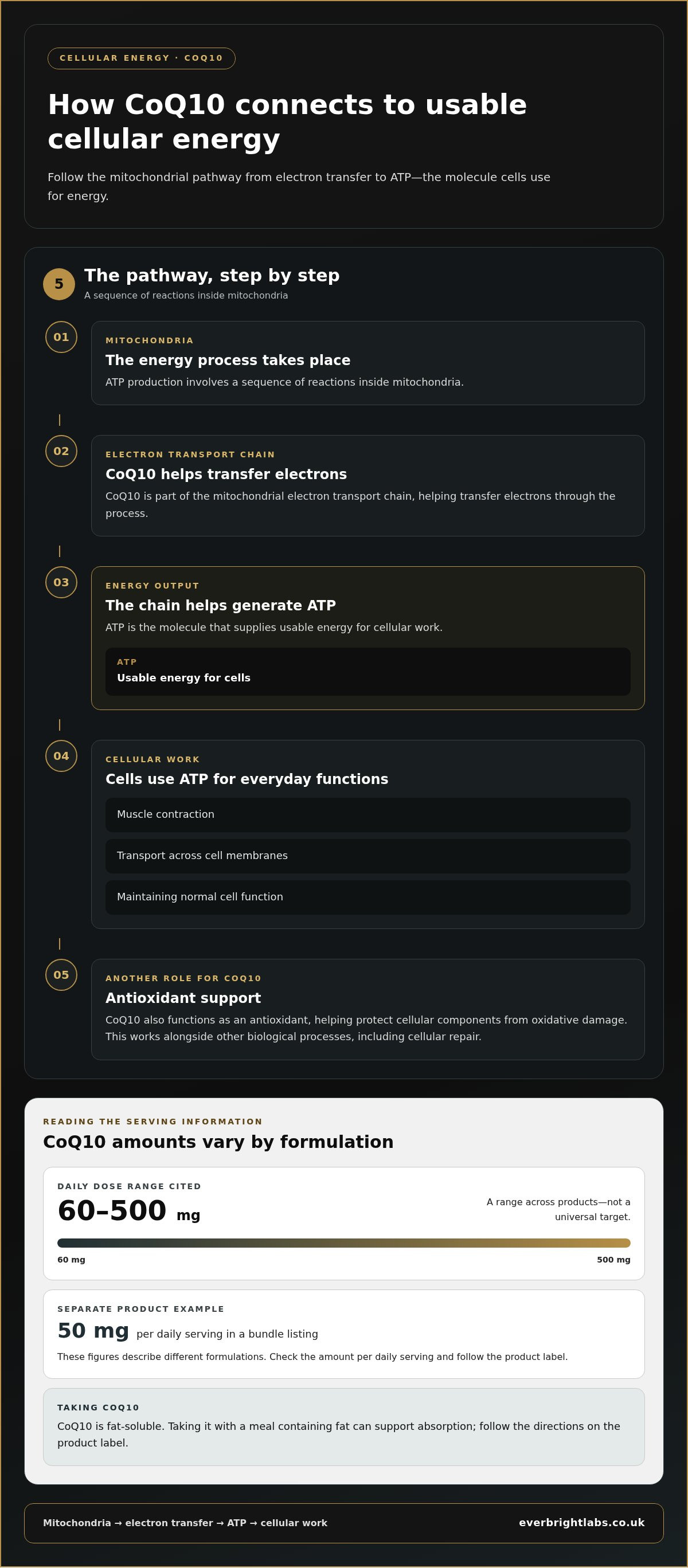
Coenzyme Q10, usually called CoQ10, is part of the mitochondrial electron transport chain. This chain helps cells produce ATP, the molecule that supplies usable energy for cellular work. CoQ10 therefore has a defined role in energy production, rather than acting like a stimulant that temporarily increases alertness. Understanding that distinction helps explain why supplement labels connect CoQ10 with cellular energy and healthy ageing.
ATP production involves a sequence of reactions inside mitochondria. CoQ10 helps transfer electrons through this process, supporting the machinery that generates ATP. Cells use ATP for tasks such as muscle contraction, transport across cell membranes and maintaining normal function. The pathway is complex, and CoQ10’s contribution forms one part of the body’s wider energy system.
Supplement labels show varied CoQ10 servings. A typical dose range is 60-500 mg a day, and a bundle lists 50 mg per daily serving. These figures describe different formulations, not a universal target. Compare the stated amount per daily serving and follow the product label. CoQ10 is fat-soluble, so taking it with a meal containing fat can support absorption.
CoQ10 also functions as an antioxidant, helping protect cellular components from oxidative damage. This role makes it relevant to discussions of ageing, because cells continually manage oxidative stress while carrying out energy production. Antioxidant support works alongside other biological processes, including cellular repair. Together, these processes help maintain the conditions cells need for their normal functions.
Energy needs differ between tissues. The heart and skeletal muscles rely heavily on mitochondrial activity, while brain cells also require a steady ATP supply for mental processes. CoQ10’s place in the electron transport chain connects it with these cellular energy demands. Its antioxidant role adds another dimension to its relevance in discussions of inflammation, healthy ageing and longevity.
Assessing a CoQ10 supplement means looking beyond the front label. Check the serving amount, ingredient form, directions and whether the product explains its intended role. Then compare those details with the evidence for the specific outcome being discussed. Understanding the electron-transfer mechanism helps explain why CoQ10 is included in formulas designed to support mitochondrial energy.
For a practical comparison, note the daily serving and take CoQ10 with a meal containing fat, as directed on its label. Consider how it fits alongside sleep, movement and balanced nutrition, which also support energy metabolism. This approach keeps the focus on the body’s underlying energy processes and the supportive role of CoQ10 within them.
Can You Get Vitamins for Cellular Health From Food?
Yes. Foods such as leafy greens, beans, eggs, dairy products and oily fish provide vitamins involved in normal cellular metabolism. Food can form a nutritional foundation, while supplements offer a concentrated way to add selected ingredients. The science is clearest when each vitamin is considered for its specific function, rather than grouped under a broad cellular-health label.
B vitamins help the body process nutrients and support energy metabolism. For example, thiamine is found in wholegrains and beans, while riboflavin occurs in milk and eggs. Poultry, fish and chickpeas provide vitamin B6. Folate comes from leafy greens and pulses; vitamin B12 is found in animal foods and some fortified products. Eating a variety of these foods helps bring different B vitamins into meals.
These nutrients support related but distinct processes. Folate and vitamin B12 are involved in DNA synthesis and the formation of blood cells. Vitamin B6 contributes to protein metabolism, while riboflavin participates in energy-related reactions. B vitamins don’t work as a single interchangeable ingredient: each has its own role. A meal combining lentils, spinach and a fortified food, for instance, can supply several nutrients through different sources.
DNA is the instruction material cells use to build and maintain themselves. Folate and B12 support processes involved in making DNA, while other nutrients and normal cellular mechanisms contribute to maintaining it. This is not the same as claiming that a particular food prevents DNA damage. Vitamins also sit within a wider system that manages oxidative processes and cellular repair. A balanced diet provides a practical starting point, alongside habits such as regular movement and adequate sleep.
Vitamin D3 and vitamin K2 have different functions, although products sometimes combine them. Vitamin D is present in foods such as oily fish and egg yolks, and in some fortified foods. Vitamin K occurs in green vegetables; fermented foods and certain cheeses can provide K2. These food sources contribute to overall nutrition, but the two vitamins shouldn’t be treated as interchangeable or automatically necessary as a combined supplement.
For a practical food-first approach, include a source of B vitamins, such as beans or wholegrains, a leafy green such as spinach, and a protein food such as eggs or fish in your meals. Add fortified foods if they suit your diet. A variety of nutrients supports metabolism and muscle function, rather than relying on one “cellular” vitamin. If comparing a supplement with food, check its ingredient form, serving directions and the specific function it is intended to support.
Mitochondrial function and ATP production
Mitochondria convert energy from nutrients into ATP, which cells use to perform essential functions. This process links food, oxygen and cellular energy through a series of biochemical reactions. Muscle contraction, nerve signalling and the movement of substances across cell membranes all require energy. This helps explain why supplements labelled for mitochondrial support focus on cellular processes rather than immediate stimulation.
ATP production begins as cells break down nutrients, including carbohydrates and fats. Their chemical energy is transferred through metabolic pathways, including reactions within mitochondria. The electron transport chain then helps establish conditions for ATP formation. CoQ10 participates in that chain, whilst other nutrients support different stages. Each step contributes to the coordinated production of ATP.
Mitochondrial biogenesis is the formation of new mitochondria. Cells regulate this process in response to biological signals and energy demands. PQQ, or pyrroloquinoline quinone, is associated with pathways involved in mitochondrial function and biogenesis. The distinction is useful when considering cellular-support formulations: mitochondrial support concerns the activity of existing mitochondria, while biogenesis relates to the formation of additional cellular energy structures.
Supplement information identifies PQQ 20 mg as a dose for mitochondrial support. This provides a concrete label detail to compare when reviewing formulations. Check the amount per serving, other active ingredients and directions. A clearly stated dose helps you understand how PQQ fits within a product’s approach to supporting mitochondrial function and cellular energy processes.
Mitochondria also manage oxidative processes as they produce energy. Oxidative stress describes an imbalance between reactive molecules and the body’s protective systems. Supporting antioxidant defences complements the work mitochondria do during energy production. These processes contribute to cellular function and are relevant to discussions of healthy ageing.
When comparing products, identify the specific pathway each ingredient supports. PQQ may be included for mitochondrial support, whilst CoQ10 has a role in the electron transport chain. Taking a multi-ingredient supplement means considering how its components contribute to different biological processes. Sleep, regular movement and balanced nutrition also support energy metabolism alongside the body’s normal mitochondrial activity.
This distinction matters when a product uses broad wording such as “cellular energy”. Look for a clear explanation of the process involved, such as nutrient conversion into ATP or support for mitochondrial function. If the formula contains PQQ, note its stated serving amount and role in the formulation. This makes comparisons more precise and helps you understand how the ingredients relate to the product’s cellular-support focus.
Supplements tagged for cellular health
“Cellular health” is a broad label, not a standardised ingredient category. One formula may focus on antioxidant compounds, while another targets NAD+ pathways or cellular recycling. Compare the named ingredients, amounts per serving and stated purpose. This gives you a clearer basis for deciding whether a supplement’s focus matches your interest in ageing, cellular energy or antioxidant support.
Consider three distinct examples: nicotinamide riboside chloride, spermidine and trans-resveratrol. Nicotinamide riboside is a precursor used in NAD+ support formulas. Spermidine is described as an inducer of autophagy, the body’s cellular recycling system. Trans-resveratrol is a polyphenol associated with antioxidant support. These compounds relate to different biological pathways, so the shared label “cellular health” does not make them interchangeable.
Serving amounts make comparisons more precise. A formula can provide 300 mg of nicotinamide riboside chloride, 3 mg of spermidine from wheat germ extract, and 100 mg of liposomal trans-resveratrol. Read each amount alongside its ingredient form. For example, “spermidine” alone doesn’t tell you whether the label identifies its source or the quantity provided by that source.
Antioxidant support is only one part of the picture. Antioxidants help the body manage oxidative processes, while other ingredients are included for different cellular pathways. A product combining several ingredients may therefore have a broader formulation than a single-compound supplement. The useful question is not whether a label lists more ingredients, but whether it states each ingredient’s amount and intended role clearly.
“Bioavailable” is another term you may encounter. It refers to how an ingredient can be absorbed and made available for the body to use. The form matters, but the word alone does not show how much a product supplies or establish the benefit of its whole formula. Check for a named form, a stated serving amount and clear directions for use.
For an informed comparison, match each ingredient to its proposed pathway, then check the daily serving and product directions. A label might identify NAD+ support, antioxidant activity or autophagy, but these descriptions refer to different functions. Don’t treat a general cellular-health label as a substitute for ingredient details. In particular, distinguish a specific mechanism from a broader claim about longevity or ageing.
The practical takeaway is to compare formulas by purpose first, then by how clearly their ingredients are disclosed. A supplement focused on spermidine, for example, differs from one centred on antioxidant compounds or NAD+ precursors. Choose the biological focus that aligns with what you want to understand, and use the label to assess the ingredients and amounts rather than relying on a broad category name.
Everbright Labs: Fat Metaboliser
Fat Metaboliser is designed to provide metabolic support, making it relevant if your priority is metabolism rather than a formula centred on NAD+ or antioxidant support. Its ingredients include 1,000 mg acetyl-L-carnitine, decaffeinated green tea extract providing 225 mg EGCG, and inulin from chicory root. The formula also contains olive leaf extract, choline, chromium and black pepper extract.
Its ingredient profile offers a distinct focus within a wider discussion of cellular health: metabolic support, not a direct substitute for food-based vitamins or a CoQ10-focused formula. Review the full ingredient amounts and label directions to see how it fits your priorities.
Explore the Fat Metaboliser formula on Everbright Labs’ website if you’d like to learn more.
Make your next choice with purpose
Choosing cellular health supplements in the UK is easier when you start with the outcome you want to support, then assess whether an ingredient profile matches that priority. Rather than collecting products with overlapping purposes, consider how each formula fits into your wider routine and what you want to understand about its ingredients.
Everbright Labs offers Fat Metaboliser for metabolic support, Timeless NAD+ Support for cellular energy and healthy ageing support, and the Everbright Labs Bundle. Each provides a different starting point, so focus on the formulation that best aligns with your current goals.
If you’d like to explore the range or discuss which direction fits your interests, contact Everbright Labs. A considered choice starts with clear priorities and a closer look at the formulation.
Frequently Asked Questions
What are cellular health supplements, and what claims do they make?
Cellular health supplements are food supplements marketed around ingredients associated with processes such as energy metabolism, antioxidant activity or healthy ageing. In the UK, claims vary, so read the wording carefully: a claim about supporting a normal function differs from a claim to prevent or treat disease. Check the ingredients and serving details against the specific claim. This product is a food supplement and is not intended to replace a varied diet and healthy lifestyle.
Which ingredients are commonly used in cellular health supplements, such as NAD+ precursors, CoQ10, and antioxidants?
Common examples include nicotinamide riboside, a precursor used in NAD+ support formulas; CoQ10, involved in mitochondrial energy production; and antioxidant compounds such as resveratrol. Spermidine is another ingredient found in some healthy-ageing formulas. These ingredients have different roles, so compare a product’s stated purpose and amounts rather than treating the list as one interchangeable group. For example, an NAD+ precursor formula differs from one focused on CoQ10.
How can I check whether a UK cellular health supplement is safe, accurately labelled, and from a reputable brand?
Start with the product label: it should identify ingredients, amounts per serving, directions and relevant warnings. Check that the serving size is clear and that the product’s claims match its stated ingredients. Look for traceable manufacturer details and information about quality controls, such as manufacturing standards. For example, note potential allergens and compare the full label with the product description. Avoid relying on a prominent front-label phrase alone.
What are the risks, side effects, and medicine interactions associated with popular cellular health supplement ingredients?
Risks and interactions depend on the ingredient, dose, your health and any medicines you take. A supplement may contain several active ingredients, so consider the whole formula rather than assessing one component alone. Before starting, show the product label to a GP or pharmacist if you take prescription medication or have a health condition. Don’t stop or alter prescribed treatment to accommodate a supplement, and follow the stated serving directions.
Who should avoid cellular health supplements or seek medical advice before taking them?
If you have a health condition or take prescription medication, seek advice from a GP before starting a supplement. Check allergen information too: products may contain ingredients or carry warnings relevant to allergies or coeliac disease. For example, wheat germ is unsuitable for someone with a wheat allergy. Read the specific product label, including its warnings, and discuss any concerns with a healthcare professional before use.
How much do cellular health supplements cost in the UK, and what is the typical cost per daily dose?
Cost per daily serving is calculated by dividing the pack price by the number of daily servings, so it varies according to pack quantity and serving size.
Share:
Role of Coenzymes in the Body: How Vitamins Help Enzymes Make ATP
Metabolic Health for Men Over 40: 2026 Science-Led Guide