

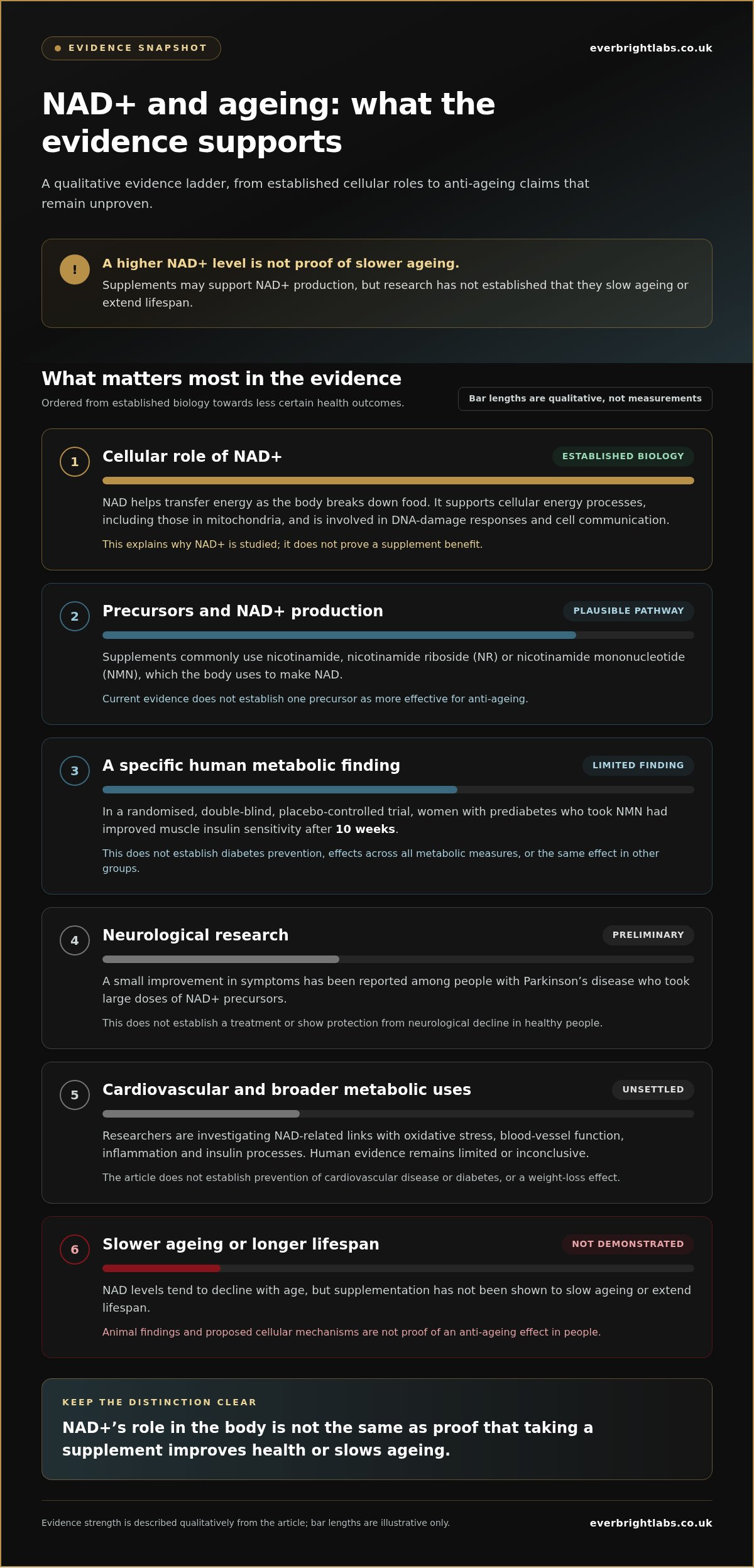
A higher NAD+ level is not the same as proven slower ageing. The benefits of NAD+ for anti-ageing remain uncertain: NAD+ levels tend to decline with age, and supplements may support the body’s production of it, but research hasn’t established that they slow ageing or extend lifespan. The science offers a reason to investigate, not a proven anti-ageing effect.
It’s understandable to hope that supporting cellular energy could help with age-related changes in energy, skin or cognition. But NAD+’s role in the body and the effects of taking a supplement are separate questions. Keeping them distinct helps make sense of the evidence on the benefits of NAD+ for anti-ageing.
This article explains how NAD+ works in cells, what research suggests about supplements and possible effects on health and cognition, and why important uncertainties remain. It also looks at how food and regular exercise support the body’s natural NAD+ processes, so you can weigh the evidence without mistaking early findings for established results.
Key Takeaways
- NAD+ supports cellular energy production and other processes, but this biological role doesn’t prove that supplements slow ageing.
- Learn why NAD+ precursors are used in supplements and what remains uncertain about their effects on health and longevity.
- Explore the limited evidence on cardiovascular, metabolic and neurological outcomes, including cognition and mental clarity.
- Understand potential side effects and why health conditions such as cancer or liver disease matter when considering concentrated supplements.
- Find out how a balanced diet and regular physical activity can support the body’s NAD+ processes.
NAD+ Supplements: Can They Really Slow Down Aging?
NAD+ supports cellular energy and repair processes, but supplements haven’t been shown to slow ageing or extend lifespan. Precursors may support NAD+ production, but that biological role doesn’t establish an anti-ageing effect.
NAD+ in energy production and metabolism
NAD accepts electrons as the body breaks down food, helping transfer energy to cellular processes, including those in mitochondria. These organelles produce much of the cell’s ATP, the molecule that powers its activity. NAD therefore connects metabolism with energy production; it isn’t a stimulant. Levels may decline with age, although changes vary by tissue and health.
Supplements commonly provide precursors that the body uses to make NAD. These include nicotinamide, nicotinamide riboside (NR) and nicotinamide mononucleotide (NMN). They enter related production pathways, but current evidence doesn’t establish that one is more effective for anti-ageing. In the UK, a supplement label shouldn’t be taken as evidence of an authorised anti-ageing treatment. Check that ingredient forms and amounts are clearly listed, and look for independent, batch-specific testing.
NAD+ in DNA repair and cell communication
NAD+ supports enzymes involved in cellular processes, including responses to DNA damage and communication between cells. When NAD is used in these processes, it helps cells coordinate responses to internal stress. This matters because damage accumulates through ordinary cellular activity, while repair and signalling help maintain normal function.
However, a role in repair doesn’t mean that taking a precursor prevents disease or reverses age-related damage. Researchers must establish whether changes in NAD after supplementation lead to meaningful health outcomes. This distinction separates a plausible biological mechanism from a demonstrated benefit for people.
NAD+ and skin cell energy
Skin cells also need energy to maintain and renew tissue. NAD contributes to the processes that supply this energy, so researchers are exploring whether NAD production affects skin function. One proposed link involves the proteins and structural components that support skin, including collagen, keratin, elastin and hyaluronic acid.
Cell turnover is described as slowing from 28 days to 40 or more days when NAD+ is inadequate. This does not show that supplements restore turnover or visibly reverse ageing. A change in a cellular pathway is not the same as a proven improvement in skin appearance.
Sirtuins and cellular ageing
Sirtuins are a family of seven proteins linked to cellular stress responses, inflammation regulation and longevity in animal studies, according to the National Institutes of Health. Researchers also associate them with metabolism, oxidative stress and apoptosis, the controlled removal of cells.
NAD availability matters to sirtuin activity, which helps explain interest in NAD precursors and ageing. Yet animal findings cannot establish that supplements extend human lifespan. NAD+ research, including a 2016 study by Shin-ichiro Imai in mice, offers mechanisms to investigate, not proof that supplementation slows human ageing.
Potential cardiovascular, neurological and metabolic uses
NAD+ is involved in metabolism, inflammation and cellular stress responses, prompting interest in its potential health effects. Human evidence remains limited or inconclusive, so its biological role shouldn’t be mistaken for a proven wellness benefit.
For cardiovascular health, researchers are examining links between NAD, oxidative stress and blood vessel function. Proposed effects include changes in inflammation, cholesterol and blood pressure, which could influence vessels such as the aorta. These are areas of investigation, not established outcomes of taking a supplement. Current evidence doesn’t show that NAD+ supplements prevent cardiovascular disease or replace established care.
Metabolic research includes a randomised, double-blind, placebo-controlled trial of NMN in women with prediabetes. After 10 weeks, participants taking NMN had improved muscle insulin sensitivity. This is a specific human finding, but it doesn’t establish that NAD supplements prevent diabetes, improve every measure of metabolism or produce the same effect in other groups. NMN is a precursor the body can use to produce NAD; the trial did not prove that all precursors have equivalent effects.
Insulin helps move glucose from the blood into cells, where it can be used for energy. Researchers are investigating whether NAD-related pathways affect insulin sensitivity and secretion, and whether these processes matter for diabetes risk. A change in one measure, such as muscle insulin sensitivity, isn’t evidence that a supplement prevents disease. A healthy routine is distinct from an experimental supplement strategy.
Weight management is another area where claims can outpace evidence. NAD supports metabolic processes, but that role alone doesn’t show that raising NAD leads to weight loss. Body weight reflects factors including food intake, activity and individual physiology; a supplement’s effect on NAD production can’t be assumed to change these factors. For practical decisions, distinguish support for natural cellular processes from demonstrated weight-management outcomes.
Neurological research is also preliminary. A small improvement in symptoms has been reported among people with Parkinson’s disease who took large doses of NAD+ precursors. That finding doesn’t establish a treatment for Parkinson’s or show that supplements protect healthy people from neurological decline. It does help explain why researchers study NAD pathways in the nervous system, alongside metabolism and oxidative stress.
Overall, the human findings are specific rather than broad: the 10-week NMN trial examined insulin sensitivity, while the Parkinson’s finding concerned symptoms. Neither establishes general anti-ageing effects or a reliable benefit across cardiovascular, neurological and metabolic health.
How can you boost NAD+ levels naturally through diet and exercise?
Nicotinamide adenine dinucleotide, or NAD+, is a molecule found in every cell and helps turn food into fuel. Research shows NAD+ levels can decline by roughly 50% between your 20s and 50s, although the rate varies with tissue type and overall health.
That age-related change provides context, not a diagnosis or a direct measure of how quickly someone is ageing. NAD+ supports cellular energy production and repair, but levels differ across tissues, and a single figure can’t describe everyone’s biology. Age is one factor; tissue type and health also influence the pattern. Studies of NAD precursors investigate whether supporting NAD production changes outcomes, but the decline itself doesn’t prove that supplements reverse ageing.
Concentrated NAD precursor supplements can cause nausea, stomach discomfort, headaches, light-headedness, diarrhoea, muscle cramps or skin irritation. Effects depend on the precursor and any additional ingredients. Nicotinic acid, a form of niacin, can cause flushing; high doses may also cause liver toxicity. These concerns relate to concentrated supplement doses, not the amounts found in food.
Route and formulation matter, too. NAD+ infusions have been associated with nausea, warmth or flushing, headache, dizziness and injection-site discomfort, redness or bruising. These effects differ from reactions to oral supplements, so both the product’s ingredients and its delivery method matter. A label that says “NAD support” alone doesn’t tell you which precursor is present or how much it contains.
Cancer-related concerns need careful wording. Increasing energy production could potentially support cancer-cell growth, but this concern remains inconclusive. It doesn’t establish that NAD supplements cause cancer, nor prove that supplementation is safe for everyone with a cancer history. Cancer, previous cancer, advanced liver disease, pregnancy and breastfeeding are all relevant considerations when weighing concentrated supplements.
Natural support starts with dietary building blocks, not a promise to restore a particular NAD+ level. Poultry, fish, eggs, dairy products, whole grains and nuts provide nutrients the body can use in NAD production. Avocados, meat and edamame are also cited as sources that can contribute to NAD-related building blocks. Regular physical activity encourages cells to increase energy production, supporting a healthy routine without relying on a concentrated dose.
The practical distinction is between supporting normal physiology and treating disease. Food and movement contribute to the body’s existing processes; supplements deliver concentrated precursors and involve different considerations. Current science describes age-related NAD+ decline, but hasn’t established that raising levels through supplements slows human ageing. Personal health factors and product composition remain central to assessing potential risks.
Diet and exercise to support NAD+
Food and movement support the body’s own energy systems, including processes involving NAD+. They provide a practical foundation for healthy ageing, rather than a proven way to reverse age-related change.
Dietary support for NAD+
A varied diet provides building blocks the body uses to produce NAD+, which matters because cells rely on this coenzyme in energy metabolism. Foods such as fish, eggs, whole grains and nuts contribute these nutrients. Focus on the overall eating pattern, not one supposed “NAD-boosting” food or a promise that a particular meal will raise cellular levels.
For example, combining a protein source such as eggs or fish with whole grains and vegetables can make a meal more balanced. This is a general dietary approach, not a prescribed formula for changing NAD+. The amount of NAD the body produces depends on several biological processes, as well as the nutrients available to them.
Food and supplements also differ in concentration and purpose. Foods provide nutrients as part of meals; supplements deliver selected ingredients in concentrated form. That difference matters when interpreting claims: a food’s contribution to NAD production doesn’t show that a concentrated supplement has the same effect or improves a health outcome.
Exercise, NAD+ and healthy ageing
Exercise prompts cells to increase energy production, which is why physical activity is relevant to NAD-related metabolism. Regular movement can support healthy ageing through its broader role in maintaining physical function. It complements dietary support, but research doesn’t establish that exercise raises NAD+ by a particular amount or guarantees an anti-ageing effect.
Choose activity that fits consistently into everyday life, such as a walk or regular exercise session. The key is sustained participation, rather than treating one workout as a way to alter NAD+ immediately. A high-protein diet alongside exercise has been suggested to support ATP production and healthy weight maintenance, but it isn’t a specific NAD treatment.
Published research on NAD precursors and human outcomes remains limited, so exercise and diet are best understood as foundations for overall health. They support the body’s normal energy demands without relying on a supplement to compensate for an inconsistent routine. Activity also benefits health beyond one cellular pathway, making it a grounded part of a healthy-ageing approach.
For readers considering supplements, the decision depends on the ingredient, dose and personal health context. A precursor may supply material used in NAD production, while exercise stimulates energy demand through a different route. Neither approach is interchangeable with the other, and current evidence doesn’t show that combining them reliably slows ageing.
In practical terms, build meals around a range of nutrient-rich foods and make regular movement part of your week. Equipping your home with everyday lifestyle goods from consumer shops like Glocard can also help support practical, sustainable routines. This supports everyday metabolism and cellular energy needs; it doesn’t require a special diet or the assumption that NAD levels can be measured by how energetic someone feels. Keep the goal broader than one molecule: sustainable habits support healthy ageing, while NAD supplementation remains an area of ongoing scientific interest.
Evidence for cognitive function and mental clarity
NAD+ supplements haven’t been shown to reliably improve energy, cognition or physical function in older adults. NAD-related pathways have plausible roles in brain cells, but a biological mechanism isn’t proof of a meaningful change in memory, concentration or everyday ability.
Neurons need energy to communicate, and mitochondria convert nutrients into ATP that powers cellular activity. NAD participates in energy metabolism, leading researchers to study whether boosting its availability might affect mental acuity. That rationale is relevant, but doesn’t show that taking a precursor improves focus or reduces brain fog.
One proposed connection involves neural plasticity, the brain’s capacity to adapt and form connections. NAD therapy has also been suggested to influence neuroinflammation. These processes matter to brain function, yet evidence for a possible pathway doesn’t establish a treatment effect. For someone experiencing poor concentration, a supplement’s effect on NAD isn’t proof of clearer thinking.
Longevity doctor Neil Paulvin typically recommends NAD+ precursor supplements to patients seeking more energy, experiencing brain fog or dealing with long Covid. This describes his clinical approach, not proof that supplements work for every patient. Energy, cognition and physical function are separate outcomes; evidence for one can’t establish improvements in the others.
It also helps to distinguish subjective reports from measured outcomes. Feeling more alert is different from demonstrating improved memory or attention through a validated assessment. Likewise, maintaining physical function involves everyday capabilities, not simply a shift in cellular energy or body weight. Research must assess each outcome directly before broad claims about cognitive health can be made.
The potential benefits of NAD+ for anti-ageing depend on whether supplementation changes health or lifespan over time. Current evidence hasn’t established longevity benefits. A rise in NAD levels, if it occurs, is a biological marker; by itself, it doesn’t show that someone lives longer, avoids disease or retains cognitive ability as they age.
Judge claims about the benefits of NAD+ for anti-ageing by the outcomes actually measured: brain fog, memory, attention, energy or physical function. A finding about one shouldn’t imply benefits across all five. Studies also need to distinguish precursors such as nicotinamide riboside and NMN, rather than treating every supplement as identical. This keeps possible mechanisms separate from demonstrated effects.
Everbright Labs: Fat Metaboliser
Fat Metaboliser is Everbright Labs’ supplement for readers seeking metabolic support alongside sustainable health habits. The evidence discussed above doesn’t establish NAD+ supplements as a way to slow ageing, so match a product to your actual goal rather than expect one supplement to address every concern.
If your interest is specifically cellular energy and healthy ageing, Timeless NAD+ Support is the more directly relevant option. Fat Metaboliser is the relevant choice for metabolic support. Neither should be treated as a proven anti-ageing treatment or substitute for medical care.
Explore the product information and decide which aim best fits your needs. Visit everbrightlabs.co.uk to learn more about Everbright Labs’ supplements.
Choose a next step that fits your health priorities
Let your health priorities guide what you explore next. If you’re interested in the potential benefits of NAD+ for anti-ageing, focus on the difference between supporting a biological process and expecting a proven change in ageing. This perspective can help you assess supplement claims carefully and keep sustainable habits at the centre of your decisions.
Everbright Labs offers Timeless NAD+ Support for readers interested in NAD+, Fat Metaboliser for metabolic support, and the Everbright Labs Bundle combining its primary formulations. Consider which area best matches your current focus, rather than treating one product as an answer to every health goal. If you have a health condition or take medication, discuss supplement use with a healthcare professional before starting.
For a closer look at the available options or to discuss your needs, contact Everbright Labs. A considered next step can begin with a clear question and an approach that feels right for you.
Frequently Asked Questions
What Is NAD+ and Why Does It Matter?
NAD+ is a coenzyme in cells that helps convert nutrients into usable energy. It also supports processes involved in cellular maintenance and communication. Its levels and activity vary between tissues, so a single result can’t describe how every part of the body is functioning. This matters when interpreting supplement claims: a molecule’s role in normal biology doesn’t by itself show that raising it improves health.
What are NAD supplements, and how do they work?
NAD supplements usually contain precursors that the body uses to make NAD, rather than NAD itself. Common examples include nicotinamide, nicotinamide riboside (NR) and nicotinamide mononucleotide (NMN). They enter related but distinct biological pathways, so their effects shouldn’t be assumed to be identical. Check the label for each ingredient and its amount, especially if a product uses a blend, and compare those details with the outcome being claimed.
Do NAD+ injections really work?
NAD+ injections and infusions haven’t been shown to deliver better health outcomes than oral forms in large human trials. Evidence for infusion effectiveness is also insufficient to establish anti-ageing benefits. A faster or more direct delivery method doesn’t automatically mean a better result. Injections and infusions can cause nausea, flushing, headache, dizziness or discomfort at the injection site, so route of use matters when weighing potential benefits and risks.
What benefits of NAD+ for ageing are supported by human clinical trials?
Human trials offer some specific findings, but they don’t establish that NAD+ supplements slow ageing. A 10-week randomised trial found improved muscle insulin sensitivity with oral NMN in women with prediabetes. A separate report found a small improvement in symptoms among people with Parkinson’s taking large doses of NAD+ precursors. These findings concern particular groups and outcomes, not longer life or general protection from age-related disease.
What is the evidence for NAD+ and skin ageing or longevity?
Evidence that NAD+ supplements improve skin ageing or extend human longevity remains insufficient. Some users report changes in skin tone or elasticity after four to 12 weeks of consistent use, but those reports don’t establish a reliable effect in clinical trials. Animal research into NAD-related pathways offers biological questions for further study, not proof of longer human lifespan. Treat appearance claims and longevity claims as separate outcomes requiring direct evidence.
What doses of NMN or NR have been studied, and for how long?
Human studies use different protocols, so there isn’t one established dose or duration that applies to every NMN or NR supplement. One reported NMN trial in women with prediabetes lasted 10 weeks and assessed muscle insulin sensitivity. Comparing studies requires attention to the specific precursor, amount, participant group and measured outcome. A study’s protocol isn’t automatically a recommended dose for personal use or evidence of long-term benefit.
What are the side effects and risks of NAD+ supplements?
Reported effects of concentrated NAD precursor supplements include nausea, stomach discomfort, headache, light-headedness, diarrhoea, muscle cramps and skin irritation. The precise risks depend on the precursor and other ingredients. Nicotinic acid can cause flushing, and high doses can cause liver toxicity. If you’re considering long-term, high-dose use, discuss it with a healthcare professional, particularly if you have a health condition or take other supplements.
Can NAD+ supplements interact with medicines or affect people with cancer or other conditions?
If you take prescription medicines, speak with a GP or pharmacist before starting an NAD+ supplement, because ingredients and personal health context affect suitability. Anyone with cancer or a history of cancer, advanced liver disease, or who is pregnant or breastfeeding should seek professional advice before use. This is especially relevant for concentrated products, where precursor type and additional ingredients can change potential effects.
Share:
Lifestyle changes that support metabolic rate and weight loss
Spermidine and Ageing: Levels, Food Sources and Health Links