

A longer supplement list can look more scientific, but quantity doesn’t show whether a routine is supported by good evidence. If conflicting recommendations have left you unsure which ingredients matter, or whether study results apply to a finished product, that uncertainty is understandable. A science backed longevity stack should be built around evidence, appropriate amounts and safety, not the latest trend.
This guide offers a practical framework for weighing research, checking doses and assessing how clearly a product discloses its ingredients. You’ll also learn how to keep a routine focused and make supplements complement, rather than replace, healthy habits. Timeless NAD+ Support, for example, discloses its three ingredients and their amounts. That transparency helps you assess the formula, but it isn’t proof of a longevity outcome. Everbright Labs products are stimulant-free and contain no caffeine. If you have a medical condition or take prescription medication, consult a GP.
This product is a food supplement and is not intended to replace a varied diet and healthy lifestyle.
Key Takeaways
- A supplement combination isn’t automatically a clinically validated formula. Set a clear healthy-ageing goal and keep expectations measured.
- Assess a science backed longevity stack by the type of evidence, the dose studied and how clearly the product discloses its ingredients.
- Review your diet and medicines before adding anything, introduce one product at a time, and consult a GP if you have a medical condition or take prescription medication.
- Timeless NAD+ Support is a disclosed three-ingredient option, taken as two capsules daily with food. Everbright Labs products are stimulant-free and contain no caffeine.
- This product is a food supplement and is not intended to replace a varied diet and healthy lifestyle.
What a science-backed longevity stack can, and cannot, do
A longevity stack is a deliberately selected combination of supplements chosen for a particular purpose. It isn’t a standard formula clinically validated as a whole. No supplement stack is proven to prevent ageing or guarantee a longer life, so treat longevity claims as questions to assess, not promises. The broader subject of Longevity includes biological processes and lifestyle factors, not supplements alone.
Lifespan refers to how long a person lives; healthspan describes the period spent in good health and with functional independence. Healthy-ageing goals are more practical and individual, such as supporting everyday wellbeing or maintaining healthy routines. These outcomes aren’t interchangeable, and a supplement’s effect on one biological marker doesn’t establish an effect on either. Sleep, regular movement and a varied diet remain foundations, not optional extras that a product can replace.
What does science-backed mean for a longevity supplement?
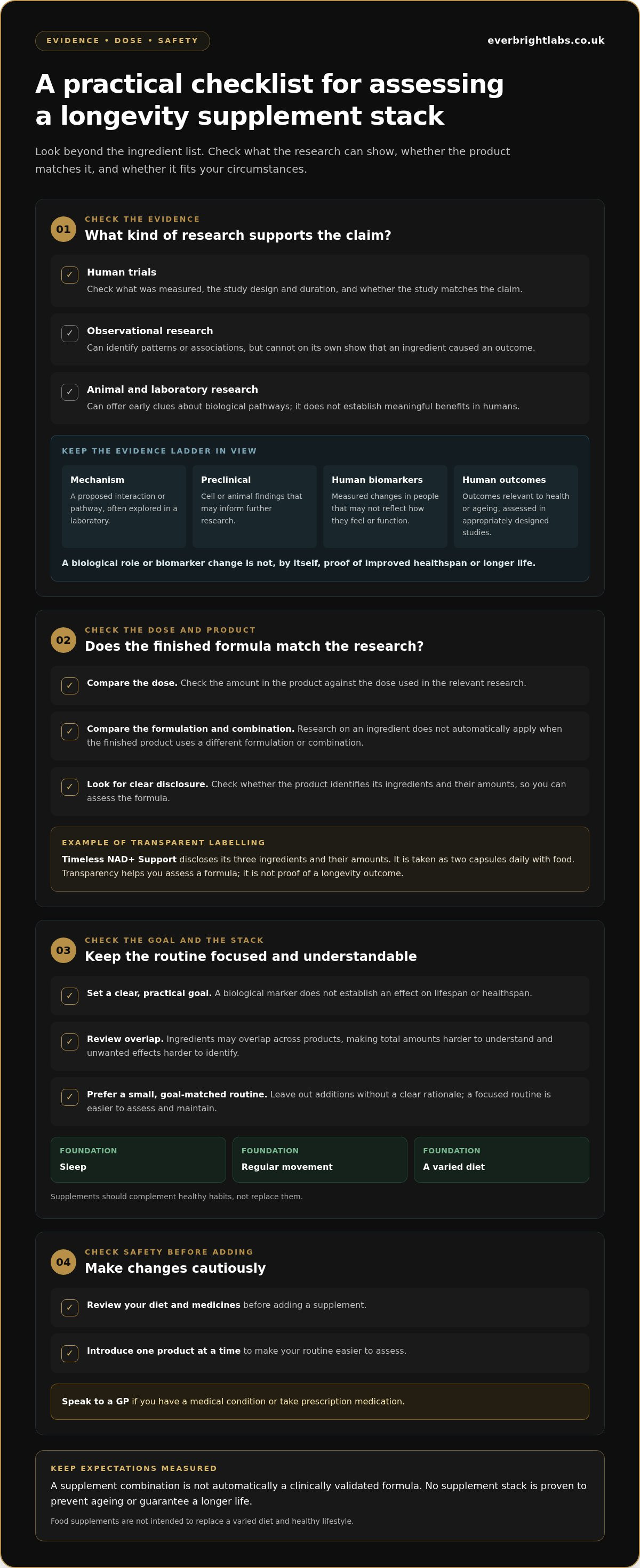
Different kinds of research answer different questions. Human trials can test effects in people, but their design, duration and measured outcomes matter. Observational research may reveal associations, but cannot on its own show that an ingredient caused an outcome. Animal studies and laboratory mechanisms can help researchers explore biological pathways; they don’t establish meaningful benefits in humans.
- Human trials: assess outcomes in people, but check what was measured and whether the study matches the claim.
- Observational research: identifies patterns, not necessarily cause and effect.
- Animal and laboratory research: offers early clues, not proof of human results.
A plausible mechanism, such as activity in a cellular pathway, is a reason to investigate an ingredient, not evidence that taking it will improve healthspan. Research on an ingredient also doesn’t automatically apply to a finished supplement: the dose, formulation and combination may differ from what researchers studied. A science backed longevity stack needs careful interpretation, not just an impressive-sounding mechanism.
Why a longer supplement list is not automatically better
Adding ingredients can increase complexity without showing that they provide extra benefit. Products may contain overlapping ingredients, making it harder to understand the total amount taken or identify what may be associated with an unwanted effect. Suitability also depends on your diet, health circumstances and medicines. If you have a medical condition or take prescription medication, consult a GP before using supplements. Stimulant-free and no caffeine are product characteristics, not evidence of a longevity effect.
A small, goal-matched routine is a prudent starting point, not a prescription for everyone. First decide what you want to support, then consider whether an ingredient’s human evidence and dose are relevant to that goal. For instance, those researching targeted, standalone options often review dedicated suppliers such as Relieve Therapeutics to evaluate single ingredients against their specific needs. Leave out additions without a clear rationale. A focused routine is easier to assess and maintain.
How ageing biology informs a sensible longevity supplement stack
Ageing involves many interconnected biological processes, so a single pathway or laboratory result can’t stand in for a meaningful outcome in people. NAD+ is a coenzyme involved in cellular processes, including reactions that help cells function. That makes it scientifically relevant, but doesn’t prove that raising NAD+ through supplementation slows ageing or extends life.
The same caution applies to proposed effects on cellular energy or antioxidant activity. A mechanism can explain why researchers study a compound; it can’t establish what taking it will do for a person. This evidence ladder helps distinguish levels of research:
- Mechanism: a proposed interaction or pathway, often investigated in a laboratory.
- Preclinical evidence: findings from cells or animals that can inform further research, but may not translate to people.
- Human biomarkers: measured changes in people, which may not correspond to how they feel or function.
- Human outcomes: outcomes directly relevant to health or ageing, assessed in appropriately designed studies.
Confidence should rise only as evidence moves towards outcomes that matter to people. “An ingredient has a biological role” is not the same as “supplementing it has been shown to improve longevity”.
NAD+ precursors and the limits of mechanism-based claims
Nicotinamide riboside (NR) is a precursor studied in relation to NAD+; it isn’t NAD+ itself. Human research may measure biomarkers such as NAD-related levels, but a change in a biomarker doesn’t by itself show a longer lifespan or improved healthspan. When reading a study, check who took part, how long it ran, what dose was used and which outcomes researchers measured. For background on precursors, see this NMN and NAD+ science guide.
Spermidine and resveratrol: rationale versus outcome evidence
Spermidine and resveratrol are researched compounds, but proposed biological rationales aren’t proof of rejuvenation or disease prevention. Preclinical findings can help generate questions; they don’t establish whether a supplement produces a useful effect in people. When assessing a study, identify its population, duration, dose and measured outcome. If it involved animals or cells, say so plainly. If human evidence is limited or uncertain, make that clear rather than implying a demonstrated benefit.
Product transparency helps you compare a formulation with what research has investigated; it doesn’t prove the formula works as a longevity intervention. Timeless NAD+ Support discloses three ingredients and their amounts, so you can assess the formulation without treating disclosure as evidence of an outcome. Everbright Labs products are stimulant-free and contain no caffeine.
How to compare longevity supplements by evidence, dose and transparency
A useful comparison asks more than whether an ingredient appears in longevity research. Check whether the evidence matches the ingredient form, dose, population and outcome, then compare those details with the product label. The table uses Timeless NAD+ Support to show how disclosed amounts can be assessed without treating a formulation as proof of a longevity effect.
| Ingredient | Intended rationale | Evidence type to assess | Disclosed amount per serving | Key caveat |
|---|---|---|---|---|
| Nicotinamide riboside chloride | NAD+ precursor research | Human studies and the specific outcomes measured | 300 mg | Biomarker findings do not establish longer life or a benefit from this finished formula. |
| Wheat germ extract providing spermidine | Spermidine research | Separate mechanistic, preclinical and human findings | 300 mg extract, providing 3 mg spermidine | Evidence for a compound doesn’t automatically apply to every extract or outcome. |
| Liposomal trans-resveratrol | Resveratrol research | Human outcomes, dose and formulation studied | 100 mg | Findings on other forms or combinations may not transfer to this one. |
Ingredient transparency helps you assess what a formula contains; it doesn’t prove that the formula is effective. A study’s findings relate to the amount and form actually examined. Compare the label with the research, but don’t assume an ingredient is effective simply because its listed amount looks similar to a study dose. Formulation, study population and measured outcome all affect how relevant the evidence is.
A practical evidence checklist for comparing ingredients
For each ingredient, look for human studies that match the dose, population and outcome behind the claim. Note limitations such as small samples, short follow-up or reliance on surrogate biomarkers rather than outcomes that matter to daily health. One study is a starting point, not consensus; look for replication and balanced reviews before drawing a firm conclusion. Consulting independent wellness guides such as Full Physical Exam can also help when evaluating product claims objectively. This is more useful than counting how many ingredients appear on a label.
Reading labels and identifying the product's actual formulation
Read the full ingredient list and check each amount, serving size, capsule count and daily-use instruction. Distinguish the specific ingredient form on the label from forms or combinations used in studies. Timeless NAD+ Support discloses its three ingredient amounts per serving, with directions to take two capsules daily with food. This makes the formulation easier to compare with research, but doesn’t establish a longevity outcome.
Manufacturing information is a separate quality consideration from evidence of efficacy. Everbright Labs products are manufactured in the UK in GMP- and HACCP-certified facilities. If you have a medical condition or take prescription medication, consult a GP before using supplements.
This product is a food supplement and is not intended to replace a varied diet and healthy lifestyle.
How to build and review a longevity routine safely
A safe routine starts with a clear reason for considering a supplement, not a long list of products. Treat a science backed longevity stack as something to assess and review, not a fixed protocol or substitute for sleep, movement and a varied diet. These habits remain foundations of healthy ageing; supplements shouldn’t displace them.
Use this sequence to make a considered choice:
- Define one realistic goal. Choose a specific, non-medical aim for your routine, rather than expecting age reversal or a longer life. A clear goal makes it easier to decide whether an ingredient is relevant.
- Review your current diet and medicines. Note supplements you already take, relevant dietary habits and prescription medicines. If you have a medical condition or take prescription medication, consult a GP before using supplements.
- Assess the evidence and cautions. Check whether human research relates to the ingredient, form, dose and outcome you’re considering. Read the product label for serving instructions and ingredient-specific warnings.
- Choose cautiously and introduce one product at a time. Starting with one makes it easier to notice tolerance and keep a clear record. Avoid adding several products at once, which can make it harder to identify what may be associated with a change.
Set a realistic goal and establish a baseline
Before starting, record relevant habits and observations related to your goal. For example, note your usual sleep routine or activity patterns, then keep the same simple record as you review your experience. This provides context, not proof that a supplement caused a change: day-to-day variation and other factors matter. Responses differ between individuals, so don’t treat a result as guaranteed or assume that a lack of noticeable change means you should increase the serving.
Follow directions, check cautions and review the routine
Follow each product’s label and don’t exceed its stated daily serving. Take Timeless NAD+ Support as two capsules per day with food. Take Fat Metaboliser as four capsules per day, split two plus two. Take with food and water; do not take on an empty stomach. Do not exceed the recommended serving. If a supplement contains green tea extract, do not exceed 800 mg EGCG per day.
Review your notes and the product’s directions periodically. If you notice an unwanted response, stop taking the product and seek appropriate medical advice. Consult a GP if you have a medical condition or take prescription medication, and consider relevant ingredient cautions before use. A measured routine is one you can explain, follow safely and reassess without assuming it will produce a particular outcome.
Explore Everbright Labs supplements to review the formulations and serving information as you consider what fits your routine.
How Everbright Labs fits a measured science-backed longevity stack
A supplement’s place in a routine depends on its ingredients, your goal and the evidence, not on how many products it can be paired with. Timeless NAD+ Support is a disclosed three-ingredient formula. Its composition provides a practical example for applying the comparison framework in this article, but neither the formula nor its manufacturing standards establish an individual health outcome or prove a longevity effect.
Where Timeless NAD+ Support belongs in the discussion
Each serving contains 300 mg nicotinamide riboside chloride, 300 mg wheat germ extract providing 3 mg spermidine, and 100 mg liposomal trans-resveratrol. The serving direction is two capsules daily with food. Assess these amounts against research on the specific ingredient forms and outcomes, rather than assuming that disclosure makes a health claim proven. Don’t exceed the stated serving.
Fat Metaboliser has a different purpose: it is a metabolic-support option, not a longevity ingredient. Consider its ingredient rationale against that distinct goal; the Fat Metaboliser ingredient breakdown provides context for the formulation. There’s no basis here to suggest that using it alongside Timeless creates a proven synergy or that you need both. If you choose Fat Metaboliser, take four capsules per day, split two plus two. Take with food and water; do not take on an empty stomach. Do not exceed the recommended serving.
A measured next step, without a promise of results
Compare the disclosed ingredients and serving directions with the evidence questions raised in this article: Does the research match the ingredient form and dose? Were the outcomes measured in people, and do they relate to your goal? Is the product suitable alongside your diet and medicines? These checks help separate a transparent formulation from evidence that a particular product produces a specific result.
They are manufactured in the UK in GMP- and HACCP-certified facilities. These details describe the formulation and manufacturing, not a guarantee of benefit. Follow label directions and treat supplements as additions to, not replacements for, healthy habits.
To review the formulations and serving information, explore Everbright Labs supplements.
Make your next step a considered one
Your routine doesn’t need to be complete before you assess it. Start with one question: does this ingredient match your goal, and can you explain why you’ve included it? If the rationale is unclear, pausing is a sound choice. A science backed longevity stack isn’t a test of how many products you can take; it’s a reasoned decision you can revisit as your priorities and the evidence change.
Everbright Labs was formulated by founders with backgrounds in applied biology and chemical engineering. That scientific grounding informs the approach to developing supplements, but it doesn’t predict your personal response. Keep expectations measured, follow product directions and speak with a GP if you have a medical condition or take prescription medication.
Explore Everbright Labs supplements to compare the formulations and choose a considered next step for your routine.
Frequently Asked Questions
Are longevity supplements proven to help you live longer?
There’s no reliable proof that longevity supplements make people live longer. A change in a biomarker, or evidence that an ingredient affects a biological pathway, isn’t the same as a clinical outcome such as lifespan. Findings differ by ingredient, dose and population, so no result should be guaranteed. Treat a science backed longevity stack as optional support alongside healthy habits.
Can you take NAD+ supplements with other supplements?
Whether combining supplements is suitable depends on their ingredients and doses, what you already take, your health and any medicines. Check labels for overlapping ingredients so you can understand your total intake, and follow each product’s stated serving directions. Combining products doesn’t establish that they’ll work better. If you take prescription medication or have a medical condition, consult your GP before adding a supplement.
Is nicotinamide riboside the same as NAD+?
No. Nicotinamide riboside is a precursor studied in relation to NAD+ metabolism; NAD+ itself is a coenzyme found in cells. Taking a precursor doesn’t guarantee a particular change in NAD+ or a health benefit. Research findings depend on factors such as dose, participants and what researchers measured. Use the evidence framework to distinguish a measured biomarker from an outcome that matters to health or longevity.
How much evidence should a supplement have before you add it to a longevity stack?
Look for relevant human research, consistent findings, a clearly stated dose and an outcome that relates to your goal. Animal or laboratory studies can help shape research questions, but can’t alone establish benefits in people. Consider whether findings have been replicated, and weigh study quality alongside your own suitability and the product’s label transparency. Popularity, an impressive mechanism or a long ingredient list isn’t a substitute for evidence.
Are Everbright Labs supplements vegan and stimulant-free?
Everbright Labs products are vegan, use plant-based HPMC capsules, are stimulant-free and contain no caffeine. These are product characteristics, not evidence of a longevity effect or proof that a formula suits everyone. Review the full ingredient information for anything relevant to your needs, and follow the label’s serving directions.
What should you do if a supplement causes an unwanted reaction?
Stop taking the supplement and seek appropriate medical advice, especially if symptoms are severe or persistent. Keep the packaging, ingredient list and details of how much you took available for the healthcare professional. Don’t try taking it again to test whether the reaction returns. If you have an existing medical condition or take prescription medication, consult a GP before starting supplements.
Share:
Cellular Energy Decline Over 30: What Changes and What Helps?
Lifestyle changes that support metabolic rate and weight loss